



Why every Indian AI developer still defaults to Ohio, and what that costs us
Vishnu Subramanian of E2E Networks believes India's AI future shouldn't be powered from halfway across the world. His keynote at TechSparks 2025 revealed why the choice between Ohio and Bangalore will define the next decade.

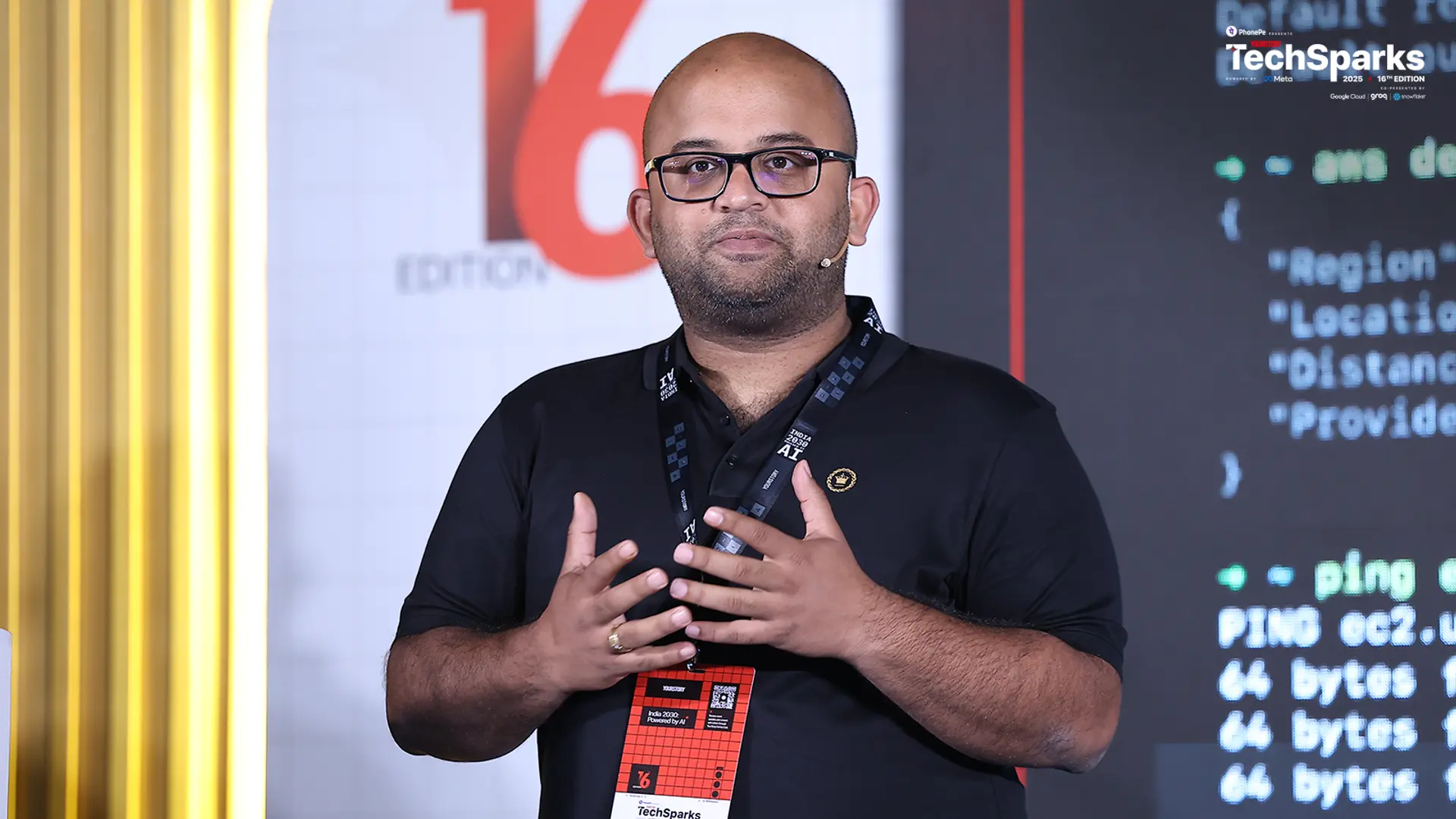

Why every Indian AI developer still defaults to Ohio, and what that costs us?
Ask any Indian developer to point out Ohio on a map, and most would struggle. But mention AWS, and Ohio becomes instantly familiar. It's the default server location where millions of Indian AI projects begin, and often end.
Vishnu Subramanian, Head of Product and Marketing at E2E Networks, opened his TechSparks 2025 keynote with this uncomfortable truth. What followed wasn't just a pitch for homegrown infrastructure. It was a wake-up call about invisible dependencies shaping India's AI ambitions.
When a silver medal teaches you about sovereignty
The problem became personal for Subramanian in 2018. Competing in Kaggle, the Olympics for data scientists, he needed a 332GB GPU to complete his submission. None were available in India. He applied for AWS quota approval, waited three days for a response from someone across the globe, and watched his competition deadline pass. The frustration of settling down for silver and not getting a quick response kept him up at night.
"Why should I pay expensive prices and wait for approval from a salesperson sitting somewhere across the globe?" Subramanian asked the TechSparks audience, channeling that 2018 anger into a question that would eventually reshape his career.
He wasn't alone. Andrej Karpathy, who headed Tesla's AI Autopilot and co-founded OpenAI, faced identical barriers. Karpathy got lucky. He tweeted about it, and Google's leadership intervened. Most developers aren't that fortunate.
The problem that refuses to die
Subramanian met a founder who had thousands of dollars in hyperscaler credits but was still waiting months for GPU access. The economics of scarcity remain intact, even as India's AI ecosystem explodes.
This reality birthed Jarvis Labs in 2019, where Subramanian aimed to solve two problems: making GPUs affordable and launching instances fast. The company succeeded, launching GPU instances in under four seconds and slashing costs by 60-70% compared to global hyperscalers.
Victory felt premature. Stable Diffusion and large language models changed AI's computational demands overnight. A Bangalore founder called, frustrated. His GPU launched quickly, but copying data from object storage took hours. The culprit? His S3 bucket sat in Ohio. An Indian company serving Indian customers had unconsciously chosen infrastructure halfway around the world.
"That's what we all unknowingly got trained to do, like how we used Visa and MasterCard before UPI changed everything," Subramanian explained.
What happens when you stop accepting defaults
E2E Networks, which had been building cloud infrastructure for 15 years, approached Subramanian. The conversation was simple: why not solve this together? The company brought 200+ GPU clusters and experience. Jarvis Labs brought speed and customer insight.
What emerged is an AI cloud platform that addresses multiple chokepoints. Users can launch high-end GPUs like H100s in 30 seconds without approval workflows. An inference platform scales GPU clusters from zero to hundreds based on real-time demand, critical for companies like Ulearn.ai, where student activity peaks and valleys make static infrastructure wasteful. Training clusters spin up 300-400 GPUs in 10 minutes for startups building foundational models.
E2E Networks currently supports two of India's largest language model training projects, both launching in the coming months.
The economics that change everything
Here's where positioning shifts from philosophy to pragmatism: GPU costs on hyperscalers run $8-12 per hour. Indian cloud providers offer the same for $2.50-3.50, depending on configuration.
AI represents a once-in-a-generation opportunity to move developers away from AWS defaults, Subramanian argued. Cloud computing inertia is nearly impossible to break until economics change completely, as they have with AI infrastructure.
"Whatever choices we make today will determine how we see AI adoption in 2030," he told the TechSparks audience. "It's a choice we're making as consumers, whether we pick an Indian cloud platform or a foreign one."
What 2030 could look like
Subramanian isn't calling for nationalism disguised as a technology strategy. He's encouraging multiple Indian companies to build cloud infrastructure, mirroring the competitive global hyperscaler landscape. Competition drives innovation. Monopolies, geographic or corporate, don't.
The question isn't whether India can build world-class AI. It's whether that AI will be powered by infrastructure we control, priced within reach of our startups, and physically close enough that data transfer doesn't become the bottleneck killing innovation before it scales.
Five years from now, will the next generation of Indian AI developers still instinctively default to Ohio? Or will Bangalore, Coimbatore, and other Indian cities become the reflexive choice?
"Let's catch up in 2030," Subramanian concluded, leaving the challenge hanging in the Bangalore air. The choice, as he made clear, isn't his alone to make.
