



India’s AI reality: The missing link between intent and execution
At TechSparks 2025, Google Cloud's Teena Bhasin breaks down the execution gap when it comes to AI-led transformation and explains why vision, not technology, determines who wins.


India is in the middle of an AI surge. Enterprises are experimenting aggressively, leaders are aligning on vision, and generative AI has made its way into every strategic conversation. Yet for all the excitement, the majority of AI initiatives remain stuck in pilot mode.
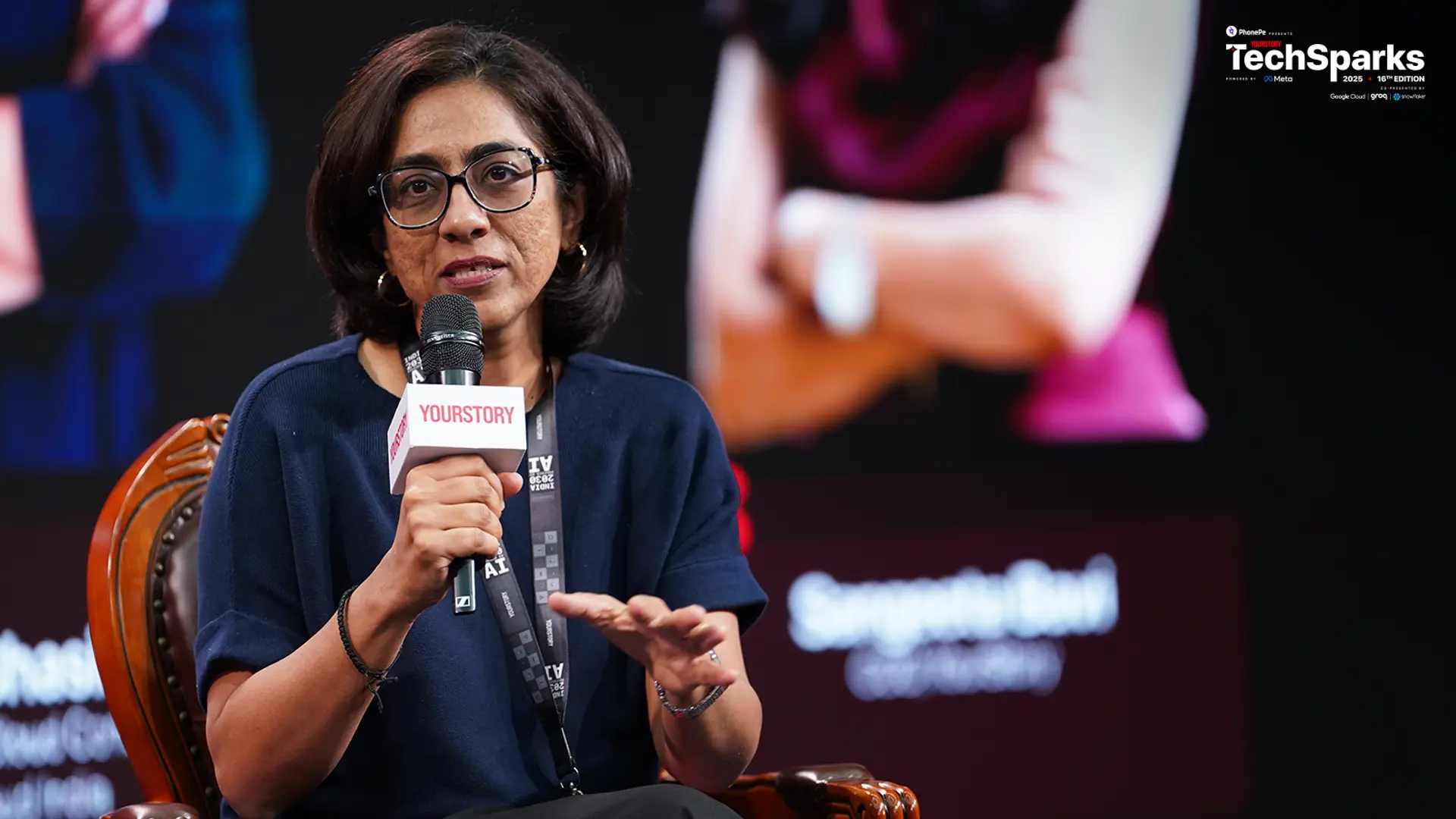
At TechSparks 2025, YourStory COO Sangeeta Bavi spoke with Teena Bhasin, Director of Google Cloud Consulting at Google Cloud India, to understand why so few pilots reach production and what separates successful adopters from the rest. Their fireside chat, ‘Scaling Intelligence: How India’s Enterprises Are Winning AI’, explored the country’s readiness for AI-led transformation and the mindset shift required to deliver it.
AI is now the central character
When asked where India stands in its AI journey, Bhasin described the shift as unmistakable. AI, she said, has moved from concept to center stage, noting that “AI is 100% the central character. All the characters have been sketched out. We are heading towards the plot twist.”
With India’s linguistic diversity, massive datasets, and young digital population, interest is high and ideas are flowing. But while generative AI has elevated conversations to the C-suite, the movement from strategy to on-ground execution is taking longer than expected.
The 22-pilot reality check
An example shared during the session captured the execution gap clearly. A CTO told Bavi that his organization had completed 22 AI pilots, yet none were in production. His hesitation wasn’t around cost or ROI; he feared that scaling the solution might break what was already working.
Bhasin said this pattern plays out across India. The ingredients for AI leadership, data, diversity, and talent, are present, yet the last mile between ambition and execution often stalls. Ideas are solid and intent is genuine, but as she put it, “execution is taking time”.
What separates winners from pilots
To explain what changes when the vision is clear, Bhasin shared two examples.
The first involved a large financial services company that wasn’t even a Google Cloud customer. They approached Google with a sharp, specific request, telling her, “We want professional services to help us. Our team will do the work. We just want you to help solve our problems where we get stuck.”
A six-week pilot stretched slightly, but the team pushed the solution to production just two weeks later, so quietly that Google learned about it only after it went live.
The second example came from a top-tier VC firm that fell under Google’s SMB category due to its headcount. A direct LinkedIn message caught Bhasin’s attention because the ask was precise and the vision clear. Despite sitting outside typical service thresholds, the alignment made it easy to support them. They now run 140 Agent Space seats and have begun expanding into data agents.
For Bhasin, the pattern is always the same. Teams that understand what they want, map their steps early, identify stakeholders, and accept early iterations move the fastest.
“When your vision is clear, when you’re willing to take a little bit of a risk, you will go the extra mile,” she said. When clarity is missing on “one, two, three”, organizations tend to remain stuck in pilot mode.
Why startups often move faster
Despite having more resources, enterprises frequently lag behind startups in AI adoption. Bhasin explained that compliance, regulatory constraints, and legacy processes weigh enterprises down, while startups operate with fewer guardrails.
She said startups have the flexibility to experiment and “the advantage of the ability to getting things wrong a little bit”, which consumers also tend to be more forgiving about. That willingness to test and adjust helps them move toward production more quickly. She added that, for perhaps the first time, startups are learning from enterprises too, recognizing that structured approaches and ROI frameworks matter when scaling responsibly.
Use cases reshaping industries
Across sectors, AI is tackling long-standing challenges. Telecom companies are building autonomous networks, while banks are advancing fraud detection and automating signature verification processes that have historically been slow and manual.
Bhasin was especially energized when discussing digital commerce. She explained that “the whole landscape is changing with conversational commerce, with catalog enrichment happening in real-time based on preferences, with AI-generated search happening”. Events such as Big Billion Days and major retail sales now rely heavily on AI-powered systems behind the scenes, serving millions of customers seamlessly.
A developer herself, Bhasin highlighted the rise of AI-generated code. At Google, 60% of internal code is generated by AI. She believes IT services companies and GCCs aren’t using this capability enough. “I think we are not doing enough, whether it is the IT services companies or GCCs, to use the power of AI for generating code.”
The missing piece: contact centers
One area where adoption has lagged is automated contact centers. Globally, contact center automation became one of the first widespread applications of generative AI.
In India, however, data sovereignty concerns have slowed momentum. Since many foundational models aren’t hosted in India yet, enterprises can’t send sensitive customer data abroad.
Bhasin said this will shift as soon as local hosting comes online, explaining that “the basic use cases which require data to be in India [will] get solved when we start building things in India, when models start getting hosted in India”.
Google’s $15 billion investment in Visakhapatnam is expected to unlock many of these restricted use cases.
Building the AI startup ecosystem
Google has expanded its support for startups significantly, extending help even at the seed and idea stage. Startups now receive infrastructure access, compute resources, and direct pathways to engineering teams through programs like the Google School for Startups.
Bhasin noted that “sometimes even we don’t have access to them”, underscoring how deep the support runs. Skills development through the AI School for Startups helps founders take ideas to production with stronger processes, and go-to-market support through ISV Springboard helps young companies reach customers effectively. Startups working on environmental or social impact missions also receive priority because Google wants to “make AI democratized. It should be available for everyone”.
Made in India, for India
When asked about her 2027 vision, Bhasin described her goal as building AI that is “made in India, for India”. She believes locally hosted models, stronger infrastructure, and continued collaboration with the government will shape the next phase of adoption.
This focus is deeply personal for her as well. She said she “cannot wait to see the difference AI will make to the disabled in India, to the vision disabled in India” - having already seen how accessible technologies have changed lives. The goal now is to help people achieve true independence.
The human element
When asked about her essential AI tool, Bhasin admitted that AI is so deeply embedded in her daily workflow that she sometimes forgets which tools even include it. NotebookLM is the one she relies on most, both personally and when teaching her children.
India’s AI journey is accelerating, but as Bhasin emphasized, pilots alone won’t determine success. The companies that develop clear vision, embrace calculated risk, and commit to execution will be the ones writing India’s AI story in the years ahead.
