



Sweden, India strengthen startup, research, and talent bridges at TechSparks
The panel discussion spotlighted a shared vision of leveraging Sweden’s research, capital, and ecosystem support alongside India’s market scale and entrepreneurial energy.

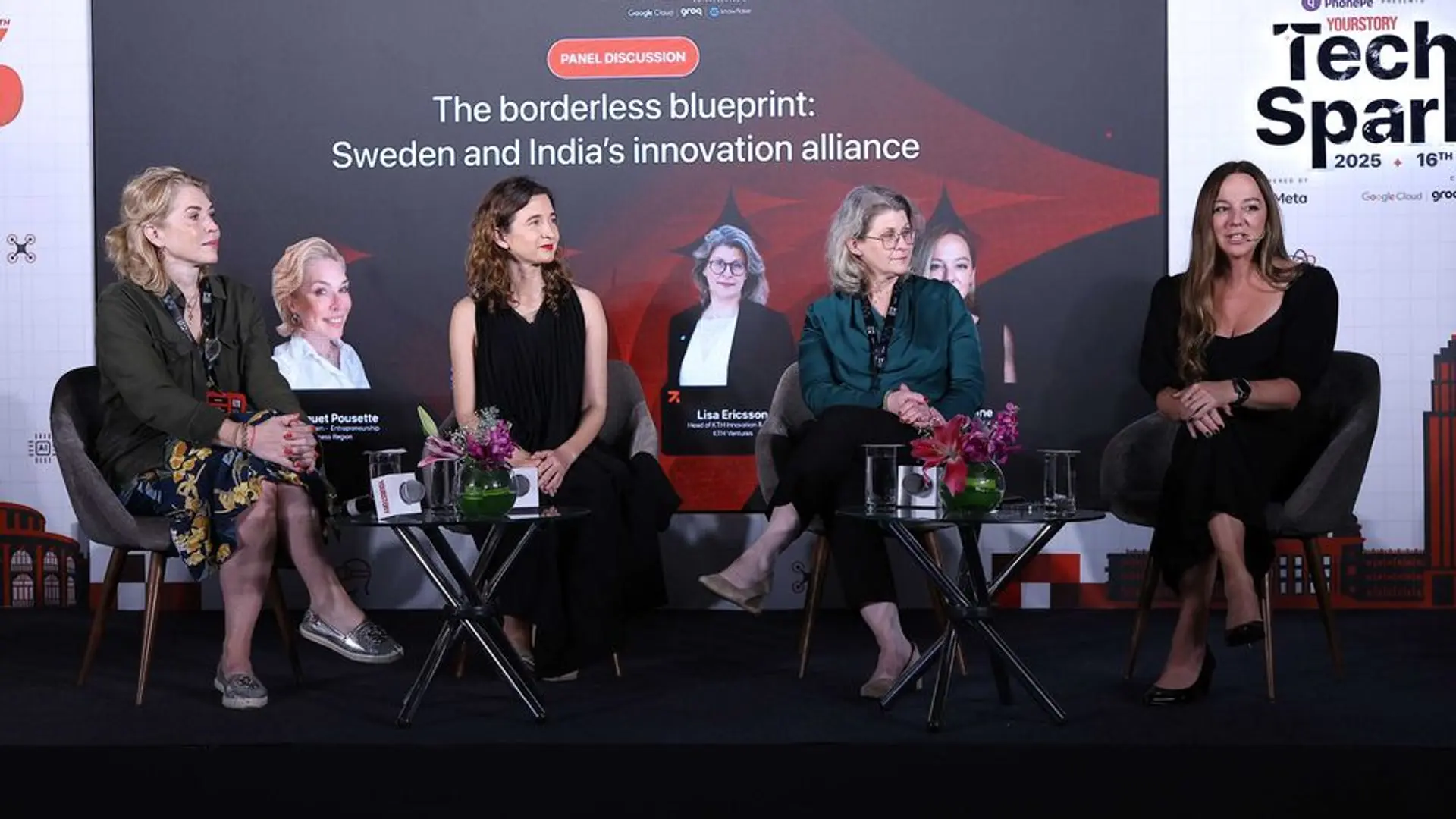

Over the decades, India and Sweden have quietly built one of the world’s most dynamic cross-border innovation relationships—one defined not just by policy, but by shared values around sustainability, technology, and purpose-driven growth.
At TechSparks 2025, India's biggest startup-tech conference, the special relationship took centre stage during the panel “The borderless blueprint: Sweden and India’s innovation alliance,” where speakers explored how the two nations are shaping a seamless innovation corridor.
The panel discussion highlighted practical, relationship-driven collaboration that connects governments, investors, startups, corporates, and academia, and showcased how this alliance is enabling startup support, research spin-offs, talent exchange, and cross-market expansion.
The discussion opened with Noi Cecilia Oldne, Chief India Representative of the Sweden-India Business Council, who framed the relationship as one driven by actionable, relationship-based engagement. Drawing on her 18 years of living in India, she emphasised, “Practical cooperation is at the heart of what we do. We connect governments, corporates, investors, and startups through CEO roundtables, innovation forums, and hands-on support for company setups.”
Her remarks highlighted the Council’s role in fostering cross-border exchange and encouraged Indian entrepreneurs to explore Stockholm’s ecosystem.
Building on this, Ariane Bucquet Pousette, Head of Startup Ecosystem for the City of Stockholm, illustrated why Sweden remains an attractive base for global startups. She described Stockholm as a compact, globally oriented market that encourages early international thinking, supported by strong research institutions and creative talent.
Quality-of-life factors, she noted, make it an enabling environment for founders. “You get 480 days of maternity leave, safe streets, robust public transport, and a society that balances work, life, and creativity,” Pousette said, emphasising Sweden’s purpose-driven culture. “Being a unicorn is fantastic, but creating impact for millions is what truly counts.”
The conversation then shifted to practical entrepreneurial experience in India. Emma Rozada, serial entrepreneur and founder of Interplanetary Species, Nexular, and Techno Creatives Venture, shared her journey of moving production from China to India.

She also highlighted India’s rapidly expanding electric vehicles market and how Swedish-engineered solutions could be tailored to local needs. “We are in a market with 1 million electric vehicles today, and it’s growing fast. Our devices are fully integrated to reduce theft and enable scalable leasing, combining Swedish quality with India-focused practicality.”
Rounding out the discussion, Lisa Ericsson, Head of KTH Innovation and CEO of KTH Ventures, provided an academic perspective on how research and talent underpin Sweden’s startup ecosystem. She emphasised that Swedish universities, including KTH, facilitate spinouts by keeping intellectual property with researchers, creating faster pathways for commercialisation.
She also underpinned Sweden’s growing engagement with India. “We have abundant talent and capital, making Sweden the best place to start up in Europe. At the same time, we are committed to strengthening collaborations with India and showcasing it as a strong innovation partner.”

Edited by Kanishk Singh