



TestGrid
View Brand PublisherInside TestGrid, the AI-powered testing platform streamlining DevOps and quality engineering
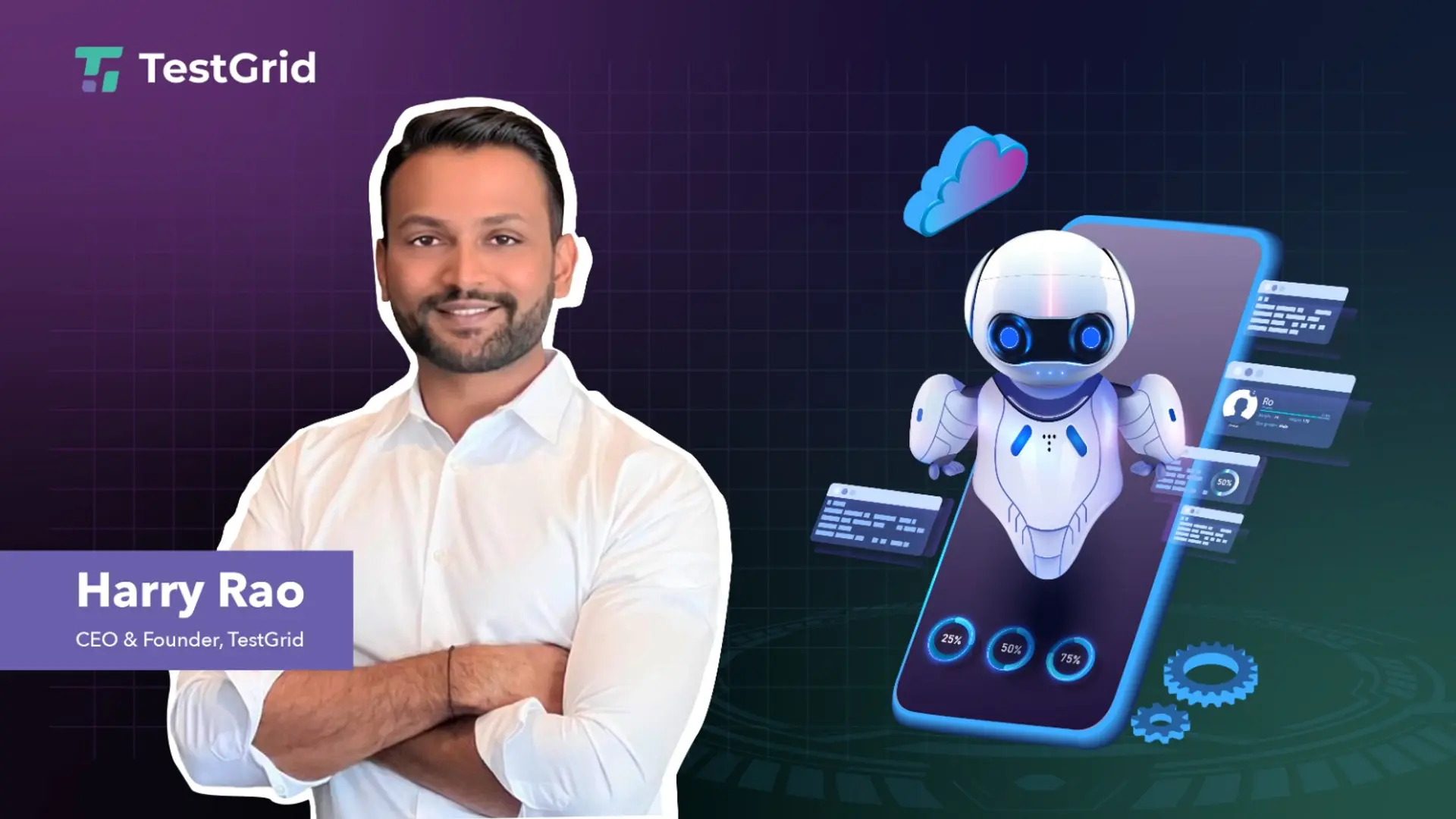
In this exclusive conversation, TestGrid founder Harry Rao reveals how the company’s AI-driven TestOS platform unifies automation, cloud testing, and agentic intelligence to make enterprise software testing faster, smarter, and far more cost-efficient.


As software grows more complex and release cycles shrink, enterprises are racing to modernise testing with AI, automation, and scalable cloud infrastructure. TestGrid, a deeptech platform used by Fortune 100 companies, is rewriting the rules with its
AI-driven TestOS, an operating system for end-to-end testing designed to eliminate bottlenecks, cut costs, and enable autonomous quality engineering.
In this conversation, Harry Rao, Founder and CEO, TestGrid breaks down the journey, the technology, and why he believes the future of testing will be fully agent-driven.
Edited excerpts from the interview…
Your Story [YS]: What inspired you to start TestGrid, and how did the idea evolve from concept into the deeptech platform it is today?
Harry Rao [HR]: When I started out after my master’s, I joined a startup and that’s where I realised testing was fundamentally broken. It was slow, fragmented, and heavily human-dependent. As I grew in my career and worked with large Global System Integrators and enterprises, the story remained the same: testing was still a bottleneck, and an expensive one.
My dream was to make testing as simple as pressing a button: no dependencies, no blockers, just “boom, done.” That vision pushed us to build everything from the ground up. We started with low-code/no-code, then moved into infrastructure, then orchestration. I often give this analogy: before you put a car in autopilot, you first have to build the entire car. That’s exactly what we did. It took years, but we built it step-by-step and brought everything under one roof.
YS: The early days of any deeptech startup are filled with uncertainty. What were the biggest challenges you faced in building TestGrid?
HR: The hardest part was earning trust. Today, we serve 20 of the Fortune 100 companies, but as a bootstrapped startup back then, we were nobody. Large enterprises already have access to the best talent, tools, and budgets, so the only way they adopt a new product is if you’re solving something they deeply don’t want to solve themselves.
Getting our first enterprise customer was the biggest hill to climb. With deeptech, the first step is always the toughest. Once you prove yourself, the world opens up.
YS: For the unfamiliarised, how does TestGrid simplify and accelerate testing for enterprises?
HR: Today, companies use multiple tools for automation, cloud testing, API testing, performance testing, mobile devices, browsers, everything is siloed. Each tool comes at the end of the development lifecycle.
We created TestOS, an operating system for testing. Everything you need, API testing, performance testing, web and mobile cloud are all built in. It’s low code/no code, but you can also bring your own code. And on top of that, we integrated our AI co-tester and orchestration engine. Think of us as a one-stop shop for end-to-end software testing with deeply embedded AI that can take you all the way to autonomous testing.
YS: AI is reshaping the testing ecosystem. How is TestGrid leveraging AI to make testing more autonomous and intelligent?
HR: I call it “inevitable evolution.” Earlier, I said you first build the car, TestOS is that car. Now you add LiDAR, sensors, and autonomous intelligence, but it can’t just be bolted on. It has to be built into the core. Because we own the entire stack, we can do that.
Today testing is reactive. With AI, it becomes proactive. Not “there’s a problem,” but “I’ve fixed the problem,” or better, “I can predict the problem.” Just like factories moved from human-driven assembly lines to autonomous lines with humans supervising, testing will move in the same direction. That’s the future we are building.
YS: How do you ensure scalability, reliability, and speed while managing thousands of parallel tests across devices and environments?
HR: Enterprises have strict SLAs, so the architecture must be robust. Everything needs to be distributed, backed up, and redundant. We distribute load across servers so thousands of devices or parallel tests run without choking. And we have fallback mechanisms: backups for backups. We do this both on cloud and on-prem, because for many customers, testing is mission-critical. If we choke, their product launch suffers.
YS: Enterprises spend massive amounts on testing. How big is the cost problem, and how does TestGrid reduce it?
HR: Large enterprises like banking, telco, and e-commerce run massive regression cycles, especially around big events like Prime Day. They maintain large teams: infra teams, automation teams, DevOps teams. For a single major customer-facing application, annual costs can easily go into tens of millions of dollars.
One CEO we worked with wanted to cut $50 million from the QA organisation while speeding up testing. Two years ago, that was impossible. Today, we make it not just possible but practical. TestGrid reduces infrastructure costs from 10X to 1X, reduces human dependencies, and lets AI handle much of the automation work. Tasks that required 10 engineers now need 2, supervising AI, not replacing humans. Speed increases, quality improves, and costs drop drastically.
YS: What’s next on TestGrid’s technology roadmap? Any upcoming innovations or integrations you’re excited about?
HR: Honestly, there’s so much to build that I lose sleep thinking about it. Just this morning, I told my CTO I dreamt of a part of the testing lifecycle we haven’t created yet. This space is incredibly exciting, and AI truly moves the needle when done right.
I believe humans should be doing meaningful work, not writing repetitive test scripts. A big part of our roadmap is autonomous orchestration where AI agents run the entire testing pipeline end to end. Humans will supervise, not execute. We are moving toward a fully agentic world inside the software development lifecycle. And we’re closer than people think.
YS: How will GenAI and autonomous agents influence the future of software testing?
HR: It’s going to be fully agent-driven. This is inevitable. Agents will write code, test applications, report bugs and auto-heal flaky tests.
One of our customers told us recently, “It feels like we’re working for the AI agents now, they’re logging bugs and assigning them to us.” That’s exactly where we’re headed. This frees humans to solve meaningful problems - things that truly matter. If AI can take over repetitive test automation, we can focus on breakthroughs, not boilerplate.
YS: What opportunities do you see for Indian SaaS and deeptech companies in the global DevOps and testing ecosystem?
HR: India has the talent. Maybe not the flashiest, but definitely the most reliable. A VC once asked why my entire dev team is in India. My answer was simple: “My team shows up even on the worst days.” Consistency is India’s superpower.My advice to founders: There are no shortcuts in SaaS. Forget jugad in deeptech. Go deep. Solve hard problems.
If you build world-class software and truly understand the depth of your domain, you can absolutely sell to the US market. The talent is here; use it well.
YS: What advice would you give to enterprises modernising their testing infrastructure, and to founders building tech-first products?
HR: For founders: pick a problem you’re willing to marry for 10 years, do market analysis so deep it scares you, and start marketing and distribution early…it can make or break you. For enterprises: infrastructure will be abstracted away. Autonomous agents will take over repetitive orchestration. Don’t fear AI, explore it. It can save millions and give you a real competitive advantage. Speed, efficiency, quality, and cost savings are all up for the taking.
YS: Deeptech teams require a different DNA. What have you learned about hiring and nurturing talent?
HR: Deeptech is a decade-long journey, so your team needs to trust you and the mission. You don’t need Ivy League brilliance; you need curiosity, reliability, and consistency. Spikes of talent don’t help in deeptech. Consistency does. I care about people who give me their trust and their time. People are the process.
YS: How do you build a culture of innovation and speed?
HR: Keep it exciting. Technologists are curious by nature. Encourage learning, send people to conferences, give them freedom, give them room to experiment. Curiosity is already there; your job is to create the environment where it can grow.
YS: How do you see autonomous testing and AI-led quality engineering evolving over the next five years?
HR: In the next three years, we won’t talk about “automation testing” anymore. The industry will shift to quality intelligence. Autonomous agents will run most of the lifecycle. Human-led orchestration, the biggest bottleneck, will vanish. We will see large-scale orchestration platforms running the SDLC like autonomous assembly lines.
That’s the future, and it’s closer than most enterprises realise.