


The IPO class of 2025: How new-age startups minted billionaires and VC windfalls
Despite valuation worries and sector setbacks, 2025’s startup IPOs delivered decisive wins—multi-bagger VC returns, founder-billionaires, strong subscriptions, and renewed public-market faith—even as India still waits for a homegrown startup capable of compounding towards $100 billion.



If 2021 is remembered as the year India’s startup IPO engine truly switched on, 2025 will be remembered for something bigger—as the year startup investors finally saw multi-bagger returns.
Several companies that listed between 2021 and 2024 did deliver strong outcomes for venture firms, but the scale and consistency of this year’s listings have been much bigger, sharply defining the IPO wave of 2025. What’s also notable is the fact that many went public without the steep valuation cuts seen in previous years.
However, Lenskart, Groww, and PhysicsWallah entered the markets under intense scrutiny. Several questions arose. Were these IPOs overpriced? Would the market sentiment crack the way it did after Paytm’s 2021 listing—when the stock slid, confidence in new-age companies eroded, and dozens of startups put off their listing plans by quarters or even years?
Quelling all such doubts, these offerings not only sailed through but also largely held their issue prices. In several cases, the stocks climbed in the following trading sessions, underscoring how public-market perception of new-age tech companies has matured.
However, while their unit economics were stronger than the class of 2021, questions around valuation persisted right until the opening bell.
The outcome was unmistakable. These IPOs generated standout returns for venture capital firms and minted a new crop of founder-billionaires. The momentum will only strengthen sentiment going forward, especially with companies like Groww and PhysicsWallah listing within a decade of being founded—delivering enviable returns to early backers. Even older bets such as Lenskart and Pine Labs rewarded investors with solid multiples. And with many funds continuing to hold meaningful stakes, their returns will keep compounding as these companies add value in the public markets.
Yet, there is one unresolved issue. India still hasn’t produced a startup with the scale to grow into a potential $100-billion company—The CapTable highlighted this in detail last year.
For global investors like Sequoia Capital, SoftBank, and Prosus, their biggest 100x outcomes have come from firms in far more mature ecosystems, such as the United States and China. In India, there are limited signs of a company that could compound at that magnitude, as the ecosystem is still in its nascent stage.
Graphic by Nihar Apte
And with the typical 7–10-year fund cycles ending for many VCs, the pressure to return capital to limited partners means investors will increasingly need to exit, even if they would have preferred to hold for longer.
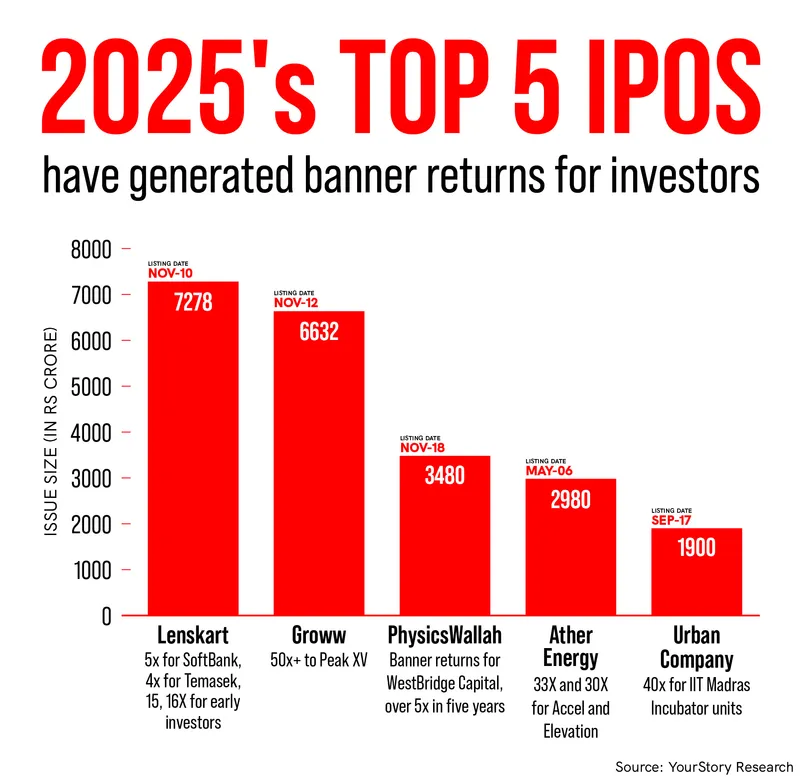
Against this backdrop, 2025’s IPO class stood out for the liquidity it finally unlocked. Here’s a look at the most-talked-about listings of the year which fetched handsome gains for investors.
Groww delivers a 50X return
Founded in 2017 by Lalit Keshre, Harsh Jain, Neeraj Singh, and Ishan Bansal, Groww rose rapidly during the pandemic, emerging as the fiercest challenger to Zerodha—India’s earliest and most enduring new-age brokerage firm. By 2023, it had overtaken Zerodha in active users and also turned profitable in FY23.
In May this year, Groww became one of the first major startups to use SEBI’s confidential pre-filing route. The mechanism allows companies to privately submit draft papers, engage with the regulator, and refine disclosures without committing to a listing timeline. If plans change, there’s no formal withdrawal or public scrutiny—an advantage several startups have begun to lean on.
By August, Groww secured SEBI approval, and earlier this month, the stock debuted on the bourses. The company had last been valued at $3 billion in 2021, but its valuation crossed $7 billion in a pre-IPO round. The listing price came in above that level, and Groww closed its first day at a market capitalisation of $8.6 billion—up 24% from its IPO price.
The rally didn’t stop there. Over the next six trading sessions, Groww’s stock surged more than 90%, pushing its market cap past $12 billion. For early investors, the outcome was extraordinary. Peak XV Partners, which held around 17%, saw its stake briefly touch a value of $1.5 billion—translating to a 50x+ return. It now ranks among the strongest VC outcomes in India at scale. (Peak XV had a shot at a 75x return on Zomato—now Eternal—had it held its stake beyond 2022.)
Ribbit Capital, Tiger Global, and Y Combinator also posted substantial gains, while co-founder and CEO Lalit Keshre became a billionaire with a little over 9% ownership.
Lenskart sails through a tough valuation journey
Just days before Groww’s debut, all eyes were on the IPO of Lenskart.
Founded in 2010 by Peyush Bansal, Amit Chaudhury, and Sumeet Kapahi, Lenskart has grown into a dominant omnichannel eyewear brand serving customers in India, the UAE, Singapore, Japan, and other markets.
The company was suddenly at the centre of a valuation debate after analysts pointed out that, even with its strong financials, Lenskart’s price-to-earnings ratio remained among the highest for a consumer retail brand—implying a very premium valuation.
Questions mounted: How large is India’s organised eyewear market? Can the company sustain its operating margins? How much growth runway remains? And would the public markets be willing to pay for that optimism?
As it turned out, the markets didn’t blink. Despite the hushed conversations—amplified after some of CEO Bansal’s interviews suggested the IPO might be aggressively priced—investors voted decisively. Lenskart’s IPO was subscribed more than 28 times, signalling strong demand across investor categories.
The company, last valued privately at around $5 billion, targeted a market capitalisation of over $7.5 billion at the top end of its price band. Once listed, the stock held its gains, and Lenskart is currently valued at more than $8 billion.
For its global backers, the listing unlocked substantial returns. SoftBank booked roughly a 5x gain on its investment, while Temasek generated around 4x—both impressive outcomes given they entered at later stages.
Early investors did even better: Chiratae Ventures and Premji Invest realised returns of about 15x and 16x, respectively. Like Groww’s listing, Lenskart’s IPO also made co-founder and CEO Bansal a billionaire.
PhysicsWallah breaks the edtech jinx
Among all the startup listings this year, PhysicsWallah’s IPO stood out the most, and for several reasons. The company was officially founded only in 2020 and raised venture capital for the first time as recently as 2022. Its market debut also came at a time when the edtech sector was still reeling from a series of high-profile failures. At the listing ceremony, co-founder Prateek Maheshwari even took a public swipe at the sector, calling PhysicsWallah the “good apple” in a basket of bad ones.
As YourStory reported, the IPO is now expected to revive confidence in India’s edtech ecosystem.
PhysicsWallah filed its draft papers through SEBI’s confidential route in March, just like Groww. The company planned to raise Rs 3,280 crore through the IPO, largely via fresh issuance to fund expansion. It also remained a rarity in India’s startup universe: the founders collectively held over 70% of the company—far higher than the ownership in most new-age firms.
The issue faced a slow start, with just 13% subscription across the first two days. But momentum surged on the final day, driven by institutional investors, and the IPO closed with a nearly 2x subscription.
When the stock was listed last week, it opened at a 33% premium and closed the day up 43%, giving PhysicsWallah a peak market capitalisation of $5 billion. Its cap table remains unusually lean, with only four venture investors on board.
The blockbuster listing also had another consequence: both founders—Alakh Pandey and Prateek Maheshwari—entered the billionaire club.
Urban Company becomes the most subscribed new-age IPO
Urban Company—founded just over a decade ago by Abhiraj Singh Bahl, Raghav Chandra, and Varun Khaitan—has long been synonymous with hyperlocal services: home cleaning, pest control, repairs, and, more recently, quick househelp services. The company has also expanded into products such as water purifiers, and media reports indicate it may soon enter the air-conditioning space as well.
Riding on strong brand recall and a category with no direct competitors, Urban Company’s IPO drew extraordinary interest. The issue, though comparatively small at Rs 1,900 crore, was subscribed more than 100 times; the retail portion saw over 40x demand.
Bankers and market observers said the enthusiasm was driven by a clear public-market thesis: Urban Company is a category leader with no immediate rival—a rarity in India’s consumer-tech landscape. That conviction carried through to its debut on Dalal Street. The stock listed at nearly a 60% premium to its issue price, pushing the company’s market capitalisation to around $2.7 billion.
Unlike Lenskart, Groww, and PhysicsWallah, Urban Company opted for modest pricing—taking a roughly 6% valuation cut from its previous private market value of $1.8 billion. The decision to leave headroom for public investors paid off handsomely. Although the stock saw a recent dip after the company reported a quarterly loss due to its aggressive push into insta househelp, its market capitalisation continues to comfortably sit above the IPO level.
For early investors, the listing was a windfall. Accel and Elevation Partners notched returns of 33x and 30x, respectively, while Bessemer Venture Partners logged a 15x outcome. The three founders, who collectively hold around 20%, now have a combined net worth of over Rs 4,100 crore.
Ather’s IPO turns IIT Madras into one of the year’s biggest startup winners
Founded out of an incubation cell at IIT Madras, Ather Energy made its public debut in April 2025, becoming the second major Indian EV maker after Ola Electric to list. Ather was also the first major new-age company to list this year. With a price band of Rs 304–Rs 321 per share, the listing valued the company at roughly Rs 11,956 crore (~$1.4 billion) at the upper end.
The IPO comprised a fresh issue of around Rs 2,626 crore and an offer-for-sale of up to 1.1 crore shares. Early on, the subscription looked weak: on day one, the issue was only 16% subscribed, and by day two, it had touched just 28%. But the story shifted; anchor allocations raised Rs 1,340 crore ahead of public bidding.
The financial outcomes for early backers were significant. Two of IIT Madras’ incubator units—the IITM Incubation Cell and IITMS Rural Technology & Business Incubator—sold small stakes and achieved returns of roughly 40x on their acquisition costs.
Meanwhile, global investor Tiger Global, which invested in Ather in a Series A round in 2015 (at ~Rs 38.58 per share), stood to gain around 734 % at the upper end of the IPO band.
For Ather Energy, the listing was a litmus test of investor appetite for hardware-heavy, capital-intensive EV makers—even in a moment of broader market caution. With early-stage institutional backers realising outsized returns, this IPO was one of the standout events of India’s 2025 public markets calendar.
Edited by Swetha Kannan