



This startup helps businesses adopt AI models and software with impact-based pricing
CreateBytes is a design and engineering studio that builds AI solutions and enterprise software for businesses, charging clients based on results rather than hours worked.


Startups are struggling to keep up with AI's rapid changes, with countless new tools and models constantly emerging. Many businesses find it hard to identify the right solutions that can help them scale effectively.
Meanwhile, most tech solutions companies still charge their clients by the hour, paying for time instead of results. Aditya Chhabra and Priyanshi Tater were working in tech and design, respectively, when they identified this as an outdated model that doesn't scale and reflect the real value delivered.
“There's a growing gap between those who can harness AI effectively and those left behind using traditional methods,” Chhabra says. The duo understood that businesses needed a better way to adopt AI and pay for what actually works.
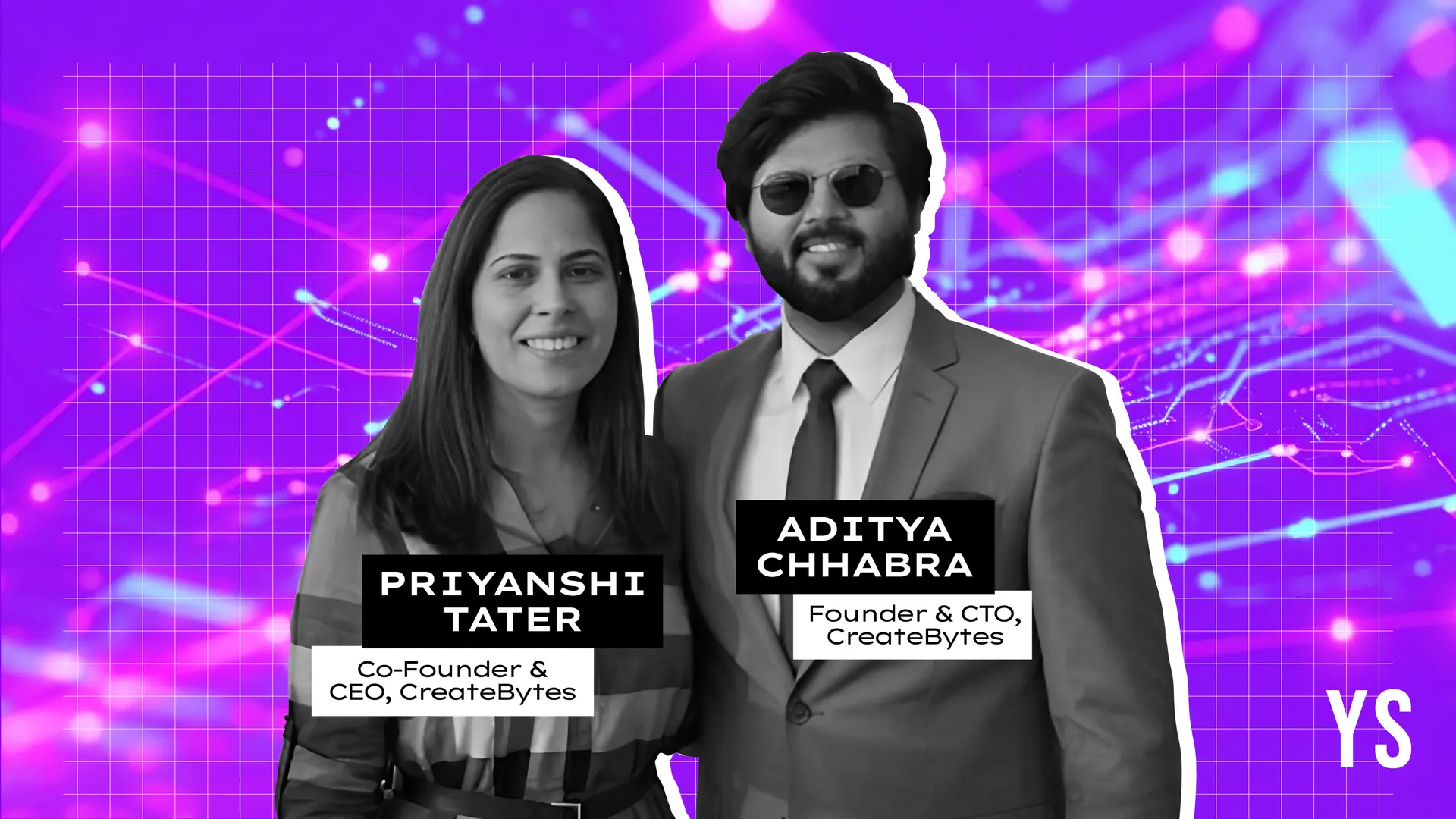
To fill this gap, in 2019, they founded , a design and engineering studio that specialises in building scalable AI pipelines and AI models for companies looking to accelerate growth and increase operational efficiency. Tater serves as CEO while Chhabra is the CTO at the startup.
Chhabra holds an M.S. (Research) in computational biomechanics from IIT Delhi, with research experience at INRIA and engineering work at Stryke. He has developed AI systems across MedTech, defence, and enterprise applications.
Tater holds a master’s degree from NIFT Delhi and was trained at the University of the Arts London. With over eight years of experience, she has led design at Grappus and GoDoctor, working with global brands.
What CreateBytes does
The Gurugram-based startup provides end-to-end digital solutions, including UI/UX design, digital marketing (SEO, PPC, social media), and custom enterprise software development. The company builds business management and customer tracking systems and develops marketing automation tools designed to scale team output.
Its solutions include computer vision tools for manufacturing and logistics, such as tracking inventory movement in factories and monitoring bulk items in real time.
CreateBytes builds proprietary large language models from scratch and fine-tunes existing models for specific use cases. Instead of using expensive commercial AI solutions, it develops smaller, specialised models tailored to particular business requirements.
The company also provides IoT solutions and platforms that deliver real-time operational data. Its recent work includes developing a comprehensive multi-platform ecosystem for Edly with customised dashboards and scalable microservices architecture; creating an Android app for KhataBook focused on intuitive daily account management for small business owners; building a three-component solution for NimNim with admin, driver, and customer applications; and delivering branding and web development for HST Hospitality.
The company claims its platforms serve over 10 million users globally. Its product, YugYog.ai, tracks individuals using body movement patterns instead of facial recognition and is used for safety and attendance monitoring at work sites and factories.
Its other product, KriGat, deployed in the UK, analyses movement and physiology through laptop or phone cameras for gyms and physiotherapists. Meanwhile, the startup’s fintech platform DDPro handles subscription payments for wellness brands, serving over 50,000 users.
The technology
CreateBytes uses Python and Django for AI development, Ruby on Rails for web applications, and C++ with ROS (Robot Operating System) for robotics projects. Its capabilities include spatial computing algorithms, computer graphics, and integrating multiple AI technologies into unified solutions.
It follows a hybrid model-development approach, building proprietary models and partnering on R&D, to create cost-effective, stable solutions for niche use cases. It offers a self-service web platform where clients can build project timelines, create requirement specifications, and view cost estimates independently. The company also trains client teams on AI adoption and assists businesses in selecting suitable models for their specific needs.
Revenue model
CreateBytes uses an impact-based pricing model, earning revenue through product-based pricing linked to the client’s revenue impact, scalability needs, and technical complexity.
It also offers subscription and licensing plans for its products, CB Vision, YugYog.ai, KriGat, and DDPro, using per-camera, per-member, or usage-based billing. In some cases, it forms co-build partnerships with startups, taking equity or a revenue share. The company has implemented revenue-share models with partners like Altrix Labs for projects in the UK market.
Market and future plans
According to Fortune Business Insights, India’s artificial intelligence market size was valued at $9.51 billion in 2024, and is projected to grow from $13.05 billion in 2025 to $130.63 billion by 2032, with a CAGR of 39% over the forecast period.
Functioning in this sector, CreateBytes remains a bootstrapped startup, operating out of Gurgaon and Jaipur with a 200-member team serving clients across the US, Europe, the Middle East, and India. It competes with firms such as UST, Happiest Minds, and Endava.
The startup has served more than 80 clients, including LoveChild by Masaba, Edly, Luxe Fitness, Khatabook, and NimNim, and has completed more than 150 projects in four years. “Our AI-automated workflows have reduced our own delivery costs by 60-70%, while clients have reported a 95% efficiency increase on activities that previously consumed 40–50% of their overall project costs,” Chhabra tells YourStory.
Looking ahead, the company plans to deepen its presence in India and the Middle East while continuing to grow its US and European client base. CreateBytes also intends to work with semi-government enterprises on specialised security and monitoring solutions.
The long-term vision is to deliver sustainable, scalable AI solutions while helping bridge India’s AI skills gap through education and training initiatives, Chhabra says.