



Lenovo
View Brand PublisherWhat growing SMBs learned from Lenovo’s AI PC webinar
The webinar explored how AI-powered PCs are helping SMBs cut downtime, boost productivity, and unlock enterprise-grade capabilities without enterprise-level complexity.


As businesses operate across time zones, scale at unprecedented speed, and respond to customers who expect instant service, small and medium businesses (SMBs) are facing a defining moment. In India, this shift is palpable as 78% of Indian SMBs are using or experimenting with AI to drive revenue and operational gains, according to a Salesforce report.
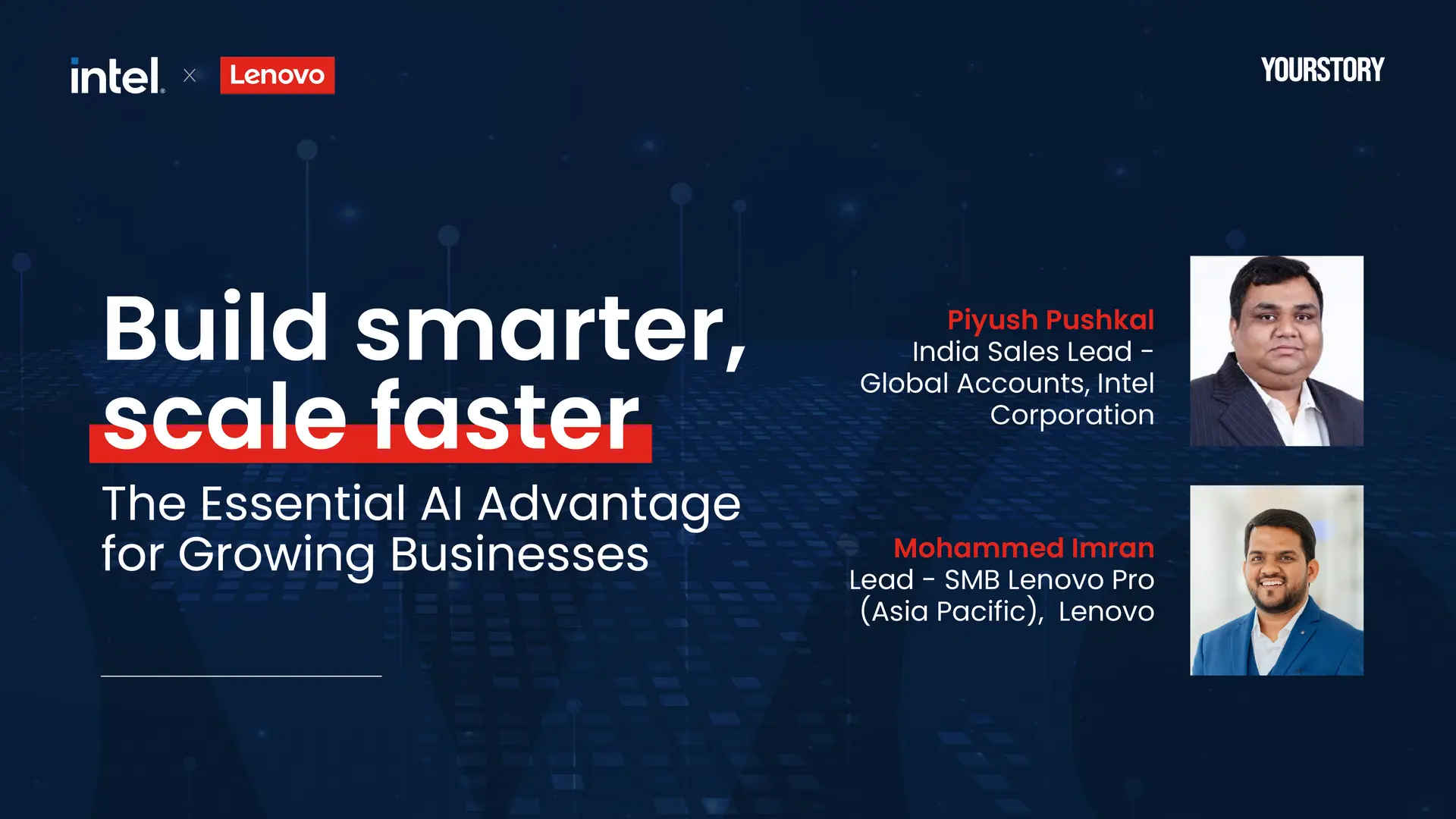
Against this backdrop, technology has evolved from a support function into the primary force shaping how businesses grow, compete, and stay resilient. This shift was at the heart of Lenovo’s recent webinar, ‘Build smarter, scale faster — the essential AI advantage for growing SMBs’, which brought together industry leaders to unpack how AI-powered devices are quietly transforming everyday work for small businesses. The session featured insights from Piyush Pushkal, India Sales Lead – Global Accounts at Intel Corporation, and Mohammed Imran, Lead – SMB Lenovo Pro, Asia Pacific.
AI PCs: From buzzword to business impact
From automating routine work to predicting device failures before they happen, AI-powered devices are now giving SMBs capabilities that were once reserved for large enterprises.
Explaining what fundamentally sets AI PCs apart, Pushkal said, “If you look at the whole foundation on which the AI PC is built, we call it a triad—the CPU for low-latency tasks, the GPU for high-throughput media and vision workloads, and the NPU for sustained AI operations.” Together, this architecture enables smoother workflows, better battery efficiency, and faster performance without pushing every task to the cloud.
Sharing real-world examples, he described how a small design agency using Intel Core Ultra laptops was able to run background blur, eye-contact correction, and live collaboration features locally, while simultaneously rendering heavy design files. “On a non-AI PC, this would have consumed nearly 30% more battery,” he noted. “With AI PCs, we saw close to a 30% saving in battery life, which is significant for mobile teams.”
Making AI practical and affordable for SMBs
One of the biggest concerns SMBs have about AI is cost and complexity. Pushkal addressed this head-on, urging businesses to look beyond upfront pricing. “Don’t just look at the device cost,” he said. “Look at the overall value it brings – how it enables your workforce, your workflows, and how future-ready it makes your business.”
By shifting AI workloads from the cloud to the device, SMBs can reduce cloud usage costs, improve data privacy, and lower latency. In one example shared during the session, an accounting firm reduced meeting preparation time 40% by using local AI tools for transcription, summarization, and drafting emails.
“If 40% of prep time disappears,” Pushkal explained, “the same team can deliver significantly more output without increasing headcount. That’s real ROI.”
Predictive AI and the end of reactive IT
Downtime is especially damaging for SMBs, often hitting customer experience and revenue simultaneously. Predictive AI is helping businesses move from reactive troubleshooting to proactive maintenance.
“What predictive AI really does is shift IT from a reactive to a proactive model,” Pushkal said. He shared examples of Intel vPro-enabled Lenovo devices flagging abnormal thermal and battery behaviour across laptop fleets, allowing IT teams to intervene before failures occurred, even during peak business periods.
“This means fewer emergency calls, faster fixes, and business continuity,” he added. “Your staff stays productive, and your customers never feel the pain of downtime.”
Creativity beyond automation
While efficiency dominated early AI conversations, creativity is emerging as the next frontier. AI-powered devices are compressing weeks of creative work into days—or even hours.
Pushkal recalled speaking to creators across industries, from music production to architecture. “What earlier took weeks or months can now happen in days,” he said. “And the creator still has full control – they can tweak, iterate, and push creativity further.”
Even everyday knowledge work is becoming more creative. “I can open a Word document and ask Copilot to summarise it in 10 points,” Pushkal shared. “That two-minute summary is enough for me to walk into a meeting fully prepared.”
Looking ahead, Pushkal highlighted private, on-device AI as a major game changer for SMBs. “I can go to the cloud and ask a question,” he said, “but I cannot send all my emails, presentations, and confidential documents to the cloud and ask for insights.”
On-device AI enables assistants that can analyse local files, generate insights, and draft content without sensitive data ever leaving the device. “That privacy aspect,” Pushkal added, “will drive the next phase of adoption.”
Simplifying procurement with Lenovo Pro
Shifting focus from devices to experience, Imran introduced Lenovo Pro, a platform built exclusively for businesses to simplify technology procurement and management.
“Buying technology for businesses is still unnecessarily complex,” he said. “Pricing is unclear, quotes take time, tracking invoices is difficult, and there’s no single platform to manage it all.”
Lenovo Pro aims to solve this by offering SMBs:
- Early access to the latest AI-ready devices
- Exclusive business pricing and GST invoices
- Instant quotes and self-serve purchasing
- Dedicated sales and technical advisors
- Centralised tracking of devices, warranties, and invoices
With over 1.6 lakh members already on the platform, Lenovo Pro is helping businesses replace fragmented purchasing with a single, streamlined system. “Even without a dedicated IT manager, founders can see exactly how many devices they own, when warranties expire, and reorder with a single click,” Imran noted.
The road ahead for SMBs
As AI becomes embedded across software and hardware, the message from the webinar was clear: this is not a trend SMBs can afford to sit out. “Not everyone needs the highest-end AI PC,” Pushkal cautioned. “But if you are buying a new PC today that isn’t AI-ready, you’re investing in something that may not support the software you’ll use six months from now.”
For growing businesses, AI-powered PCs are no longer optional upgrades. They are fast becoming the foundation for smarter operations, stronger security, greater creativity, and sustainable growth.