



India is flying more passengers than ever, but aviation remains a money-losing game
Indian carriers flew 165 million passengers in FY25 and lost Rs 52,897 crore. Only IndiGo is making money.

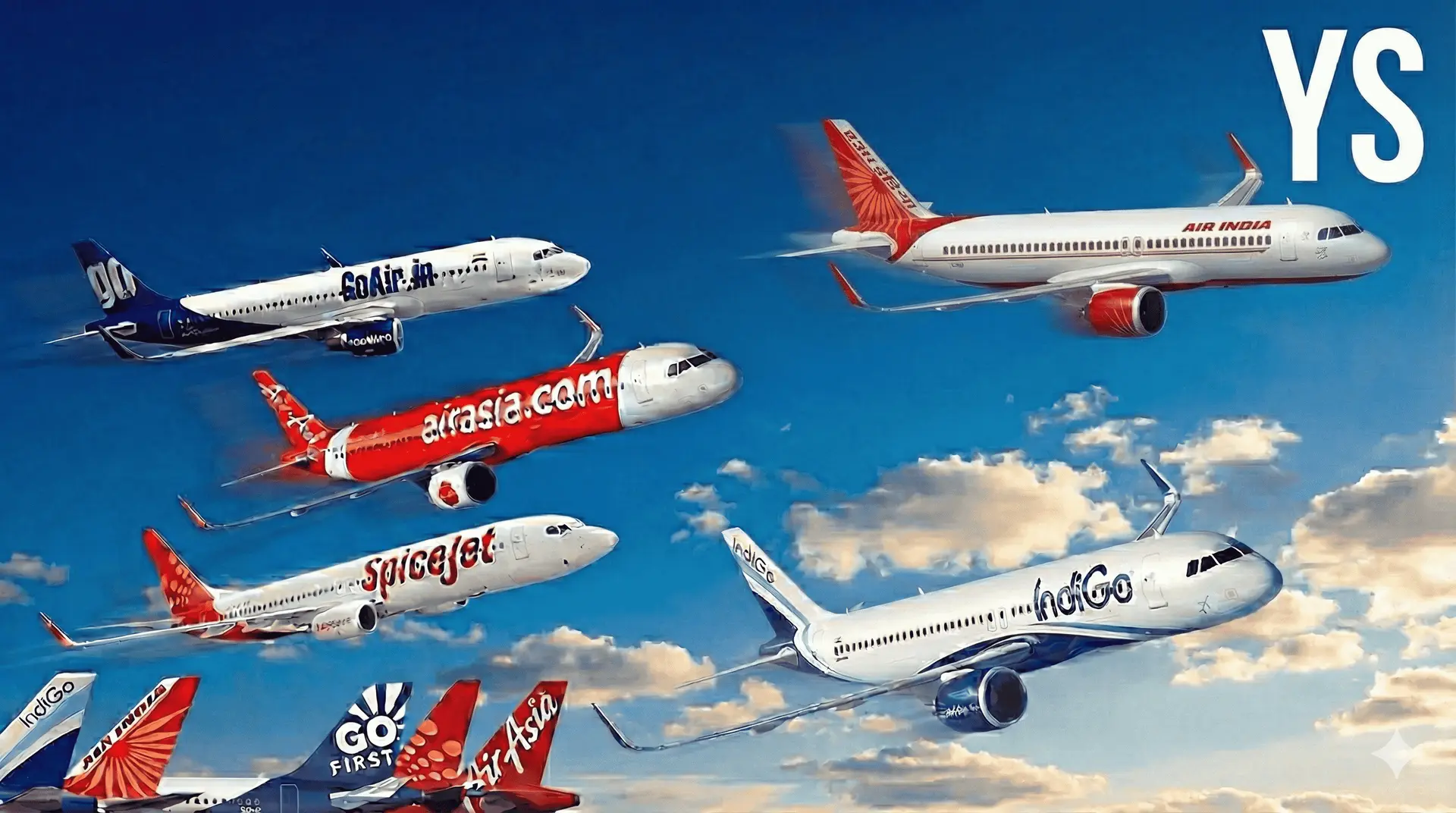

India's aviation industry is finally delivering on the metrics it once promised investors. Domestic passenger traffic has reached historic highs, airports are operating beyond designed capacity, and airlines are inducting aircraft at a pace unmatched by most global peers. Yet, the sector continues bleeding money.
India's airlines flew 165.5 million passengers in the financial year ending March 2025, a 22% surge from two years prior, and lost Rs 52,897 crore while doing it.
This disconnect between soaring demand and deepening financial stress has become the defining paradox of Indian aviation. Growth is no longer the problem; profitability is.
The winner takes most
Only one airline has cracked the code. IndiGo, which controls over 60% of domestic capacity, swung from a loss of Rs 3,167 crore in FY23 to a profit exceeding Rs 7,250 crore in FY25.
Every other major passenger airline—from legacy carriers to new-age challengers—remained in the red. Air India alone lost nearly Rs 40,000 crore in FY25, despite aggressive restructuring under the Tata Group.
The numbers reveal that India's aviation sector is not uniformly troubled. It's bifurcated, approaching a winner-takes-most market where scale and cost discipline matter more than headline growth.
That imbalance raises an uncomfortable question: If airlines cannot make money at record traffic levels, when exactly are they supposed to?
Passenger growth is slowing
If sustained losses during boom years are concerning, the early signs of slowing growth are even more alarming.
After rebounding from the COVID-19 pandemic slowdown, domestic passenger growth has begun to cool. Traffic rose 13% in FY24, then slowed to 7.7% in FY25.
In the first half of FY26, the deceleration became unmistakable. Between July and September 2025, domestic passenger numbers actually declined year over year, marking the first sustained soft patch since COVID-era disruptions.
This slowdown matters because airlines are expanding capacity as if growth will remain exponential. Aircraft orders placed during the recovery years are now entering fleets. But as fares rise to cover fuel, leasing, and airport costs, price-sensitive travellers are pushing back.
India's aviation market is deep, but not infinitely elastic. There's a ceiling to what middle-class consumers will pay, particularly outside metros. When ticket prices climb faster than incomes, demand thins quickly, said an aviation consultant.
For airlines already struggling to turn profits at peak demand, even modest growth slowdowns could tip balance sheets back into distress. The brief uptick in industry performance seen in FY24 now looks less like a turnaround and more like a temporary alignment of capacity discipline and pricing power.
Flying regional is still a money pit
Nowhere is the structural weakness more visible than in regional aviation.
A decade after the government made regional connectivity a centrepiece of India's aviation policy through the UDAN scheme, small and regional carriers continue to struggle under the weight of uneconomic routes, high fixed costs, and thin demand outside metro corridors.
Alliance Air reported a loss of Rs 6,911 crore in FY25, extending a streak of persistent losses. Smaller operators tell similar stories. While IndiaOne Air finally turned marginally profitable, most regional players remain financially fragile or dependent on state support.
The UDAN scheme has undoubtedly expanded India's aviation map, connecting towns that had never seen scheduled air service. But it has not produced sustainable airline businesses. Airlines fly fuller than before, yet yields remain low, operational costs are high, and subsidies are insufficient to offset structural disadvantages.
Regional flying, industry executives privately concede, is still treated as a public service obligation rather than a commercial enterprise. That may be politically attractive, but it leaves airlines absorbing losses in exchange for visibility and access to future routes.
The result is a two-speed aviation economy: profitable trunk routes controlled by a handful of large carriers, and loss-making regional networks that drain capital without delivering durable returns.
A hands-off government, an unforgiving market
In its response to Parliament, the Ministry of Civil Aviation made clear that the sector is deregulated and that airlines are expected to manage their own financial viability. There is no rescue plan, no coordinated debt relief, and no new support framework on the table.
That leaves airlines facing a harsh reality. The era of blaming pandemic disruptions, fuel shocks, or temporary demand swings is ending. What remains is a business model test—one that only a few appear equipped to pass.
Airlines are responding with predictable moves: cutting unprofitable routes, delaying deliveries where possible, and in some cases, exploring consolidation. But these are defensive manoeuvres, not strategic breakthroughs.
India's aviation boom is real, but so are its losses. And unless airlines can convert traffic into durable profits, the industry risks entering its next phase not as a growth story, but as a survival story—where staying solvent and not scaling up becomes the ultimate competitive advantage.
The paradox may resolve itself through consolidation rather than turnaround. In markets where only one player is consistently profitable, the question shifts from "how do we all succeed?" to "who gets absorbed first?"
For now, Indian skies remain crowded with carriers. How long they stay that way depends less on passenger demand, which remains strong, and more on how long investors are willing to fund growth that doesn't pay.
Edited by Suman Singh