



From India to Japan: Crafting global careers in innovation and technology
At YourStory TechSparks 2025, a panel of senior leaders from Japanese companies discussed how India’s talented, agile workforce is driving innovation, scaling businesses, and shaping a new era of cross-border collaboration.

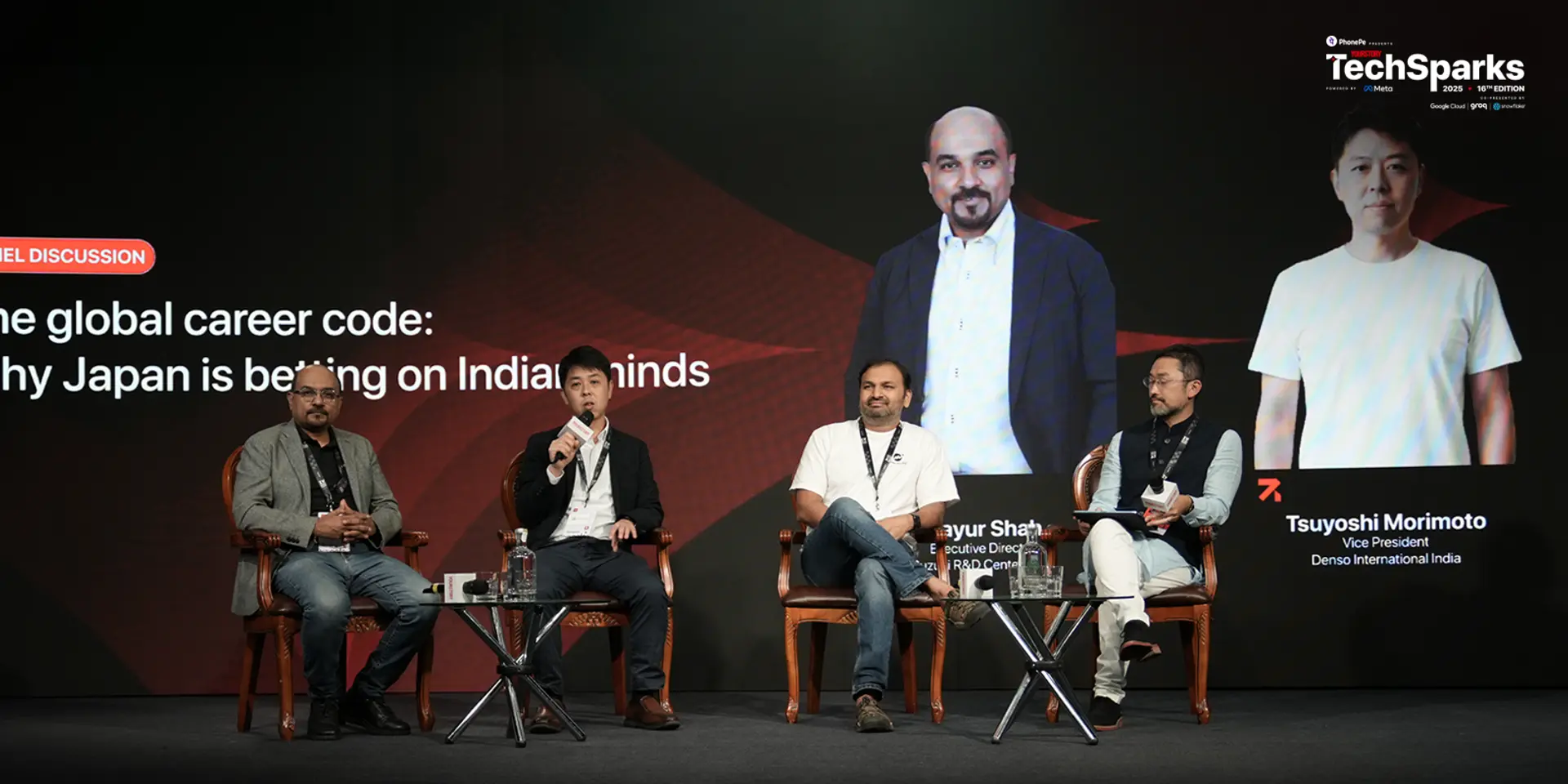

As the world of work becomes increasingly borderless, Japan is emerging as a compelling destination for Indian professionals seeking growth, balance, and purpose. From deeptech startups to fintech unicorns, Japanese companies are actively engaging Indian talent not just to fill roles, but to co-create, innovate, and shape the next chapter of international collaboration.
This conversation unfolded at a recent panel titled ‘The global career code: Why Japan is betting on Indian minds’ at YourStory’s TechSparks 2025, hosted under the India-Japan Talent Bridge program. Moderated by Takahisa Ohira, Head of Asia Region, Deloitte Tohmatsu Venture Support, the discussion brought together Mayur Shah, Executive Director at Suzuki R&D Center India; Vivek Gokhale, CEO of Money Forward India; and Tsuyoshi Morimoto, Vice President at Denso International India.
From personal journeys to global opportunities
Shah set the stage by recounting his early experiences with Japan. “I wrote my thesis in Japanese back in 1994-95,” he said. “That experience shaped my whole journey. I never viewed India and Japan as two separate countries, but as a shared opportunity.”
Shah’s career spans IT R&D, investment banking, venture capital, and now automotive innovation at Suzuki, reflecting the breadth of opportunities Japanese companies can offer Indian talent. His message was clear: India’s young, agile workforce, when paired with Japan’s scale and discipline, can drive innovation to a whole new level.
Gokhale highlighted his own trajectory with Money Forward, a fintech company founded 13 years ago in Japan. Having relocated from Tokyo to Chennai to lead the development centre, he explained how Indian engineers are now integral to the company’s global growth. “We adopted English as the internal language for engineering teams and hired top talent globally, including India’s IITs. Today, Indian teams collaborate seamlessly with Japan, driving innovation and scaling products,” he said.
Morimoto shared Denso’s experience in India, where the company is building new digital platforms from the ground up. “Traditionally, product development happened in Japan and then scaled globally. Now, India is central to innovation. For our Solver initiative, four out of five applications are developed entirely in India. Our Indian engineers are leading product development, QA, and business strategy,” he said. This shift demonstrates the trust Japanese companies place in Indian talent and the evolving nature of global collaboration.
Structured immersion and collaborative innovation
A central theme of the discussion was Japan’s structured yet empowering approach to talent. Shah outlined Suzuki’s three strategic verticals: software-driven cars, alternative fuels, and alternative mobility. New engineers undergo a three-month immersion in Japan to build understanding and trust before contributing to India. This cultural and technical exchange strengthens collaboration and accelerates innovation.
Beyond internal teams, Suzuki actively collaborates with Indian startups, providing platforms for experimentation and scaling. “We reach out to mature startups with solutions in logistics, warehousing, precision farming, and defence,” Shah said. “If they can integrate their solution onto our platform and expand their market, we collaborate. This is how we empower talent and technology while contributing to the broader Japan-India innovation bridge.”
Morimoto and Gokhale echoed the value of such immersions. At Money Forward, engineers from India and Japan work jointly on projects, leveraging the strengths of both teams. Morimoto highlighted that Denso engineers in India collect real-world data from factories, enabling them to develop applications with global relevance while learning Japanese standards of quality and precision.
Culture, trust, and the path forward
The panelists underscored that cultural understanding is just as crucial as technical expertise. Shah highlighted the Japanese principle of Shu-Ha-Ri, which means “first follow, then break, then innovate”, as a guiding framework for navigating Japanese work culture. “Skipping steps can lead to frustration,” he said. “Embrace the system fully, and you can become a bridge between two nations.”
Morimoto emphasized that quality and trust form the foundation of long-term success in Japanese organizations, while Gokhale pointed to respect as central to Money Forward’s everyday operations. “Mindfulness, collaboration, and consideration for colleagues are essential to building effective, high-performing teams,” he noted.
The panel wrapped up with a pertinent message: Japan is offering far more than jobs; it provides a structured environment where Indian talent can grow, innovate, and scale globally. Through mentorship, cultural immersion, and a deep commitment to excellence, Indian professionals are uniquely positioned to drive the next chapter of Japanese-Indian collaboration.
