



India Quotient’s latest $129M fund will follow time-tested playbook, says Partner Kanika Agarrwal
India Quotient’s fifth fund will look into the emerging areas of enterprise software and AI tech. But there will not be any drastic changes in the firm’s seed-stage investment strategy which has worked well over the years, emphasises Kanika Agarrwal, Partner at India Quotient.

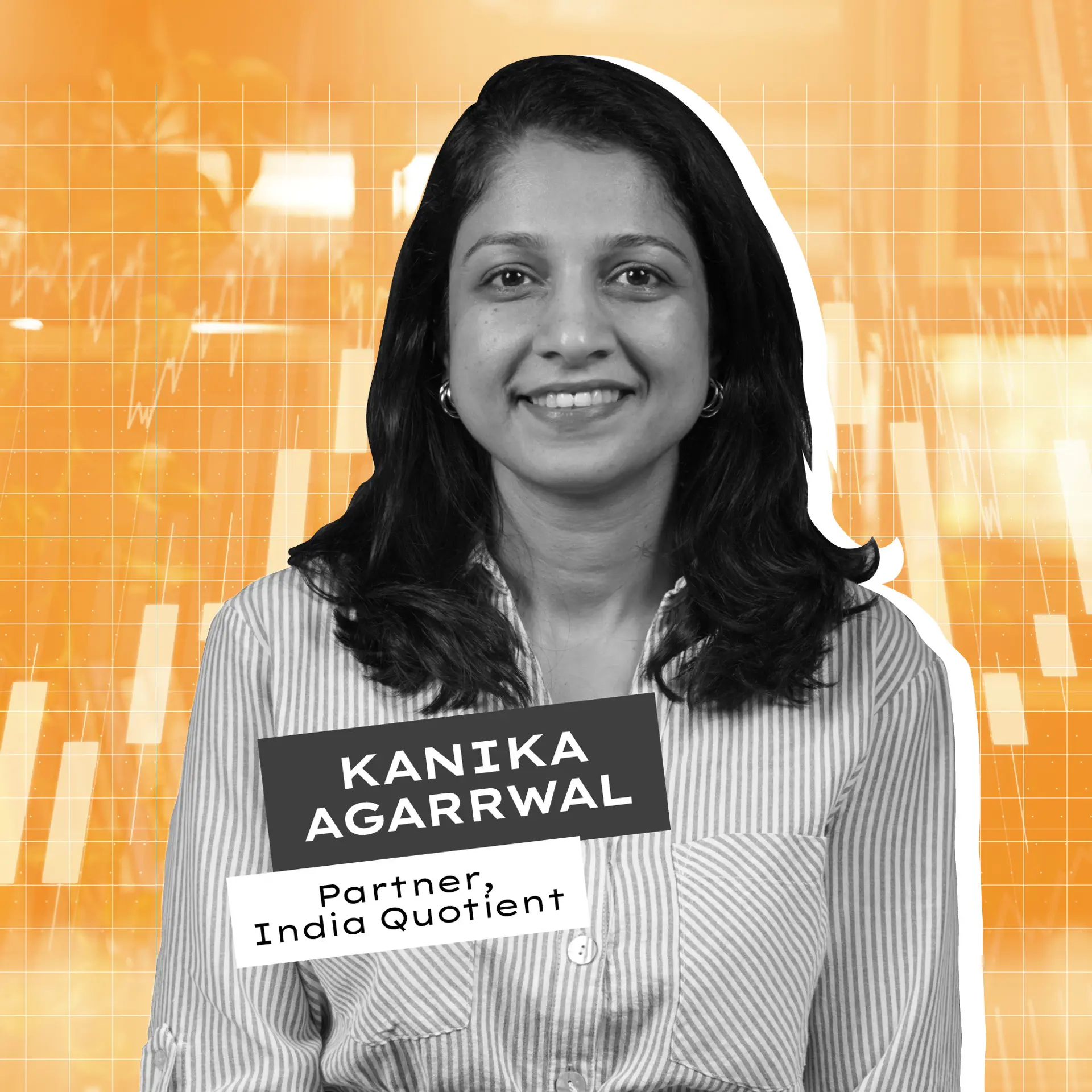

Venture Capital firm India Quotient has a proven blueprint for seed-stage investments in startups. As it endeavours to write a startup’s first cheque, it comes on board as early as possible and prefers working closely with founders from Day 1.
This approach won’t change as it gears up for its fifth fund.
With its new $129-million fund—its largest to date—the firm is not looking to tweak its strategy drastically. In fact, it is looking to double down on the framework that has worked for the company since 2012. The VC firm has reserved half the target corpus of Fund V for follow-on investments.
India Quotient had earlier backed social media brand ShareChat, accounting software Vyapar, hair care brand Fix My Curls, jewellery brand Giva, inter-city bus service, CityFlo, and audio stories platform KukuFM, among others. The firm was also one of the early investors in cosmetics brand, SUGAR and fintech company Lendingkart—part of its Fund I portfolio. In 2022, the firm returned its maiden fund in cash to limited partners at a net multiple of 5.9X, according to reports.
The VC firm, which has seen many of its early bets take off, is now eyeing companies that are trying to solve unique Indian problems with emerging technology.
The firm is currently bullish about enterprise software and technology that helps accelerate digitisation in the country. India Quotient believes software adoption is going to leap going forward, driven by AI which will make software easier to use.
“AI is going to accelerate digitisation by making software easier to use. People won’t need to learn menus or buttons; they can just give plain-text commands, which is huge for SMEs and prosumers,” says Kanika Agarrwal, Partner, India Quotient.
India Quotient recently promoted Kanika Agarrwal and Sahil Makkar as partners to help facilitate deals in emerging segments; they join existing partners Anand Lunia, Madhukar Sinha, and Gagan Goyal.
Agarrwal also heads the firm’s First Cheque programme, a pre-seed platform targeted at ideas at the on-paper stage. She talks to YourStory about some of the spotlight sectors for the VC firm, how the firm goes about investing in a company, and the firm’s exit strategy.
Edited excerpts…
YourStory [YS]: What are the plans for Fund V?
Kanika Agarrwal [KA]: Fund V is really more of the same. We’ve always been a seed-first firm—coming in on Day 1, usually leading the round, and working closely with founders from the start. That’s why we keep our fund size intentionally small at $129 million. If you raise a huge fund, you get pushed into later-stage investing, and that’s not who we are.
Our typical cheque is anywhere from $500K to $2 million–3 million, depending on what the company needs at seed. We stay focused on India and back founders solving uniquely Indian problems—whether it’s building local versions of global models or creating products tailored to the realities of Indian users.
A good example is Vyapar. When we invested in it in 2018, everyone said Indian SMEs wouldn’t pay for software. But we believed they would, as long as the value was clear and the pricing made sense. And that’s exactly how it played out.
In terms of sectors, nothing drastically changes. The themes evolve—today every company has some AI built into it, but the fundamentals are still the same. Our job is to invest before something becomes a theme, like we did with Sugar before D2C was a thing, ShareChat before regional social media exploded, or KukuFM, or before UPI Autopay scaled content payments.

YS: Have you started deploying from the new fund?
KA: This has been one of our busiest quarters. We’re usually very selective—we do maybe 12 deals a year—and every partner only does a couple of deals. We move fast while still being highly picky. This quarter, we’ve already done five deals from the new fund; they’re still in the paperwork phase, so nothing’s been announced yet.
YS: Could you elaborate on the firm’s First Cheque programme?
KA: First Cheque is a pre-seed platform. The idea is to give founders up to $400K–500K at the paper-plan stage, when they’re still figuring out their direction. It’s been really successful so far; and even if we don’t take them into Fund V, these startups often go on to raise from every tier-A fund.
This cohort is focused on brands. We want to back 12–15 unique teams in large markets, super early. It’s easier than ever for anyone to get their product in front of customers. This has made it difficult to tell whether early users genuinely love the product or are just trying it because it’s easy to find. So instead of waiting for early usage metrics, we are choosing to evaluate customer love at an even earlier stage
Part of Fund V is earmarked specifically for First Cheque; so we can continue supporting these founders and potentially invest more through the main fund later.
YS: Are there any overarching themes for your First Cheque cohorts?
KA: It’s not a cohort in the traditional sense; so we don’t have a set demo day, though maybe we’ll try that in the future. So far, 12–13 First Cheque companies have gone on to raise from the main fund, which is significant given we do only 12–13 deals a year.
We’ve backed First Cheque companies across a few consumer segments—handbags, home improvement, FMCG, even a health-tech brand. We’re also open to B2B or prosumer-focused startups—think carpenters, architects, or shopkeepers—as long as it’s a large or potentially large market and the founders are fantastic.
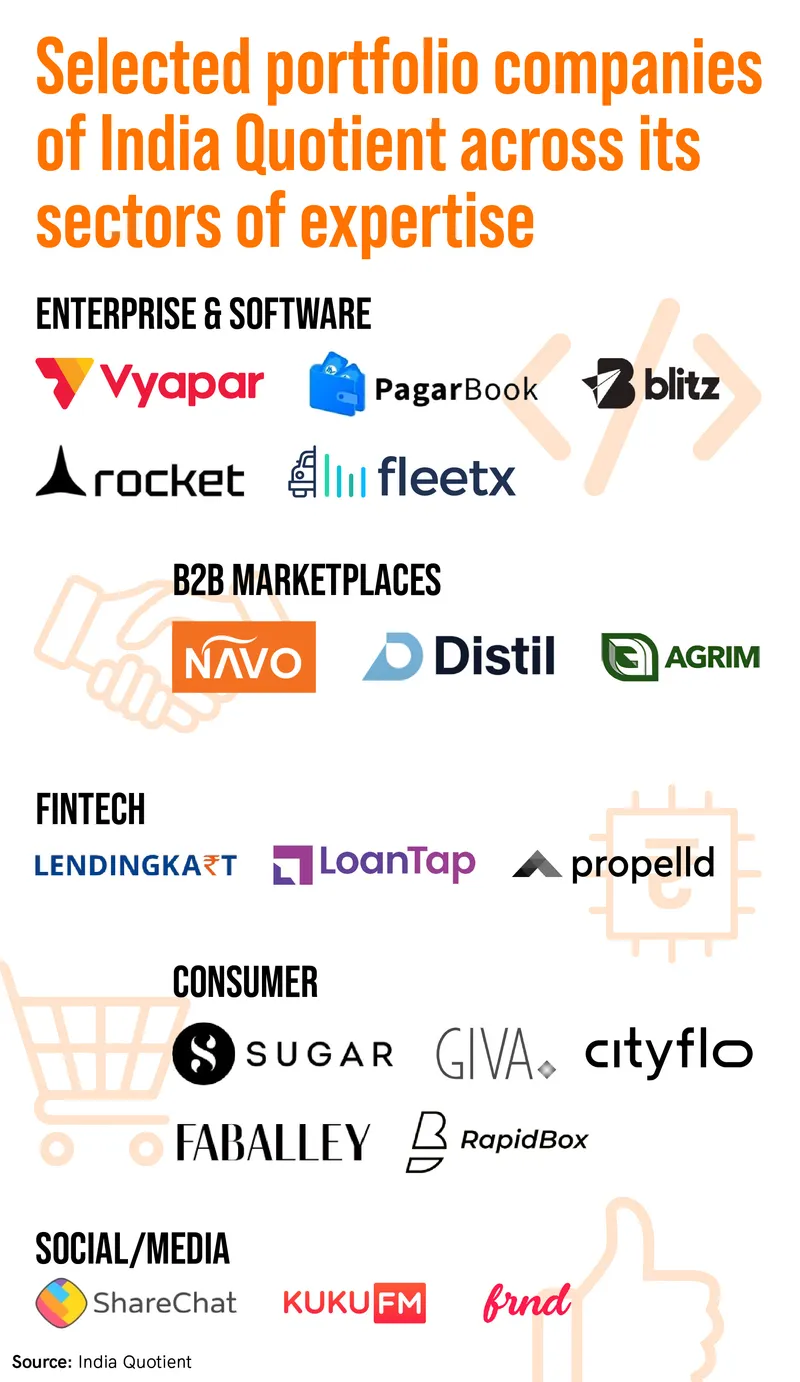
India Quotient was an early investor in companies like SUGAR Cosmetics and Lendingkart I Design: Nihar Apte
YS: What are some of the spotlight sectors India Quotient is looking at?
KA: We’re bullish on a couple of areas. First, India software. AI is going to accelerate digitisation by making software easier to use. People won’t need to learn menus or buttons; they can just give plain-text commands, which is huge for SMEs and prosumers. The next generation entering family-run businesses will naturally adopt this; so software adoption is going to leap.
Second, Internet 2.0 and marketplaces are ripe for disruption. With better tech, logistics, and payments, new players can build personalised, network-effect products (network‑effect products are products that become more valuable as more people use them) and challenge incumbents, whether in B2C, B2B, horizontal, or vertical markets.
And of course, we continue to look at brands that serve large, everyday markets—not niche high-end products— where pricing, loyalty, and value really matter.
YS: How have the exit opportunities been for the firm?
KA: The IPO market has been really healthy for the ecosystem. A large number of DRHPs have been filed this year alone, across companies of all sizes—from $130M revenue startups to larger players like Bluestone. This kind of liquidity is great for both founders and funds.
Early-stage founders now have public-market role models to learn from, and the market is more forgiving of loss-making or experimental companies. Even in our portfolio, there's a growing aspiration to go public. Overall, this should create more exits, stronger DPIs (distributed to paid-in capital), and healthier signals for the startup ecosystem.
Exit strategies vary. In earlier funds, exits were mostly to family offices, institutions, or via M&A. We haven’t had an IPO yet, but with the current market, more companies are likely to go public over the next few years. Liquidity is much better now than a decade ago, though M&A is still developing—it’ll likely take time for blockbuster deals to emerge. Overall, it’s all cyclical and evolving with the next generation of companies.
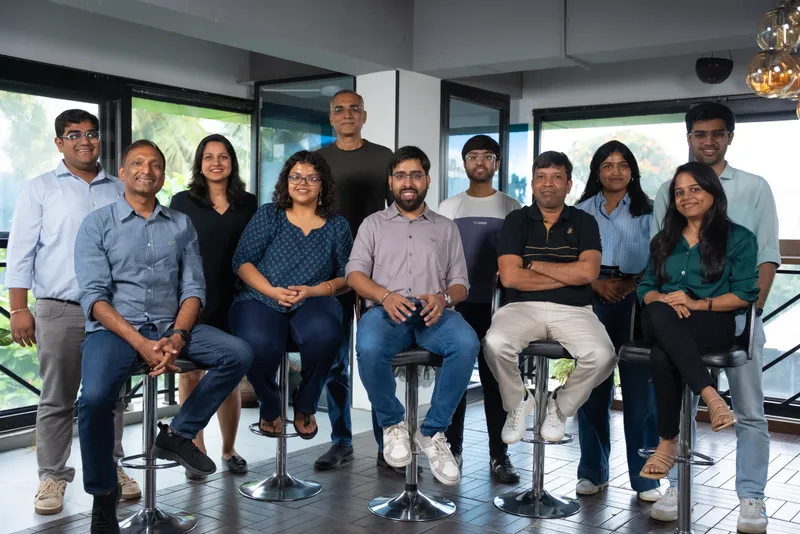
The India Quotient team
YS: What are your thoughts on this year’s deal flow?
KA: Seed-stage funding has been fairly stable year to year, maybe 20% up or down, but the number of deals stays roughly the same. Cheque sizes might change a bit, and bear markets can affect valuations, but broadly the pattern holds. Later-stage rounds follow with a lag: strong seed years feed Series A the next year, and growth rounds after that.
Short-term sentiment can feel volatile, and IPO windows may open and close, but over a 10-year trend, things generally move upward. For individual companies, timing can be tough, but for the ecosystem as a whole, there’s no existential risk.
YS: Has the firm disbursed Fund IV completely?
KA: We’ve finished deploying the fund; so now it’s mostly follow-ons. Typically, we allocate about 1:1—so if we had $50 million for first cheques, another $50 million is set aside for follow-ons, usually up to Series B.
YS: How do you see the social media landscape evolving? Your investments ShareChat and KukuFM have moved into micro-dramas—how is that trend shaping up?
KA: Social media is always evolving. Each generation—Gen Z, Gen Alpha, and beyond—uses different platforms; so there’s always room for the next big player. Building network effects is tough, but we’re always on the lookout for great social media companies.
For the ones we’ve invested in, like ShareChat and KukuFM, micro-dramas and new content formats are just extensions of what they were already doing. Different partners manage them independently; so there’s no overlap or conflict—that’s not been a concern for us.
YS: Do you see the social media sector being impacted by the ban on real-money gaming (RMG)? ShareChat has said it felt a hit since RMG companies were major advertisers on its platform. Do you expect this ban to have ripple effects across the industry?
KA: Yes, ad revenue from RMG takes a hit, but there’s an alternative way to look at this. Since RMG companies are no longer competing for ad space on Meta and Google, customer acquisition costs for other brands and content companies like ShareChat have come down. So, while some revenue is lost, acquiring users becomes cheaper, and over time, that revenue tends to stabilise and even improve. It’s largely a short-term impact that balances out.
YS: Cityflow is one of your portfolio companies and YOLO Bus was another. How do you view the travel tech segment in India?
KA: We’re definitely interested in travel tech—we’re looking for the next MakeMyTrip or a next-gen booking engine, maybe AI-enabled. The challenge is finding great founders and defensible businesses. Without a moat, it often ends up being just cash arbitrage: you spend to acquire users and hope they stick around. We’re still figuring out where real differentiation comes from in this space.
Edited by Swetha Kannan