



This startup is bringing clarity to India’s textile supply chain
Founded in 2018, Kosha.ai is building tools for the textile industry. By using real-time material measurement, the startup helps manufacturers, recyclers, and brands verify what their textiles are made of.



India’s textile industry is massive and spans mass manufacturing units, small powerloom clusters, and traditional handloom regions. Despite its scale, the sector still relies heavily on fragmented processes, subjective quality checks, and limited material verification.
Outdated verification practices such as burn tests and visual checks are often imprecise, leading to mislabelled fabrics entering export channels and recyclable materials being down-cycled because of inaccurate sorting.
Against this backdrop, Bengaluru-based .ai, incorporated under Architect Innovations Pvt Ltd in 2018, set out to build measurement and traceability tools designed specifically for textiles.
Founded by Vijaya Krishnappa and Ramki Kodipady, the startup develops hardware and software systems that identify fiber composition, digitise sorting processes, and create verifiable traceability records for circularity, enabling proof-backed tracking of materials and their movement through the value chain.
Over the years, Kosha.ai has gained support from IISc, C-CAMP, and CSTRI, and its textile-first approach has been recognised by the World Economic Forum (WEF), H&M Foundation, IKEA Foundation, Mercedes-Benz, and Startup India.
By using its flagship device Fibersense, the company has processed nearly 15 tonnes of material, and has helped avoid an estimated 52.5 tonnes of carbon-dioxide emissions, according to standard industry metrics.
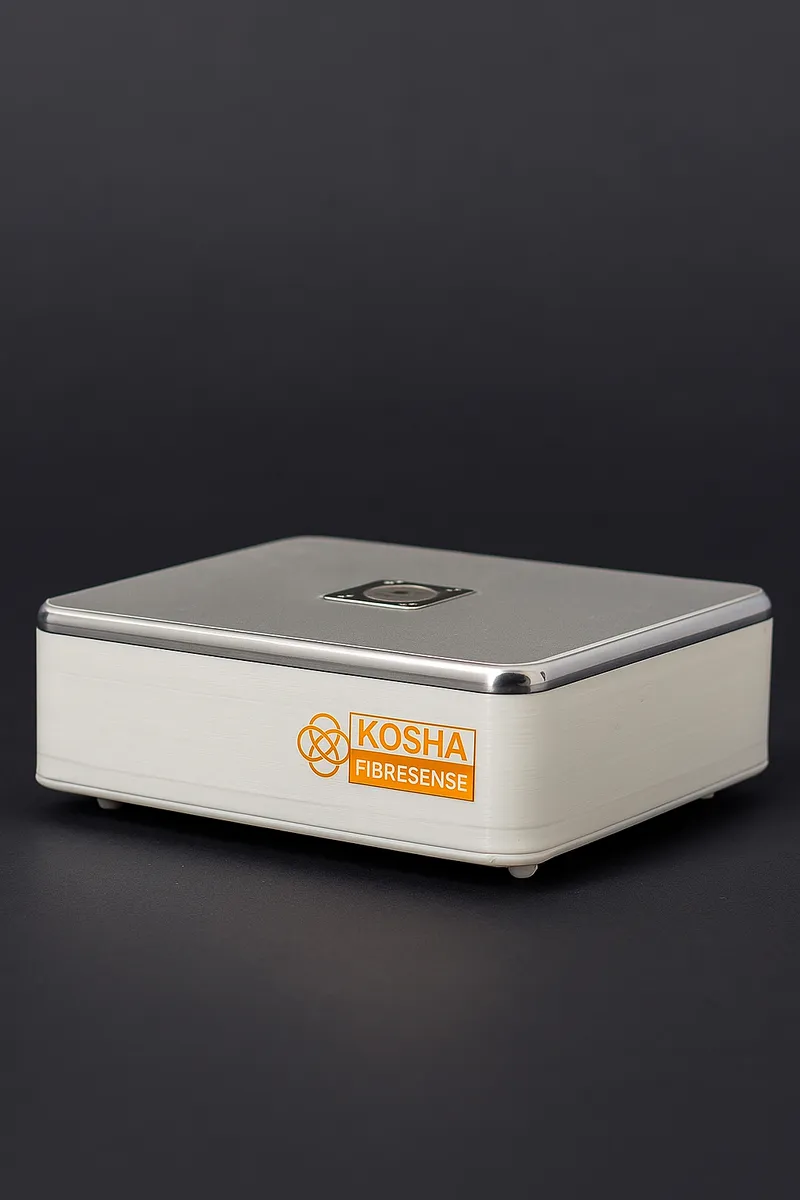
Kosha's Fibersense
The startup has diverted over 10,000 kg of textile waste from landfills, prevented more than 35,000 kg of CO₂-equivalent emissions, and verified over 5,000 ESG credentials across partners.
“Once you spend time across different parts of the supply chain, you realise everyone is making decisions with partial information. The scale is large, but the data behind those decisions, such as material composition, quality metrics, sourcing, and processing details, is surprisingly thin,” Vijaya Krishnappa, Co-founder and CEO, Kosha.ai, tells YourStory.
Early exposure to textile realities
Krishnappa’s background in textile engineering, global sourcing, and consulting, combined with an MBA from XLRI, exposed him to how differently fabrics were assessed across the supply chain. The same material could pass in a weaving unit but be questioned in a buyer’s office. “You see how two people, looking at the same fabric, can arrive at opposite conclusions. The inconsistency is built into the system,” he says.
His work in handloom regions like Banaras, Prakasam, Guntur, and Godda highlighted simple issues such as poor lighting often influenced quality decisions. “The skill was exceptional, but the conditions made precision difficult. When a weaver has to strain just to see the yarn, the system clearly needs redesigning,” he says. These experiences convinced him that technology for textiles must adapt to real working environments.
Krishnappa and Kodipady met during morning runs at Bengaluru’s GKVK campus. What began as casual conversations grew into discussions on building impactful ventures. Krishnappa’s expertise in textiles, authenticity, and brand-building combined with Kodipady’s technology background and social entrepreneurship experience led to the creation of KOSHA.ai.
In 2018, Krishnappa tried improving handloom market access by attaching QR codes that linked to artisan stories. Buyers appreciated the transparency, but it did not influence procurement. “People enjoyed the stories, but decisions still came down to price and material certainty. Transparency without measurement doesn’t change behaviour,” he says. This insight shaped Kosha.ai’s focus on tracking material origin, environmental impact, and supply-chain integrity.
The startup’s early prototypes were built in a village near Gadag in Karnataka, tested with local weavers, and refined in home workshops. “If a device can’t handle dust, humidity, or uneven fabric edges, it won’t last in production,” he notes.
A chance pitch at Deshpande Startups brought incubation support, and during the pandemic they developed a Rs 10,000 proof-of-concept at the Weavers’ Service Centre in Bengaluru. On mentor advice, the team validated demand first. A Tata Group buyer placed an order even before the product was finalised, confirming they were on the right track.
Krishnappa initially invested Rs 25 lakh and later added additional Rs 10 lakh. With support from IIMA Ventures, the total funding now stands at around Rs 2.5 crore.
From handloom authentication to waste sorting
Kosha.ai initially developed and patented a handloom authentication technology, but discussions with material aggregators, sorters, and recyclers revealed a bigger gap: reliably identifying fabric composition, a challenge that influenced both recycling costs and recovery decisions.
“We realised that the authentication problem, while important, affected a narrower segment. Composition detection touched every part of the textile chain, especially waste. If we could improve that measurement, the downstream impact would be far greater,” Krishnappa says.
This led to the development of FiberSense, its flagship device. The handheld 5x5 device uses near-infrared photonic scanning to detect material composition within seconds, detecting molecular signatures of fibers like cotton, viscose, wool, silk, and multiple synthetics. For blended materials, FiberSense estimates percentage composition in two to three seconds.
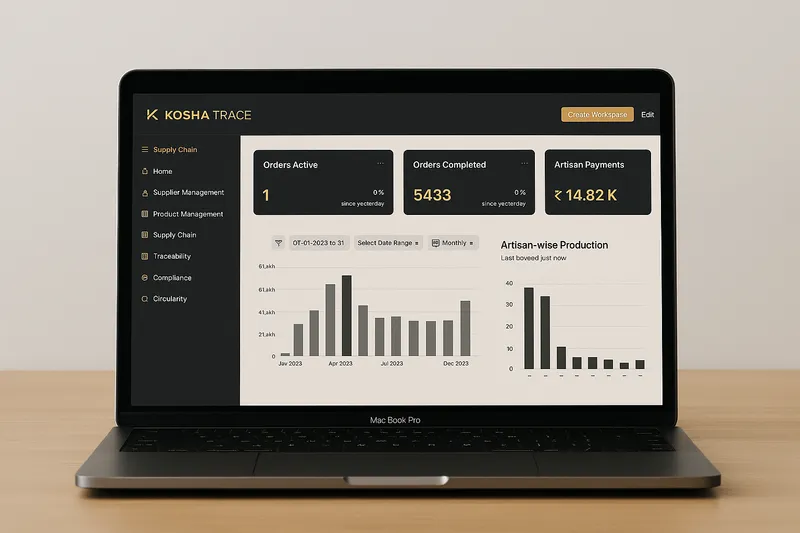
Kosha Trace
Each scan is automatically recorded in Kosha Trace, the startup’s software platform that builds batch-level and facility-level datasets.
“The device measures the specific point you scan. The accuracy depends not just on the sensor but on how consistently you sample across the fabric,” Krishnappa notes.
By converting scan data into records, Kosha Trace helps operators understand what materials move through their facility. These form the basis for chain-of-custody documentation and buyer-facing QR codes.
“Most operators want clarity on what they handled; most brands want clarity on what they purchased. Traceability simply ties these realities together using actual measurements,” Krishnappa explains.
To date, Kosha.ai’s systems have supported waste diversion, artisan-linked value chains, and ESG verification, and has empowered over 1,200 artisans and verified over 5,000 ESG credentials through its platform.
Commercial progress and financial structure
Kosha has sold about eight devices in the latest operational cycle, placed additional units on rental, and has around fifteen devices in advanced discussions. The device costs Rs 4.5 lakh, with a software subscription of Rs 5,000 per month. Rentals support smaller facilities that prefer low upfront cost.
The startup also runs pilots and MoUs with multiple institutions, including bodies under the Central Silk Board for validating accuracy across textile segments.

“Our aim is to deploy devices only where they genuinely improve routing decisions. A smaller footprint with real usage is better than broad distribution without adoption,” Krishnappa says.
The startup currently competes with players such as TextileGenesis and TrusTrace, but differentiates itself by using real-time material measurement rather than documentation-based tracking.
“We turn guesswork into certainty, we use IoT sensors and AI-based analysis to identify fibre composition and track every step from raw material to finished textile, creating proof-backed records that make circularity, authenticity and trust measurable,” says Krishnappa.
Market outlook and future roadmap
The Indian technical textiles market is projected to reach $28.7 billion by 2030, witnessing a CAGR of 6% between 2025 and 2030, according to Grand View Horizon.
Kosha’s ten-member team includes engineers, field technicians, and domain specialists. The startup hires from rural communities and waste-worker networks for roles involving device usage and field implementation.
“The person using the device on a sorting line is our true end-user. Their comfort and clarity matter more than any feature list,” explains Krishnappa.
Kosha follows a systems-integration model, optical components are sourced externally, while assembly, firmware, model development and backend engineering are handled in-house.
The team is developing a lower-cost FiberSense variant for decentralised units and a conveyor-based high-throughput system for recyclers processing 5–10 tonnes per day.
Early interest from Europe has already resulted in an initial device order and ongoing trials. Additional pilots and MoUs are underway with government and private organisations to expand coverage across textile categories.
“Every facility teaches us something new. Our approach is to strengthen the fundamentals, measurement, usability and consistency, before thinking about scale,” Krishnappa says.
Edited by Megha Reddy