



Wealth goes public: How India’s startup founders are beating old money
India’s startup founders are no longer mere disruptors; they’re the new power centres. With thousands of crores in enterprise value, significant job creation, and growing tax contributions by their companies, new-age entrepreneurs are overtaking legacy wealth and rewriting the rules of capitalism.



India’s wealth story is undergoing a quiet but decisive reset. For decades, wealth was inherited, protected, and quietly compounded within a cluster of influential business families. But not anymore.
The IDFC FIRST Private Banking & Hurun India’s Top 200 Self-made Entrepreneurs of the Millennia 2025 list makes one thing amply clear: India’s economic centre of gravity is no longer anchored only in inherited capital, legacy conglomerates, or slow-compounding businesses. It is increasingly being shaped by founders who have built fast, digital, consumer-facing, and scalable businesses in this millennium.
If this year’s record startup IPOs are anything to go by, wealth is now built in public, tested in markets, and constantly revalued. IPOs bring about governance discipline, profitability pressure, and transparency, all of which are now being rewarded by the markets.
The combined value of the Top 200 companies now stands at Rs 42 lakh crore, up 15% year-on-year. To put that in perspective, businesses founded in the last 25 years already command a quarter of the value of India’s most valuable family-owned enterprises, many of which took seven or more decades to build.
“This list showcases the extraordinary impact of self-made entrepreneurs on India's economy, with a total business value of $469 billion—equivalent to a quarter of the value of India’s 300 Most Valuable Family Businesses, despite being founded within the last 25 years compared to the latter's 73-year average age,” Anas Rahman Junaid, Founder and Chief Researcher, Hurun India, shared.
Signals indicate structural shift
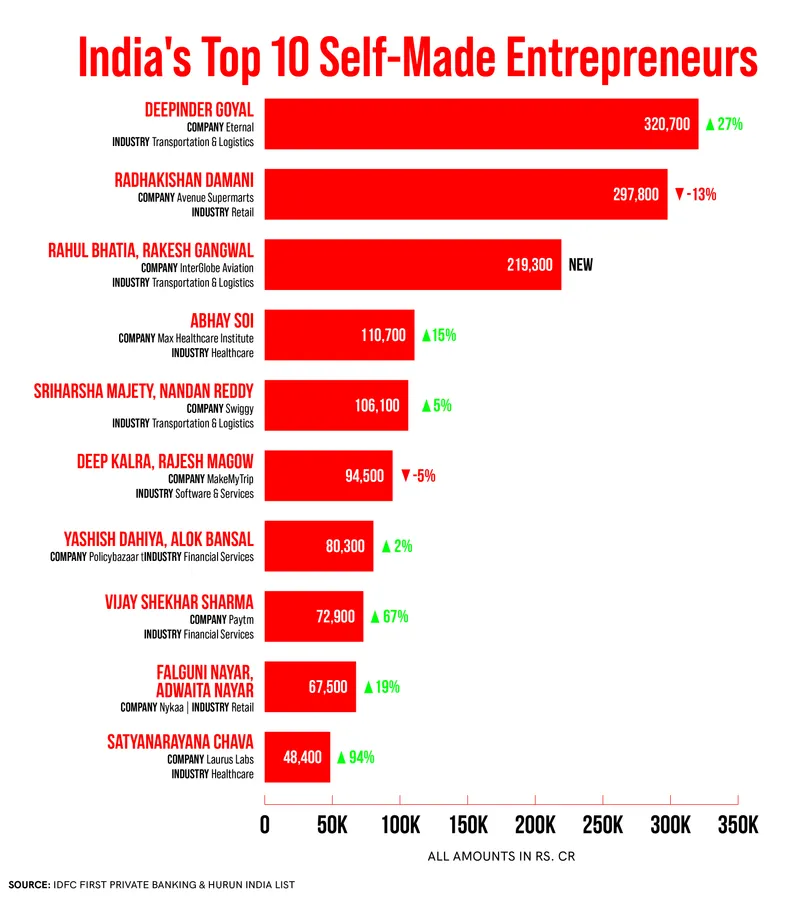
For the first time, Deepinder Goyal of Eternal (which owns Zomato and Blinkit) tops the list of India’s self-made entrepreneurs, going past retail veteran Radhakishan Damani of Avenue Supermarts (who incidentally picked up a stake in Eternal this year). Eternal’s valuation jumped 27% to a mammoth Rs 3.2 lakh crore this year.
Goyal’s ascent to the top and Damani’s slip to second place reflect India’s broader economic transition from asset-heavy, physical retail models to platform-driven consumer ecosystems that monetise logistics, user data, and subscriptions, and thrive on network effects. It also highlights how capital markets are increasingly rewarding scalability and tech-led consumption, even as traditional businesses remain profitable.
Not just Goyal, but consumer tech was back in the driver’s seat again. Vijay Shekhar Sharma of Paytm and Peyush Bansal of Lenskart entered the Top 10—both riding on more than a 60% jump in the valuation of their respective companies—even as the founders of Razorpay and Zerodha bowed out of the Top 10.
GFX by Nihar Apte
Swiggy’s Sriharsha Majety, MakeMyTrip’s Deep Kalra, PolicyBazaar’s Yashish Dahiya, and Nykaa’s Falguni Nayar were other notable names in the Top 10. Nayar, in fact, is one among 20 women founders in the country today who control Rs 3.3 lakh crore in enterprise value. This cohort signals a shift from women’s symbolic representation in wealth creation to their economic influence at scale.
Largely, the resurgence of consumer tech companies in India’s wealth map underscores the fact that investors are now backing brands with sticky users, omnichannel presence, and cross-sell potential. Lenskart’s rise, in particular, shows how digital-native brands are evolving into global retail platforms, blending manufacturing, distribution and data.
Meanwhile, fintech’s dominance has slightly plateaued; even though the sector remains large, consolidation has replaced high-speed expansion.
Jobs, taxes, and real impact
Critics of the internet economy have long argued that startups create paper wealth, with limited real-world value. The data shows otherwise.
The Top 200 companies in this year’s list employ nearly 8 lakh people, which is roughly the population of a small country. These enterprises collectively paid Rs 8,030 crore in direct taxes, nearly double last year’s figure (Rs 4,570 crore), to the exchequer.
“Five companies founded post-2020 are now collectively valued at Rs 78,000 crore. These entrepreneurs are driving growth and contributing to nation-building, with employee benefits increasing from Rs 54,000 crore to Rs 57,200 crore this year, reflecting their investment in people,” Junaid of Hurun India shared.
Hence, this is no longer a fringe ecosystem. Startups have already transitioned from private capital guzzlers to prudent fiscal contributors. These new-age companies are becoming systemically important in driving youth employment, fiscal revenues, and public consumption.
The ‘upstart’ entrepreneurs who once disrupted industries are now shaping large-scale public institutions. And in doing so, they are also redefining what power, wealth and influence look like as India embarks on its next economic chapter.
Edited by Swetha Kannan