



How Big Is the Adani Group? A Look at Its Companies and Strategy
From ports, power, and airports to green hydrogen and data centres, Adani Group’s expanding footprint makes it both a capex bellwether and a focus of market scrutiny.

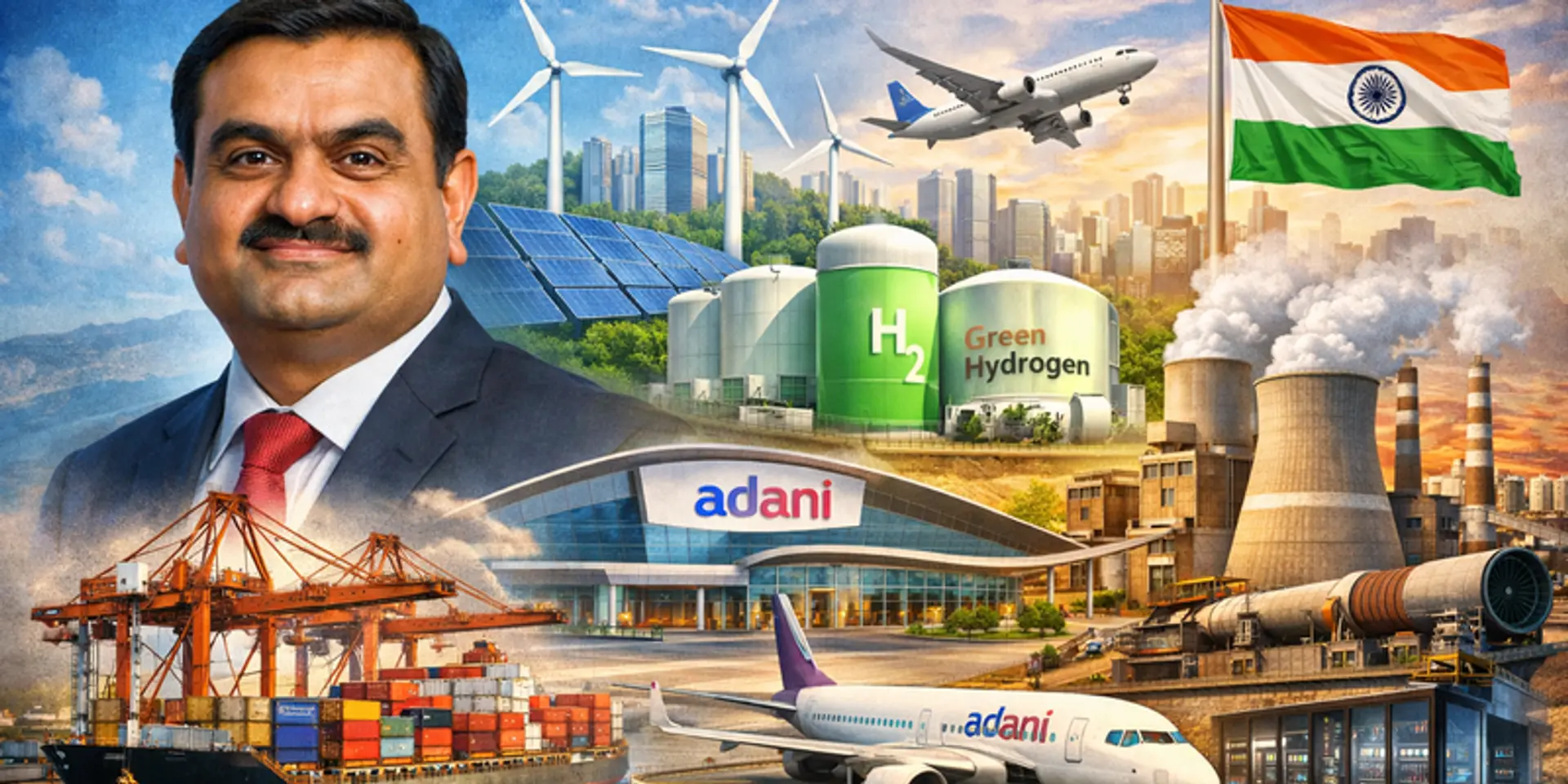

Adani Group is one of India’s biggest infrastructure-led conglomerates, with major bets across ports and logistics, power (thermal + renewables), transmission, city gas, airports, cement, and newer “incubating” businesses like data centres, green hydrogen, and defence manufacturing. Its scale makes it both a bellwether for India’s capex cycle and a lightning rod for scrutiny when markets, regulators, or courts move.
Brief history: from commodities to infrastructure scale
Adani’s modern rise is closely tied to India’s post-1991 liberalisation era and the build-out of trade and energy infrastructure. The group’s journey page maps key milestones, including the listing of Mundra Port and SEZ in 2007 (a landmark moment for the group’s ports platform) and the gradual expansion into energy, logistics, resources, and later consumer-facing and digital businesses.
By the mid-2010s and into the 2020s, Adani accelerated into sectors that sit at the centre of India’s national development priorities: renewable power, transmission, city gas distribution, airports, and cement manufacturing—while also incubating emerging platforms like green hydrogen and data centres.
Key people
Adani’s leadership page lists the senior leadership team and the operating heads across businesses. The group is chaired by Gautam Adani and includes business CEOs across ports, airports, defence & aerospace, and more.
A few high-visibility operating leaders and roles (examples from official profiles/pages):
- GCFO (Group CFO): Jugeshinder “Robbie” Singh (quoted in FY25 performance release).
- Airports CEO: Arun Bansal (AAHL).
- Adani Shipping / Adani Harbour Services leadership referenced via leadership listings.
Key business numbers
These are portfolio-level indicators Adani has publicly disclosed in its results/credit compendiums:
- FY25 leverage improvement: Net debt-to-EBITDA reduced to 2.6x in FY25 (vs 3.8x in FY19).
- Liquidity: Cash balance of ₹53,843 crore as of 31 March 2025 (stated as 18.5% of gross debt).
- Asset base milestone: portfolio asset base ₹5.53 lakh crore (as per H1 FY25/TTM release).
- Earnings scale (portfolio): Run-rate EBITDA ₹88,192 crore (annualised recently commissioned assets) referenced in the same release.
- Headcount: “over 48,000 people” (group-wide statement on leadership page).
Operational scale snapshots (official business pages):
- Airports: AAHL manages/develops 8 airports and is described as accounting for 25% of passenger footfalls and 33% of India’s air cargo traffic.
- Ports: “13 ports and terminals” and 580 MMTPA cargo handling capacity shown on the ports business page.
Adani Group companies
A) Listed companies commonly presented as Adani’s “listed portfolio”
Adani’s official site lists these as group companies, and they are widely tracked by Indian markets.
B) Other publicly listed/transaction-linked names often associated with the “Adani cement platform”
These have been part of the group’s cement consolidation story in recent filings/news, and may remain listed while merger schemes progress.
C) Major unlisted operating arms and platforms (core to the group, not always stock-listed)
These are significant operating companies/brands that Adani describes on its business pages and press releases: