




AI, authenticity, and the creator’s edge: Lessons from Varun Mayya
After 13 years of building, Varun Mayya explains how human voice, brand trust, and mental resilience—not clones—will define the next phase of the creator economy.

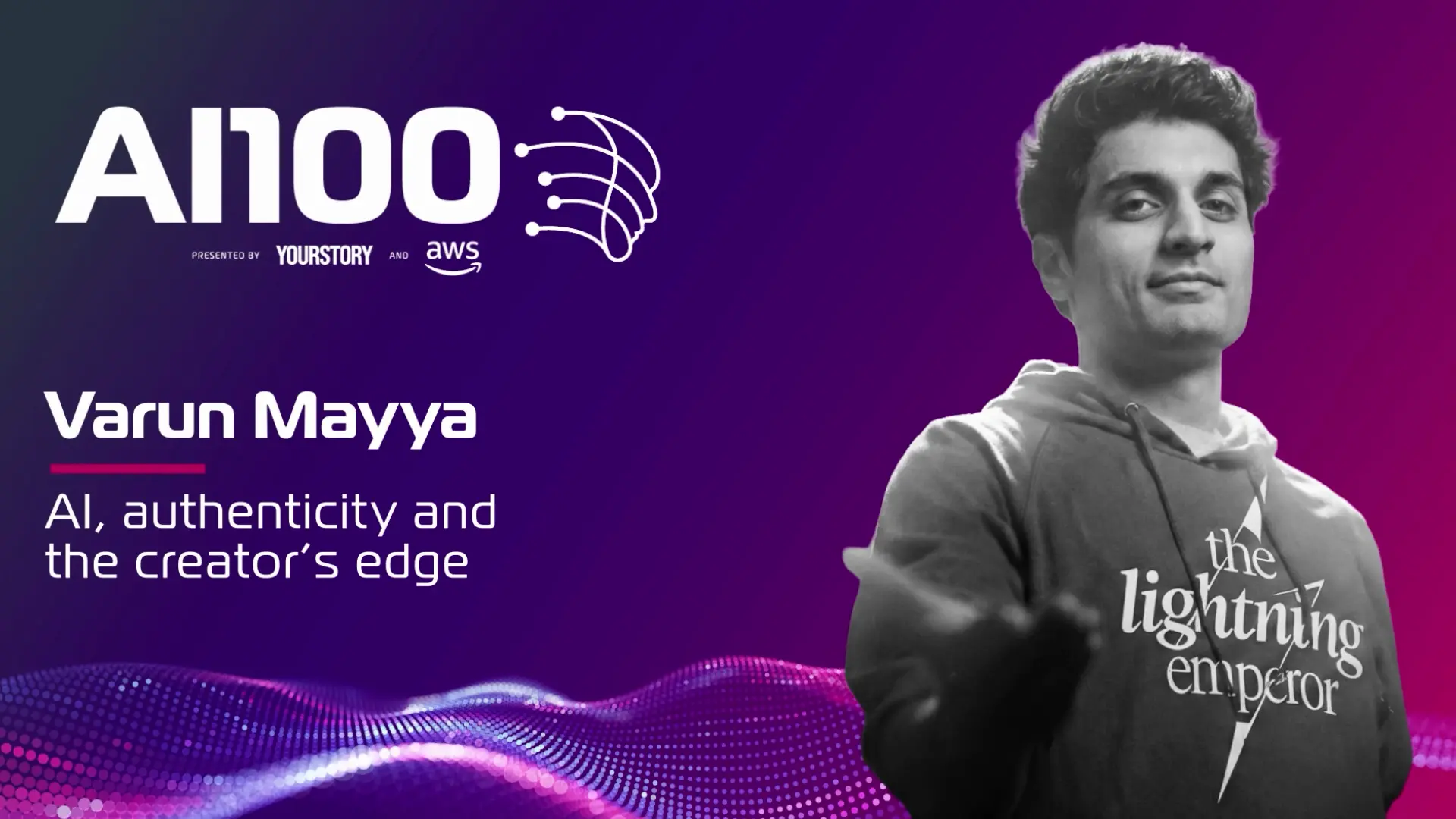

As a newly minted entrepreneur, Varun Mayya approached startups with a technology-first lens and honed that approach over the next decade. Now, with 13 years of experience, he’s shifted to a problem-statement focus. The right solution, he believes, could leverage technology, human effort, or clever business models to address the core issue. Mayya co-founded Aeos in 2022 with his wife Achina Mayya, a Bengaluru-based bootstrapped media-tech company. Aeos serves B2B clients like Redbull, Amazon Prime, and IPL teams. Its closed-loop model integrates content creation, distribution, talent scouting, and GenAI tools for scalable operations.
He began by targeting the problem of videos, with an aim to focus on video games later. His team pursued every avenue: business model innovations, manual hiring, or tech solutions. This flexibility allowed the problem to be attacked by multiple vectors, an approach that transformed everything.
In just the last month, Mayya’s bootstrapped company Aeos achieved over a billion views with a staff of 500 employees. “We have much higher margins than a traditional video services company - almost 3 to 4x. But the minute you start using technology, the minute you start using AI, you have better margins.”
Inside Mayya’s mind: the entrepreneur
Every time Mayya heads to work, he’s an entrepreneur first, anticipating challenges, appraisals and the rush of being a leader. Having rubbed shoulders with the best - be it Mark Zuckerberg, Sundar Pichai, or Satya Nadella - he’s learned that every greater leader weathers cycles of doubts from the people around them. It’s practically a rite of passage, but Mayya says leaders shouldn’t allow these periods to shake their confidence. Instead, they need to view them as a challenge and re-earn people’s trust, brick by brick.
That's why he no longer chases external validation. Bootstrapping means no funding pitches, no need to explain himself. For young founders in their early 20s, the trap is obvious: obsessing over raised capital, fame, or public buy-in. Mayya's 30s gifted him the wisdom his 20s lacked: he's now fully internally motivated, unshakable.
When kickstarting his business, Mayya took it upon himself to map out his capabilities. With brutal honesty, he detailed his strengths and weaknesses, opportunities and threats on a whiteboard. “I think everyone should do it: find a room, lock it and be very brutal about yourself. I always say this, there's no critic, no person who has done a more brutal takedown of me than I have of myself during that white board session,” he says.
A day in the life
Varun Mayya begins every day with a daily WhatsApp message to his team—a news snippet paired with his take, often as a quick voice note. Writers then craft it into a script, mimicking his natural speaking style.
Next, the script feeds into ElevenLabs, a text-to-audio tool fine-tuned on years of Mayya's YouTube clips and custom recordings. As part of the process, he once asked ChatGPT to list words a YouTuber might use, then recorded them all. Weekly, his team flags mispronounced words— for instance, "devotee" early on—and he re-records just those, fine-tuning and adding to the repository of recorded words. A year of tweaks has resulted in what Mayya terms “one of the world's best audio models”, covering nearly every term flawlessly.
The audio then goes to HeyGen or their custom workflow: a fine-tuned LoRA on Wan 2.2 AI, trained on Mayya's footage of him looking up, down, or chatting. It syncs lips to audio perfectly. Four editors per pod (in his 17-person team) divide a one-minute video into chunks, polish them, and stitch them together.
The team renders the footage on an internal NAS "cloud" server. The whole pipeline—from voice note to final video—clocks in under 10 minutes. This speed lets them tackle world news, announcements, and more, posting fresh content rapidly.
Betting big with AI
Mayya spotted AI's potential for content workflows the moment ChatGPT and DALL-E 2 emerged—despite early ridicule. He dove in with Wav2Lip, an old-school 2D avatar tool, replacing himself on Instagram. Friends warned of brand risk and potentially alienating his audience. But Mayya, in (as he terms it) his hard-headed mode, pushed ahead to prove it possible.
Over time, avatars improved rapidly, becoming seamless. Even with full disclosure about AI use, views held strong—audiences craved content, not perfection. Time savings were massive. The team has since built in-house inpainting tools and more - everything to ship videos faster and in greater volume, while maintaining quality.
Last month, across channels and client services, Aeos hit 2,000 videos, a feat impossible without AI. “It’s the amalgamation of technology and people. We needed AI, and so we took some early bets, but it paid off,” Mayya says.
AI in the creator industry
Varun Mayya believes AI won't disrupt the creator industry much, even as it enters creative spaces and cuts labor. "Anyone can mimic the top 10 Indian creators' content with AI," he says, but audiences remain loyal to the original.
He offers the example of music, stating that AI tools can craft a perfect Justin Bieber track, yet fans wait for Bieber himself. They connect with the artist, not the clone. AI might polish Bieber's work—no one cares, as long as the final output shines. In Mayya’s opinion, the creator economy thrives the same way.
He believes that building a brand is tough but worth it. Once earned, fans crave the creator's voice. They may overlook the presence of AI in the process. Clones on the other hand will flop— as viewers can easily spot fakes. Ironically, the more AI floods feeds, the more people crave human touch.
Today, Mayya’s team has pivoted to vlogs, offering real-life glimpses, camera crews, and raw energy. "If everyone's on tit (AI), go tat (human)," he shares. "Then flip back." Vlogs demand more talent and effort, but that, according to Mayya, is the edge. “The creative process is strange. You can't codify it. You can't pinpoint what the formula is, because by the time everybody knows the formula, something new will take its place.”
His rule, when it comes to ethics, is straightforward: deepfaking yourself is fine—you own your likeness and can do as you please with avatars. Trouble brews when using others' identities, especially unknowns, as it risks lawsuits at scale. His team learned this firsthand and dialed back accordingly. Negative deepfakes are a clear no-go. People intuitively know that line, even amid social media's gray areas.
Scaling the mind
Mayya marvels that at 100 million+ monthly views, nothing truly breaks—neither compute and data, nor platform policies. Previously, if he hit 1.5 million users it was a big deal then; now, his channel alone draws 100 million views, with all channels reaching a billion. The team has learned to cope, shrugging off 100,000 daily comments as normal.
Tech holds steady, Mayya believes, but the human brain? That's what cracks. Handling millions of voices—praise, criticism, advice—feels like Superman overload. At Aeos, the team has built mental frameworks from Mayya's slow growth (plateaued at 100k for six years). New creators get tools to cope, to stay empathetic, even amid abuse, without losing focus.
For Mayya, platforms like YouTube will continue to scale; it's the mind that needs resilience. “What will break is your internal firmware, internal software. I think you need a strong mind to be able to handle all of it. And that comes over time, and it comes with training. It's very hard to rage bait or troll us at Aeos”, he says.
The next step in AI-driven media
Talent, especially skilled writers, is the biggest hurdle in building AI-driven media in India, according to Mayya. While his editor and creator schools can help build the next wave of professional editors and creators in India, good writers remain elusive. Writing resists easy teaching; tools like ChatGPT generate generic contents, but social media rewards the unique. Authentic writers deliver unparalleled, research-driven content that's rare at mass scale. Good creatives blending tech savvy with originality? Even scarcer.
For founders launching an AI avatar channel, Mayya's advice is practical:
First three hires: Video editors who double as channel managers.
First three tools: HeyGen, ElevenLabs, and Google Docs.
First three experiments: Simplify content—drop 20 IQ points to appeal broadly. Top creators like Tanmay Bhat had simplified their content early to hit 100k followers. "Alienating 90% of India helps no one," Mayya says.
Creators need to scale first, then unleash depth.
Ultimately, Mayya’s journey underscores a defining truth of the AI era: scale is no longer defined by technology, but by clarity of thought and strength of mind. By staying problem-first, blending AI with human creativity, and building inner resilience, he offers a blueprint for founders looking to grow fast without losing authenticity.