



Inside the small factory in Basti powering its paper dona economy
Virendra Kumar Mishra’s dona raw material unit in Basti addresses a cost problem many small manufacturers quietly face, access to processing equipment.

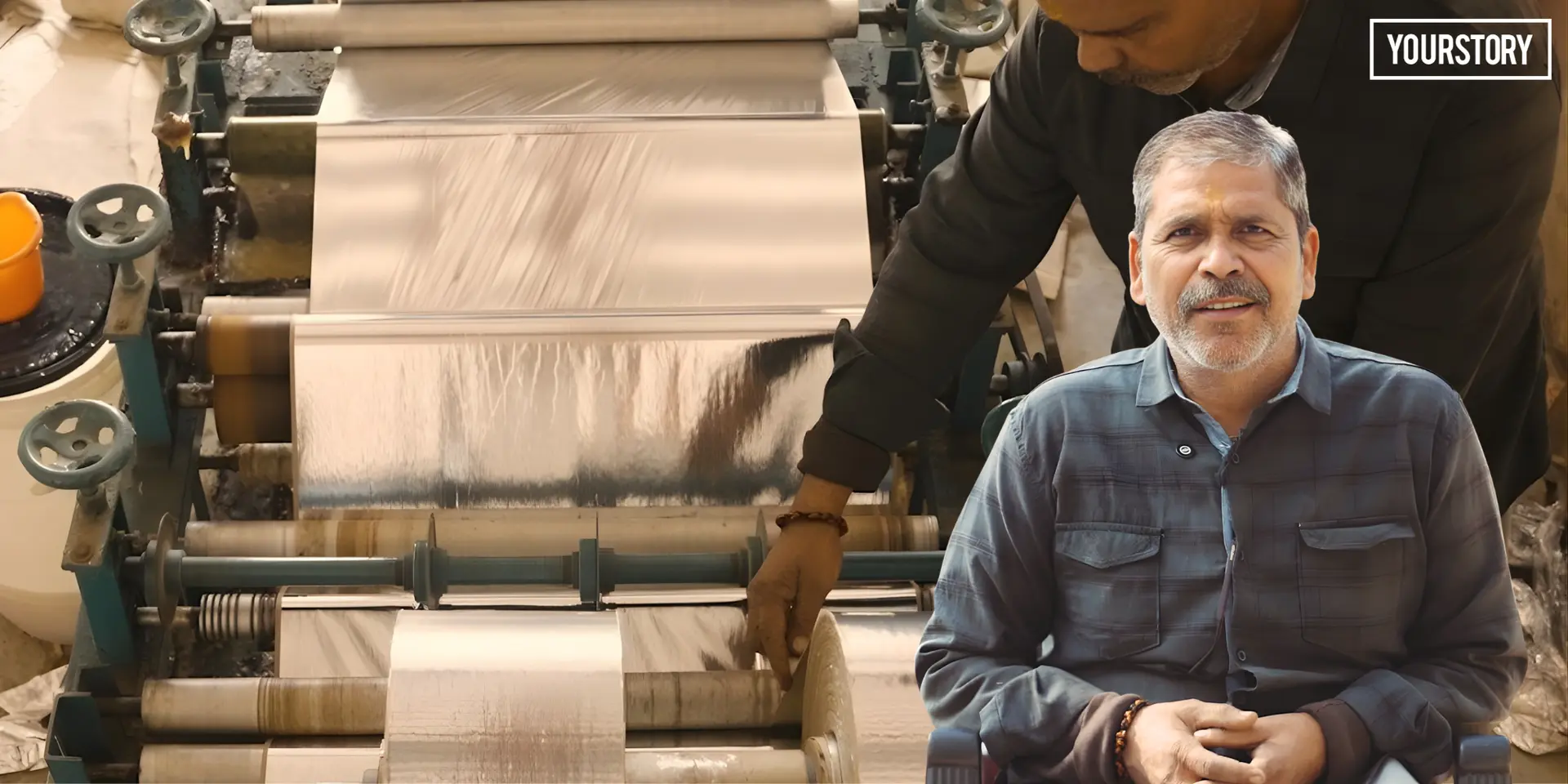

In Basti district, Virendra Kumar Mishra runs a small manufacturing unit linked to a product most people barely notice: disposable paper dona and pattal.
These sit quietly behind weddings, street food stalls, hotels, and local events. But for Mishra, his business has always been about filling a gap: one not in demand, but in equipment.
Mishra belongs to Baronia village and Atalnagar Basti. For years, he worked across several mechanical and manual trades — electrical wiring, welding, masonry, small marketing jobs, including milk distribution, etc. Each phase taught him how local markets function and where costs rise unexpectedly.
It was in 2019 that he first thought about the dona raw material business. The early experience was positive, though limited. After the lockdown, he returned to the idea with more focus.
At the time, most dona makers in the area depended on raw materials 50 kilometres away. Transport delays and small purchase volumes kept costs high. This is what Mishra set out to solve.
The business he runs today supplies paper-based raw material used to make dona products. The paper alternative costs more than thermocol, which still dominates many markets. But Mishra saw demand shifting slowly, driven by changing rules and awareness around cleanliness and waste.
Still, one issue remained constant: equipment. Without the ability to process raw material in bulk, pricing stayed tight, and growth stayed slow.
“If you don’t buy in bulk, your cost never comes down,” he explains. The problem was not knowledge; it was cash tied to machines.
A factory that changed pace
Mishra built his workspace with his own savings. Electricity connections were arranged privately. He started with a second-hand dona machine. As orders grew, the pressure on raw material supply increased. That was when he decided to expand processing locally instead of depending on outside suppliers.
He learned about Chief Minister Udyami Vikas Abhiyan (CM YUVA) Yojana during an industry event held in Basti in December. After applying through the district industries office and his bank, the loan was approved within weeks. The funds helped him invest in machinery and power backup, and secure working capital support.
The impact was immediate. Raw material could now be processed in-house, bulk buying became possible, and costs stabilised. Other small dona machine owners began sourcing material locally instead of travelling long distances.
Work, family, continuity
Today, Mishra’s unit supports employment beyond his household. He involves his family in daily operations, and his children are studying technical trades linked to manufacturing. His routine is simple — orders in the morning, production during the day, and deliveries by evening.
“There will always be challenges in business,” he says. “But if you stay in the line long enough, growth follows.”
For Mishra, machines were never just tools. They were the missing link between effort and sustainability.
What is CM YUVA Scheme?
Under the leadership of Hon’ble Chief Minister of Uttar Pradesh, Yogi Adityanath Ji, the state government aims to transform youth from job seekers into job creators.
To achieve this vision, the Directorate of Industries and Enterprise Promotion, under the Department of Micro, Small & Medium Enterprises and Export Promotion, is implementing the ‘Mukhyamantri Yuva Udyami Vikas Abhiyan’ (CM YUVA) Yojana.
Under this scheme, young entrepreneurs are provided with up to Rs 5 lakh in 100% interest-free and collateral-free loans to start their industrial or service-based ventures. In addition, beneficiaries also receive a 10% margin money subsidy on the project cost.
CM YUVA is not just a financial assistance scheme; it also provides mentorship, guidance, market access, and essential resources to help youth become self-reliant entrepreneurs and generate employment opportunities for others.
Click here to know more about the CM YUVA Scheme.