



California Burrito’s Mueller on growth, being an ‘American Marwadi’, and overcharging by food delivery platforms
The founder of India’s largest Mexican food chain on why he refused to Indianise his menu, how 400 farmers found him on Instagram, and why more competition in food delivery is welcome.

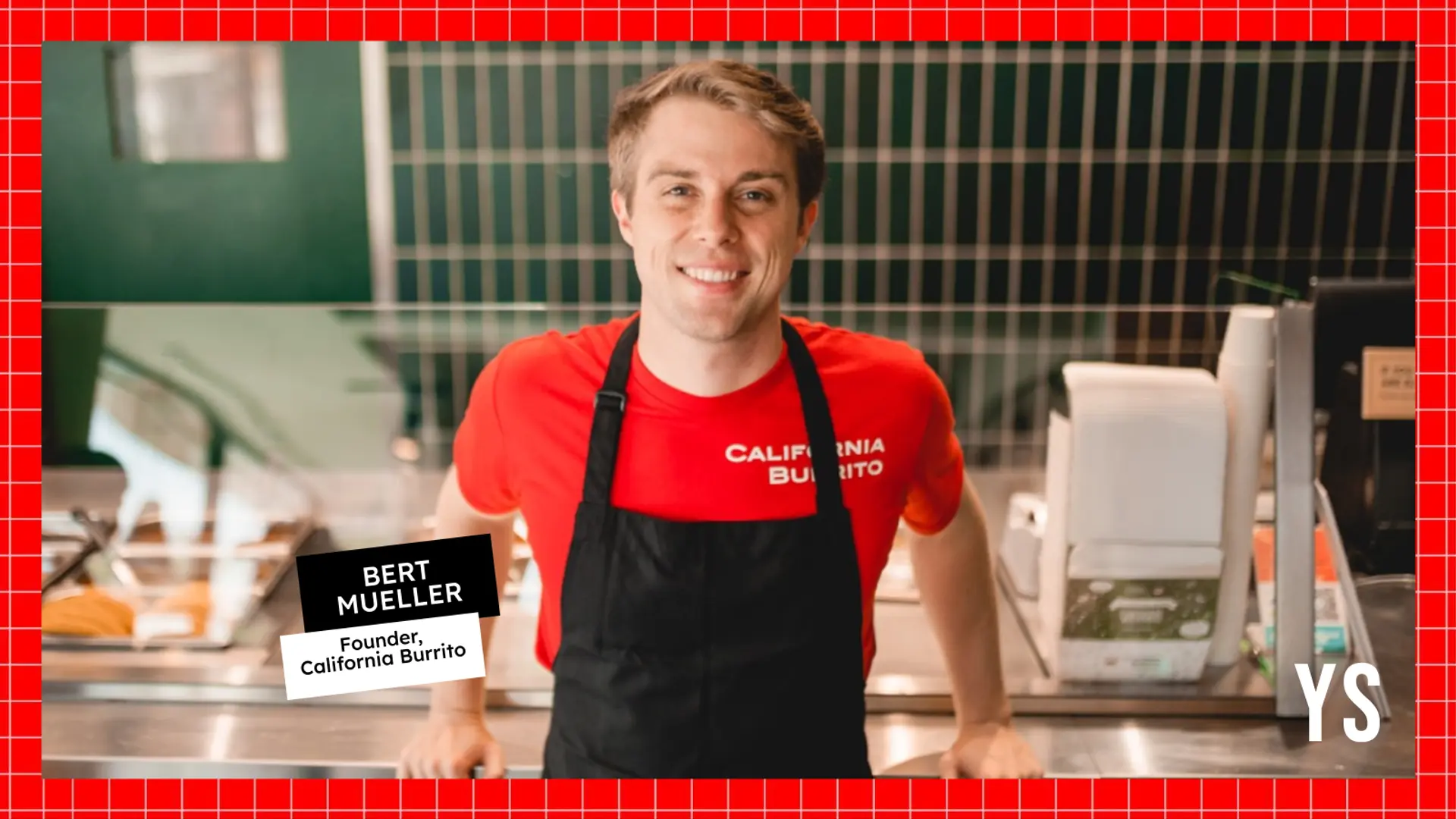

It was raining in Chennai the afternoon I met Bert Mueller, and the rain had done something unusual to the city. The humidity had lifted, the air had cooled, and for a few hours, Chennai felt less like itself and more like Bengaluru. That seemed appropriate. The man sitting across from me in the Kissflow conference room had built his entire empire in that other city, and here he was in a red California Burrito t-shirt —the kind his store managers wear—with the unhurried manner of someone who stopped trying to impress people a long time ago.
There is a particular ease that comes to founders who have made it past the survival stage, who no longer need to perform confidence because they have earned it, and Mueller has that ease now.
He is about 35 years old and has lived in India for 13 of those years, which means he has spent more of his adult life here than he ever did in the United States. He arrived at 22 with $250,000 pooled from friends and family, a music degree from the College of William & Mary, and an idea that had lodged itself in his head during a study abroad trip in Jaipur: Indians, he was convinced, would love burritos if someone made them properly.
The conventional wisdom at the time said otherwise: you had to Indianise everything, add paneer, tweak the spice levels, maybe throw in some tikka masala. Mueller ignored it, and 13 years and over a few hundred stores later, the conventional wisdom looks rather foolish.
The story of California Burrito is familiar enough by now that it does not need retelling in full. The first store opposite Goldman Sachs at Embassy Golf Links. The avocado trees that took five years to fruit. The elephants that trampled some of them. The tomatillos grown in Karnataka. The decision to stay bootstrapped when every venture capitalist in Bengaluru was throwing money at anything that called itself foodtech.
What is less familiar, and what I wanted to understand that rainy afternoon, is the texture of how Mueller thinks. A CEO of a popular food company once called Mueller an ‘American Marwadi’, a description that delighted Mueller, and he does not dispute. Kumar Vembu, the Co-founder of Zoho who later started GoFrugal Technologies, offered a variation: “Bert, the reason we like you is because you’re basically a middle-class Indian person.” These are not insults. They are, in the vocabulary of Indian business, high compliments.
We talked for a little more than half an hour, and what struck me most was how Mueller speaks about the food delivery platforms. Sixty percent of his business flows through Swiggy and Zomato, and he is not entirely comfortable with that dependence. The aggregators take up to 25% of revenue, and Mueller thinks it’s high. But he is also a realist. The aggregators are not going away. The question is whether they can be made to compete.
Edited excerpts:
YourStory [YS]: When you started California Burrito in India, what were the biggest assumptions you got wrong about Indian consumers?
Bert Mueller [BM]: The only assumption I think we made was that we needed to Indianise the product. That was a wrong assumption; it’s not required. You should stay true to the original, really.
YS: A lot of other brands that came before you changed their products for the Indian market.
BM: They have. But, you know, people have very mixed views on those. If you talk to the CEO of one company, he’ll say that there’s one big example, of course, which is the McDonald’s example. But there’d be other people who said that was very strategically wrong. McAloo Tikki is, of course, the famous example of that. In common circles, it’s considered a big success. Others say that going and doing that so early in the game actually sets them back by a while. Our view has been that we don’t have much of a view on what other people have done, but from our perspective, we’re here to deliver a California burrito, like what you get in California.
YS: What was the evidence that led you to believe you didn’t have to Indianise?
BM: It was just a personal gut feeling. I go to Mexico, I have the food, I like the food better than when I eat at my own restaurants. If I like that better than what I have, then I should try and make it more like that than what I am doing now.
YS: You’ve been called an American who built an Indian empire. Do you feel like an American entrepreneur in India or an Indian entrepreneur who happens to be American?
BM: One of our investors calls me an ‘American Marwadi’. He was the CEO of Domino's Pizza. I'm obviously from the US, and my family’s originally from Germany or something. I don’t know. I think there’s high overlap with a lot of traits that people have here. Certainly frugality. People try to make people feel good here. I don’t like to say no to people. I’m aggressive about my work, but I try not to be too aggressive in the way I speak with people. Family values. Kumar Vembu had made a comment to me. He said, ‘Bert, the reason we like you is because you’re basically a middle-class Indian person.’ Living within your means. I’m not much into branding and all.
YS: Those are values you came with. Are there any values you picked up here?
BM: If I started with 20% overlap, maybe now it’s much higher. Being creative about solving problems, not being overly indexed on the way people think things have been done before. India has a concept of jugaad, which is often used in a negative, sometimes in a positive way. But I think it’s fundamentally about being creative and bringing creativity to problem-solving, especially when you have constrained resources or a constrained environment. I respect that. I come in with a high level of respect for these things.
YS: Does jugaad work in the era of deeptech?
BM: Maybe the word jugaad comes with a lot of baggage. The essence is being creative in solving a problem. Now, is the problem I’m solving for a greedy cause or is it for a noble cause? Then we can get into the specifics, and that’ll lead to whether it’s a positive or a negative. But the creativity is there. And there are so many people here who run their own businesses. I have a high respect for that.
YS: You went as far as growing your own avocados and other vegetables. Most other founders would have compromised or adjusted the menu. What made you integrate backwards?
BM: I hate to do things badly. I want to do things really well. At that point in my mind, I committed that I'm going to do this for a long time. Farming is always a very long-term affair. Avocado trees take five years to fruit. Once I was mentally committed to that, it was just the logical step. If you want to do this well, you have to have great ingredients. Ingredients are the essence of the food. If you can’t get them, you have to grow them. If you import them, no one can afford them.
YS: You were convinced about it. But how difficult was it to convince the farmers? You weren't a really big brand then…
BM: We’d work with one larger partner, and then gradually you get proof of concept, and then you can use that to sell to slightly bigger people. When people see that people are making money on something, gradually everyone shares the information, and it works out. We had a reel go viral about tomatillo growing. I had 400 farmers contact me on Instagram. I gave the contacts to the team, and we're now growing with 10 or 15 of those guys.
YS: We are not used to the concept of farmers on Instagram…
BM: Oh, they're on Instagram. I thought it was incredible how well the algorithm was working. Facebook somehow knew exactly which farmers to show the reel to. Now, 400 farmers are contacting me. Maybe farmers are looking for interesting new things to grow. They're very entrepreneurial, especially North Indian farmers around Punjab.
YS: You have a store-level EBITDA margin of around 15%. What trade-offs are you making that other QSR companies that are burning cash to grow aggressively are not? What kind of growth are you sacrificing to preserve these margins?
BM: I don’t know. I guess we could open lots of stores. The thinking is that every place you open, you learn something new. You always want to generate store managers from your existing employee base. It’s much better. If we were to go into hypergrowth on units, then you also don’t work on existing units. Maybe half of the brain should go into opening new ones, but half the brain should go into what you can do on existing ones to make them go up. Rather than only focusing on unit growth, you should diversify your work. Maybe someone like KFC feels that they’ve already reached saturation on that, but I would question that. I feel there can be improvement. They’re obviously big guys that do a good job, but we see it that way, where you should keep working on all aspects, not only go crazy on one.
YS: What about food delivery platforms? They take up to 25% of your revenue, and about 60% of your business comes from online food delivery. How do you handle that?
BM: We try to ensure our marketing drives people into dine-in because we prefer that. First off, the food tastes better in the store. It’s fresh. You can see it, it looks great. It’s a good environment. We invest money in the store, so we want people to come. But there are people who want to only have it delivered. Our view is that it should be fast and as good as possible. Aggregators, at the end of the day, do give us a lot of information, so that’s valuable for other aspects of the business.
YS: Is there a solution for the huge amount that delivery partners are taking? Or do you think it’s reasonable?
BM: I think it’s probably a bit high. It’s not that they’re so efficient with their work. People like Rapido coming in will make them reevaluate their cost structures. Maybe the corporate team at some of these companies is very large. Rapido is notoriously lean on the corporate overhead side, in the same way they did with the cab business. They’ve found ways to optimise cost structure. Any competition will hopefully make the other people better. It can’t really be a race to the bottom because everyone’s expectations also keep going higher.
YS: Did you never think of having your own fleet, like Domino’s?
BM: We’ve tried that. Remember, Domino's Pizza’s slogan for many years was ‘the pizza delivery experts’. They were almost more of a logistics company than a food company. They had to kind of tell people, ‘Actually, we fixed our food. We always had great logistics, but our food wasn’t that great’. In fact, their (former) CEO Ajay was a logistics CEO before he was Domino’s CEO. That’s just a different company DNA. Their strength is logistics, and our strength is fresh food at a store. We’ve tried it, but it’s really a different DNA as an organisation to do that well. In this world, you have to do it really, really well. We don’t see any benefit to trying to do it ourselves. This is not what we’re experts in. We're experts in good, fresh food.
YS: Early on, you had to build demand and supply at the same time. Which was tougher to build?
BM: Supply for sure. Demand is often dictated by the real estate you’re in, by the competition. At the beginning, there wasn’t anyone really in the category. But going to Mexico, the US and having the food, my benchmark is at a very high level, and I want that. I don’t want to give something that I’m not proud of. Given that no one had done it before, we had to work on several aspects of the supply chain.
YS: You’ve crossed 100 stores and Rs 200 crore in revenue. What’s the biggest thing you got wrong in the first five years? And what would you advise other young startup founders?
BM: The biggest thing we got wrong in the first five years was opening too many stores too quickly. In our second year, we probably opened five stores too fast. Should have learned the lessons of the first few stores slowly and then gradually gone faster. Also, we didn’t invest anything in marketing, which was not a great idea. Turns out marketing works. At the same time, maybe your product wasn’t in a place where it deserved to be marketed. It was good, but not top, top class.
YS: Five years from now, what would success look like for you? Is it opening more stores or more formats?
BM: If I look at the restaurant landscape, who does the most revenue? Probably Haldiram’s. Highest sales per store. I feel that if you can get up to that level… but that to me is a place where you have a great restaurant because you’ve competed with Indian food and done a good job. The core of Mexican food is fresh vegetables and rice with a sauce flavour. These are everyday foods that theoretically can reach that level. That would be exceptional. The unit counts; anyone can open 300 restaurants, 500 restaurants.
YS: How do you pick and choose a town or city? Would you go to Tier II and III towns?
BM: Eventually, for sure. But at the beginning, I think it's much better to just saturate a city fully and then move on to the next.