




Harsh Vardhan: Steering Innovation at Apollo Tyres
From human-centric automation to smart manufacturing, Harsh Vardhan is guiding Apollo Tyres to an intelligent, AI-powered future.

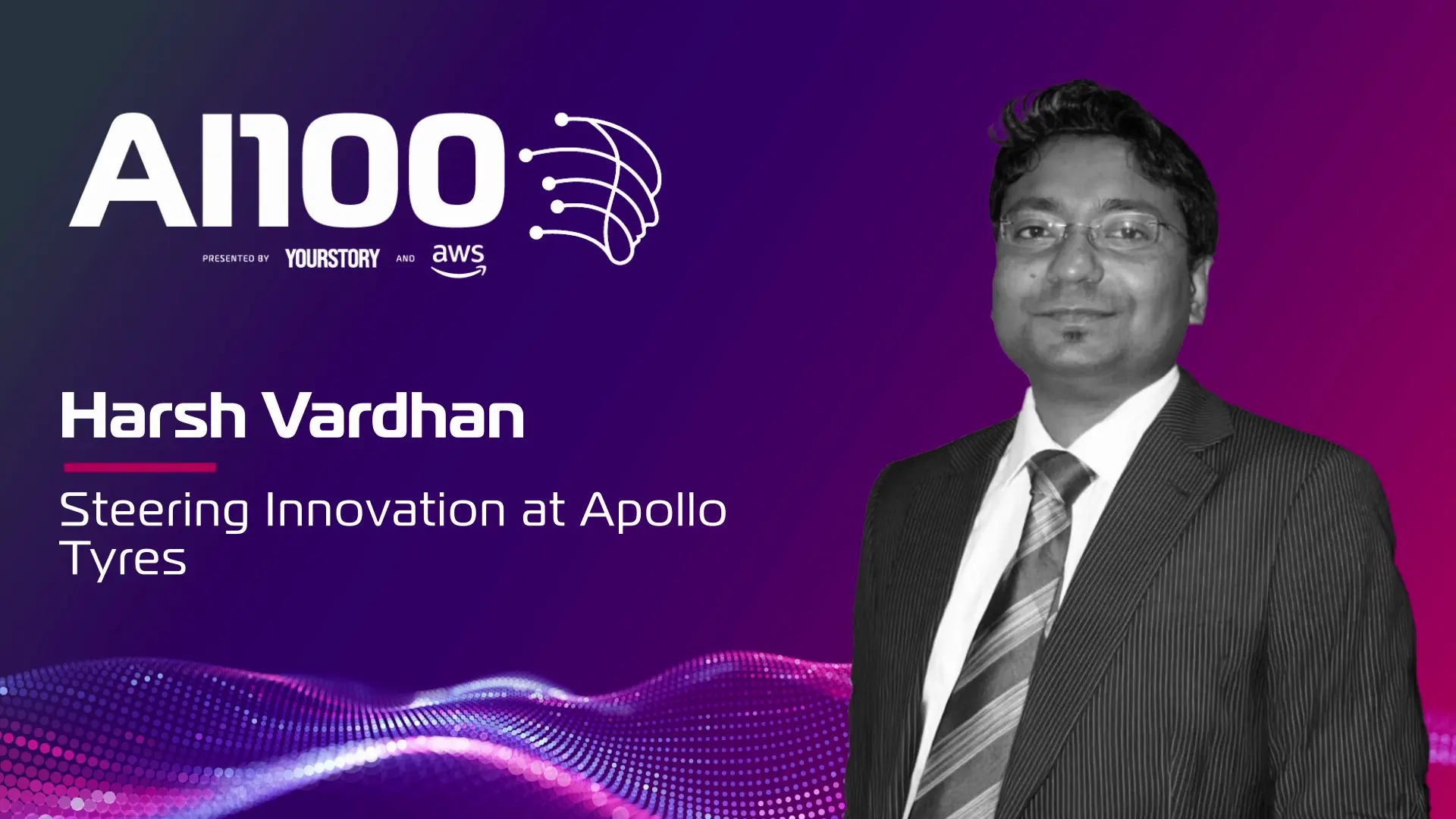

Harsh Vardhan, Global Head of Digital Innovation, AI, Industry 4.0, and Innovation Culture at Apollo Tyres, first encountered artificial intelligence during his engineering studies at NIT. Back then, it was little more than an academic concept confined to textbooks. His interests at the time lay in coding and large mainframe systems rather than in machines that could mimic human thought.
After graduation, he began his career in IT within the banking and financial services sector. Expecting to work on transactional systems using COBOL and JCL, he instead joined Compute Credit, a fintech credit card provider, where he was introduced to data warehousing, mining, and business intelligence. Analysing vast datasets to identify patterns and behaviours, he helped to build solutions for subprime and non-prime customers. Early analytics and machine learning techniques were applied to drive financial inclusion — a practical, real-world use of AI that would shape his professional outlook.
What began as a detour from his plan became the foundation of his career in analytics. He saw firsthand how data-driven insights and pattern recognition could reshape decision-making and customer experience. AI had moved from theory to impact — and he was hooked.
Today, with over two decades of experience, Vardhan leads Apollo Tyres’ digital transformation journey, harnessing AI-driven smart manufacturing and Industry 5.0 technologies to create more intelligent, adaptive systems.
Beyond Apollo, he mentors the Telangana government and T-Hub on advanced manufacturing initiatives, offering cross-sector expertise. An active open-source contributor through his community Deep HiveMind and GitHub projects, he has earned recognition such as the Arctic Code Vault badge. Blending leadership, mentorship, and hands-on innovation, Vardhan continues to shape the evolving intersection of AI and manufacturing.
AI across the Apollo Tires value chain
As a Global Head of Digital Innovation at Apollo Tyres, Harsh Vardhan’s mission is clear: to transform the company into a global frontrunner in AI-driven intelligent manufacturing. To understand the scale of that ambition, one must first grasp the vastness of Apollo’s operations.
Home to two powerful brands, Apollo and the Dutch premium brand Vredestein, the company runs seven manufacturing plants (five in India and two in Europe), producing more than 2,000 SKUs across over 20 tyre segments. Its portfolio spans passenger and commercial vehicles, electric mobility, agricultural, mining, and micro-mobility tyres. With a presence in more than 200 countries and a network of 14,000 distributors, Apollo’s operations are supported by three global supply chain hubs across India, Europe, and the US, including over 170 warehouses in India alone. The manufacturing ecosystem is equally intricate, relying on more than 200 raw materials, from polymers and steel to oils and chemicals, that all must function within a highly synchronized supply chain.
Within this complex system, Vardhan’s focus is on using AI and digital technologies to simplify processes, enhance efficiency, and deliver measurable business outcomes across the entire value chain, from R&D and manufacturing to logistics and customer operations.
“In a nutshell, my job is to transform Apollo Tyres into a global frontrunner in AI-driven enterprises,” he explains. “That means recognising complex business and process transformation opportunities, then making them happen through AI and other digital technologies, always aligned with business goals.”
His strategy rests on three pillars. The first is fostering an AI-first innovation culture, encouraging teams to adopt a data-driven mindset and experiment with new technologies. The second is industrialising AI under the vision of “AI at speed, at scale, at ROI”, ensuring that promising pilots evolve into enterprise-wide capabilities. The third is reimagining AI by integrating modern digital techniques with time-tested operational excellence models, blending design thinking and agile processes with Lean, Six Sigma, Total Quality Management (TQM), and Total Productive Maintenance (TPM).
Innovation has long been part of Apollo’s DNA, woven into its business, processes, and culture. Vardhan’s challenge has been to infuse this legacy of innovation with an AI-driven mindset. Early AI pilots and prototypes showed strong potential, but scaling them across such a vast organisation required a strategic shift.
The paradigm shift: From industry 4.0 to 5.0
Industry 4.0 ushered in a new era of automation, integrating operational and IT data through industrial IoT to achieve mass production with unprecedented efficiency and quality. But Industry 5.0 marks a paradigm shift. It places humans back at the center of the system, using AI not merely to automate but to amplify human capability, fostering true collaboration between people and intelligent machines. It also embeds sustainability into the manufacturing process, moving from mass production to mass customisation and personalisation at scale — making industries more agile, resilient, and adaptive.
At Apollo Tyres, this evolution aligns closely with Harsh Vardhan’s vision as Global Head of Digital Innovation. A long-time mentor in Industry 4.0, Vardhan sees Industry 5.0 as the natural next step, powered by Generative AI and Agentic AI, technologies that enable autonomous, intelligent workflows. Agentic AI, he explains, connects multiple systems to automate end-to-end tasks, empowering business users, from supply chain managers to plant engineers, to extract insights directly from data, without relying on IT or data science teams.
“My story has always been about intelligent automation — bringing human-centricity to the centre, whether it’s Industry 3.0, 4.0, or 5.0,” Vardhan says.
One standout example of this vision is an AI-first project that transformed how Apollo’s machine operators interact with data. Traditionally, telemetry data from automated machines was displayed through dashboards — static and often complex. Vardhan’s team took this further by developing an AI-powered conversational system that lets plant engineers ask questions in natural language and receive real-time, context-rich insights directly from the data.
The result was transformative: operators could now make instant, data-driven decisions on the factory floor without depending on IT intermediaries. The solution has since scaled across 400+ automated machines covering over 240 SKUs, driven entirely by business adoption — a powerful example of how human-centric AI can democratize technology and drive operational excellence at scale.
AI and India’s leap toward inclusive growth
Vardhan believes AI is transforming every aspect of life in India, bridging economic and social divides through transformative digital public infrastructure. Platforms like UPI, DigiLocker, and Digi Yatra provide seamless, inclusive experiences—whether for a street vendor or a corporate executive. Initiatives like the Direct Benefit Transfer (DBT) scheme, powered by the JAM trinity (Jan Dhan, Aadhaar, and Mobile), have revolutionized governance by enabling direct, transparent transfers to beneficiaries—saving the nation an estimated $40 billion in leakages over the past decade.
Beyond governance, he supports the open development of AI models for medical imaging, agriculture, and sustainability, promoting what he calls profitable sustainability. “ AI is really touching almost every part of life and making an impact across every spectrum. It is the great equalizer and leveller,” he says.
AI and beyond…
Amid the rapid evolution of AI, Vardhan makes continuous learning a way of life. He keeps pace with new developments through journals, books, podcasts, and industry research, while also contributing to the conversation as a member of the AIM Leaders Council of Analytics India. Just as importantly, he learns from the next generation, engaging with young minds at Apollo and in his open-source community, inspired by their fearless experimentation and adaptability.
Outside work, Vardhan finds balance on the road, often taking long, spontaneous drives between metro cities, and in his passion for democratising knowledge. He regularly teaches government school and college students about technology, business, and sustainability, believing that true innovation must be inclusive.