



How Tredence is redefining enterprise AI with last-mile execution
From just a whiteboard idea in 2013 to serving Fortune 500 companies globally in 2025, San Jose-based Tredence has built its business around solving one persistent challenge in analytics and AI: the last mile problem.

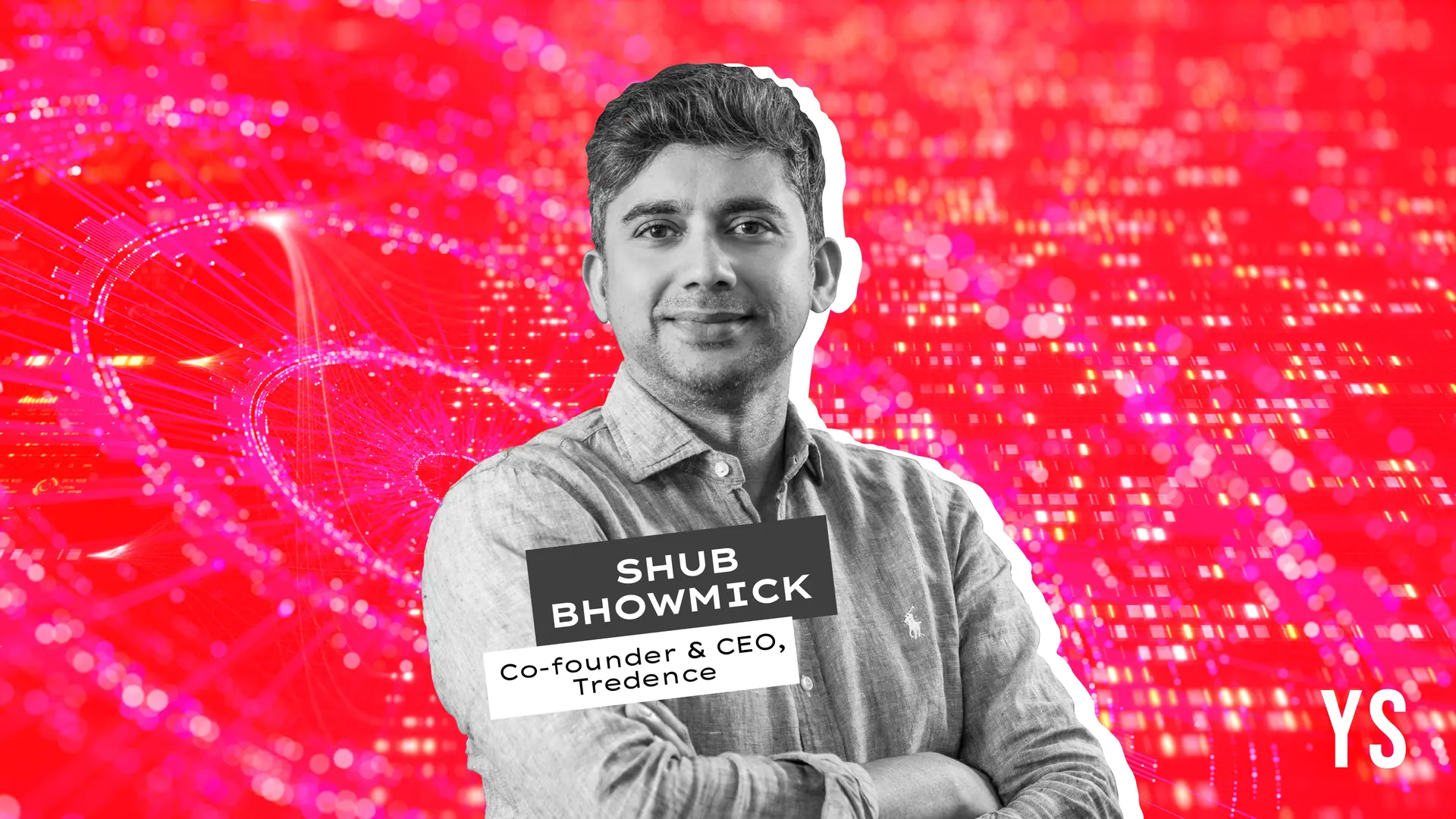

Back in 2012, when founder and CEO Shub Bhowmick was working in technology and consulting services, he noticed that smart ideas looked great in PowerPoints and dashboards, but rarely translated into real business outcomes. This disconnect between insight and impact is what professionals call the ‘last mile problem’, and Bhowmick joined forces with Sumit Mehra and Shashank Dubey to find a solution.
In 2013, they founded , a data science solutions provider focused on solving the last-mile problem in AI.
“We wanted to build a company that combined strong domain knowledge, robust engineering, and first-principles problem solving to take analytics all the way to measurable value. We literally wrote this on a whiteboard in early 2013, and that became the foundation of Tredence,” Bhowmick tells YourStory.
Today, Tredence has grown into a nearly 4,000-strong organisation serving over 100 global clients, including several Fortune 500 companies such as PepsiCo, Mars and Unilever. While most of its employees are in the US, the company’s delivery and R&D centres are located across Bengaluru, Chennai, Pune, and Kolkata.
From dashboards to decision intelligence
Back when AI was formally addressed as Advanced Data Analytics, Bhowmick says that nobody was trying to figure out the ‘last mile of analytics’. Most people equated analytics with dashboards.
“Our first challenge was category-creation: we had to educate clients that the real value was in operationalising insights on the shop floor, in the store, in the call centre, not just in the boardroom. The other big challenge was credibility. We were a small team going up against global consulting giants. Yet, clients trusted us because of how fast we moved and the vertical expertise that we brought in,” he explains.
Bhowmick emphasises that Tredence doesn’t take a “one-size-fits-all approach” to AI. The CEO mentions that their team’s goal is always to work with all the leading foundation models available in the market and fine-tune them to the specific needs of each client.

Its offerings span generative AI for content creation, natural language interfaces, and decision support; agentic AI, where domain-specific agents monitor data and trigger actions; and multi-agent domain accelerators that provide tailored, real-time intelligence across business functions.
“All these integrated ecosystems of models, accelerators, and agents keep in mind the last mile adoption of insights and quantifiable business outcomes. This enables us to modernise entire enterprises, not just isolated use cases,” says Bhowmick.
Scaling responsibly
The CEO says that the present challenges that the company faces are less about technology and more about mindset, talent, and responsible scale. He also mentions that many enterprises still treat AI as costly or a collection of pilots rather than a core transformation lever, which slows decision-making and large-scale adoption.
“There is a global shortage of people who combine deep domain expertise with AI, data engineering, and product thinking, even as expectations from GenAI and agentic AI accelerate. At the same time, governance, regulation, and trust are evolving, and clients rightly expect transparency, security, and clear guardrails around how AI is built and deployed,” he says.
To address those issues, Bhowmick shares that Tredence is doubling down on value storytelling and last-mile execution so CXOs see AI as a business outcome, while investing heavily in talent by scaling India centres and reskilling teams. In parallel, it is also embedding responsible AI-governance, explainability, and compliance into its platforms.
Industrial challenges
The CEO says that after COVID, India has become a critical hub where projects are moving from pilots to production. Bhowmick believes that India’s experience in digitising and automating business processes positions it well for the next wave of intelligent, AI-driven systems.
“With generative and agentic AI, deterministic, rule-based scripts can evolve into systems that make probabilistic, human-aware decisions,” he says. “India has the talent, depth, and scale to lead this change, as the next generation is actively learning new AI skills.
What’s next
Tredence plans to strengthen its global footprint through strategic acquisitions, especially in Latin America, to build nearshore delivery and expand in key European and Middle Eastern markets. Bhowmick says the team is also scaling their co-innovation ecosystem with partners such as Google Cloud, AWS, Snowflake, Microsoft, and Databricks to take differentiated platforms and solutions to market.
“Our business has accelerated significantly over the past few years, with revenue growing around 40% year-on-year. This momentum gives us a clear line of sight to $1 billion in annual revenue over the next four to five years, powered by rising enterprise demand for AI and decision intelligence,” he says.

Since 2020, Tredence has raised about $205 million across Series A and B rounds and may plan a Series C in the next 12–18 months based on strategic needs. An IPO, however, isn’t on the near-term horizon.
“Our priority remains building durable, profitable scale and reinforcing Tredence as a trusted global AI partner,” he says.
Competing with other global companies like Fractal Analytics and Tiger Analytics, Bhowmick sums up Tredence’s differentiation simply.
“An obsession with last-mile value from AI, a fusion of domain engineering and problem-solving mindset, and an ecosystem-led approach to agentic AI. Together, these ensure measurable business impact for our clients,” he signs off.
Edited by Jyoti Narayan