



Inside IIM Bangalore’s startup incubation journey: learning to teach its craft
In the shelter of a green campus at IIM Bangalore, NSRCEL, the institute’s startup and entrepreneurship centre, has spent years learning how to guide young ideas while figuring out how to evolve itself.


The quiet roads inside IIM Bangalore are a sharp contrast from the busy city outside. Trees filter the late morning light, and students move leisurely on well-paved roads. A short walk from the main gate, past lush, multi-layered trees, sits NSRCEL, the institute’s startup and entrepreneurship centre.
NSRCEL has always lived at the intersection of calm and commotion. It is a university-based incubator that has spent a quarter of a century learning how to support founders while now trying to transform that craft into something that can be taught and shared.
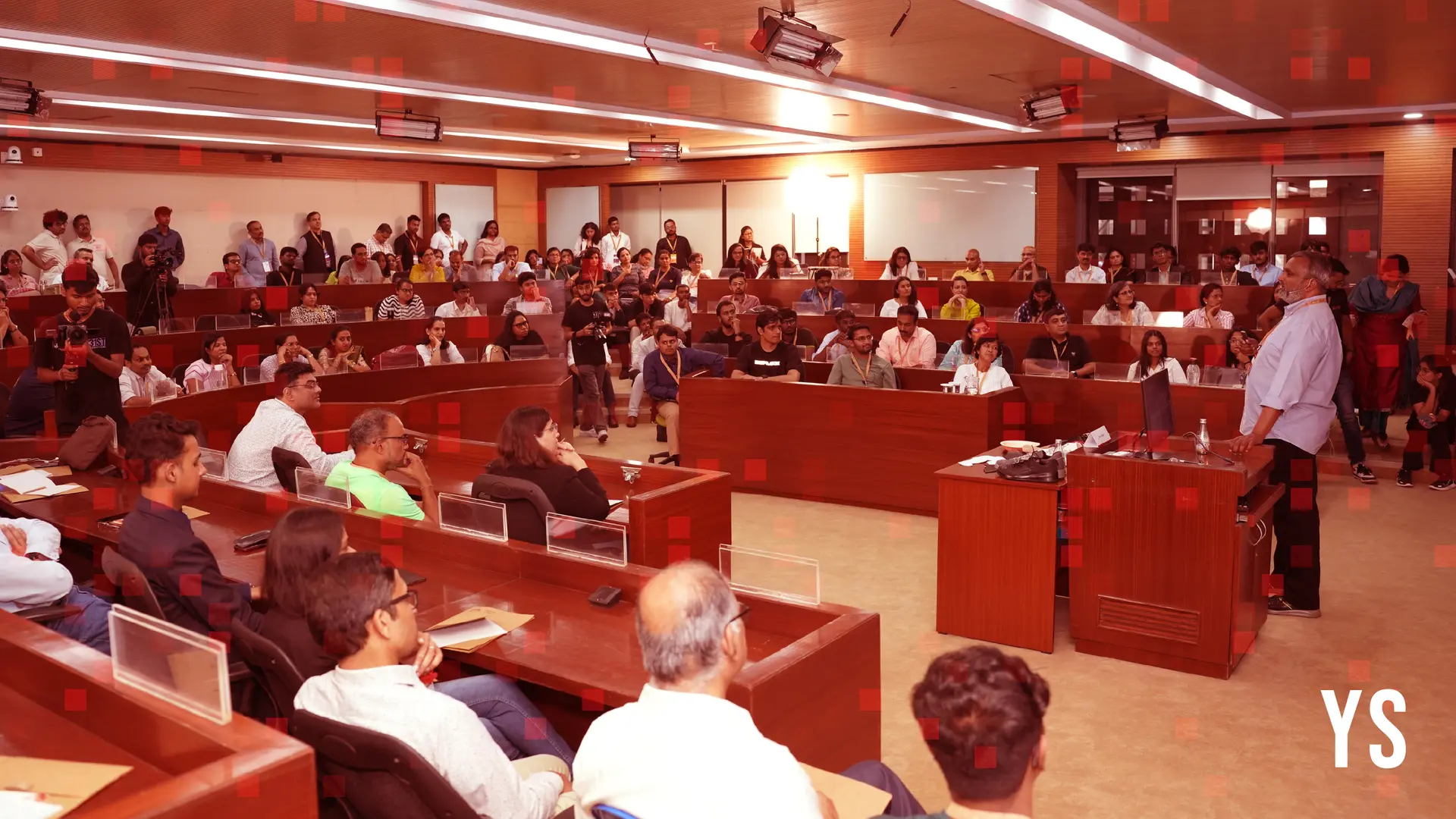
On a sunny day in late November, the building hummed with a different energy. Founders, mentors and alumni filled its corridors to mark 25 years of incubation and to reckon with how much the world of entrepreneurship has changed since the centre first opened its doors.
During a coffee break, I found myself among returning alumni and wide-eyed young founders, each group animated for different reasons. The conversations spilling through the corridors, half nostalgia and half ambition, captured something essential about NSRCEL’s pull. Before long, I was sitting down with people who had long considered the place a kind of “family”.
Over a long, candid conversation, Anand Sri Ganesh, CEO of NSRCEL, describes the centre’s evolution from a mentor-led hub into an attempt to codify and share the methods of incubation. He says the centre’s work is now split between refining its own operating model and contributing to the wider ecosystem beyond IIM Bangalore.
Craft of support
NSRCEL’s strength, as Ganesh and several alumni emphasise, lies in the day-to-day rituals of support. An empathetic mentor who helps a founder sharpen a pitch, a professor dipping into a problem at odd hours and quick introductions that can mean the difference between a stalled prototype and a pilot.
Ganesh describes a deliberate programme architecture, a mixture of pre-incubation, incubation and later stage support, with a focus on early revenue ventures. He notes that these design choices are the product of long experience.
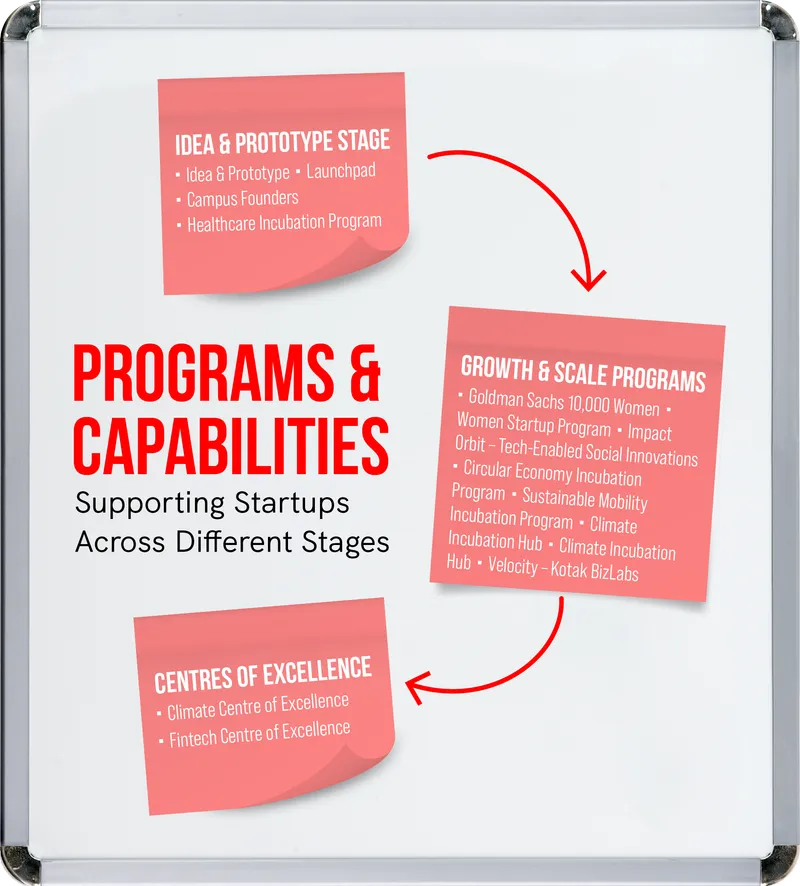
Source: IIMB-NSRCEL | Design: Nihar Apte
He also speaks about how NSRCEL’s operating model is changing because innovation is increasingly technology-driven. Ganesh shares that the centre now needs operating models that allow co-incubation with science labs and corporate innovation teams. “We need operating models that allow for joint incubation,” he adds.
He acknowledges the difficulty of this work and mentions a new MOU with IIT Kanpur for deep tech co-incubation in AI-driven manufacturing, robotics and drone technologies.
To make incubation more systematic, the centre has built ECKNA, a structured framework based on 25 years of experience. “We know all the mistakes not to make,” he says, and the team began codifying its methods.
He describes ECKNA as “entrepreneurial capability building through knowledge, networks, and assessments”. It consists of methods, standard operating procedures and knowledge assets that define what effective incubation requires.
NSRCEL is now using this framework with younger incubators. Ganesh notes the aim is to shorten their journey from decades to “eighteen to twenty-four months”. The centre already works with five incubators and hopes to add more.
Founders on the ground
If the institutional case can feel abstract, the founders’ stories make it concrete. Jeetendra Lalwani, Co-founder of Dial4242, describes a personal first cause for his venture.
“When my dad had a heart attack, the ambulance guy said he would reach in five minutes. He never reached my home and went straight to the hospital. My dad could not survive. That was a breaking point for me,” he remarks. It pushed him to reflect on why ambulance services in Indian cities and towns could be so unreliable.
Lalwani explains that NSRCEL’s help often combines counsel and credibility. The centre assisted with pitch decks and investor introductions, and the association made partners and CSR donors take the team more seriously. He also talks about the practical doors an incubator can open. Lalwani describes conversations with Toyota and Maruti that became possible through NSRCEL.
“As a startup, you come with a lot of ideas, a lot of innovation. But you need those helping hands to reach the right people,” he says, adding, “NSRCEL has been like a family.”
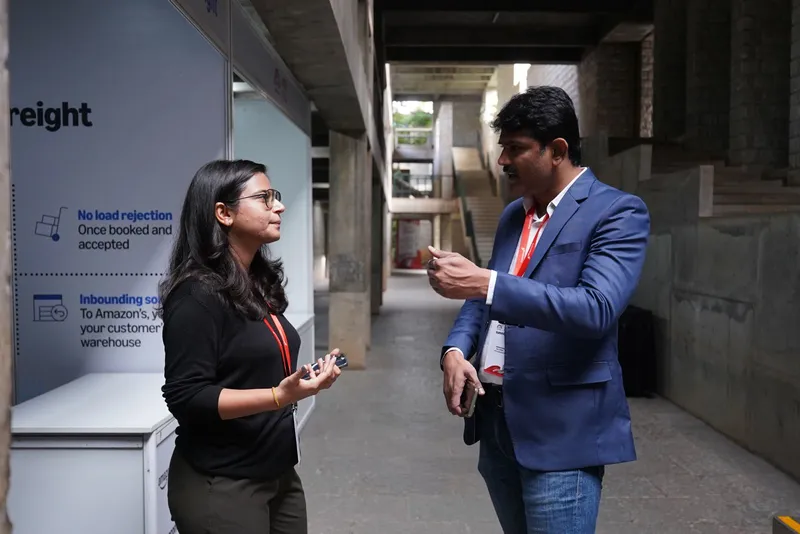
One of the many entrepreneurship focused conversations in the halls of IIM Bangalore’s startup and entrepreneurship centre. | Image: IIMB-NSRCEL
Nikita Doshi, Co-founder of Biome Healthcare, offers a complementary view. She runs a hardware-oriented medical device company that moved from contract manufacturing to a factory in Coimbatore and now produces indigenous oxygen concentrators. Her route into NSRCEL was modest and accidental.
“Through WSP, there was a bootcamp at IIM Bangalore. I visited the campus with no idea what NSRCEL was or what incubators were. That is where my journey with NSRCEL started. Since then, we have done two incubations back to back,” she says.
Doshi works in a regulated healthtech environment. She shares that the incubator reduced trial and error by exposing founders to mentors and by sending advisors to their manufacturing facility for grounded feedback.
Her first WSP grant taught her how to prepare for funding, even though the company had initially self-funded its development.
Together, the two founders speak to the range of NSRCEL’s impact. Both benefited from mentoring, introductions to partners and targeted training. They also show that incubation often buys trust in a market where trust matters as much as cash.
From tech to trials
Ganesh frames the second axis of NSRCEL’s evolution as technological readiness and platform access. Generative AI and large language models have become part of founders’ conversations. He says the nature of innovation has changed because technology spans fields from life sciences to artificial intelligence, and that incubators must help founders separate real capability from hype.
The NSRCEL chief warns that hype is not the same as capability and that enterprise AI incurs significant compute and integration costs. He underlines the need for sandboxes and partner arrangements with cloud and hardware vendors so that prototypes can become robust products. He believes incubators must help founders access such environments so they can test in realistic conditions instead of treating pilots as proof of readiness.
For founders like Lalwani, support appears as practical introductions to OEMs and pilot partners. His team needed access to mobility and hardware partners to test location solutions and emergency response protocols, and NSRCEL’s introductions made that possible. Pilots did not always scale, but they provided learning.
Doshi’s work also shows the value of structured piloting. Her company moved from contract manufacturing to designing and building domestic devices. The work required compliance checks, supplier vetting and demonstration tests that small teams cannot easily run alone. She says mentors visited their factory to offer grounded feedback and that incubation reduced time spent on avoidable errors.
Pilots, however, have limits. Ganesh is candid about pilots that fail to scale or remain one off studies. He notes pilots can be useful, but they are not proof of a market, and that incubators must help founders interpret them carefully and assess economic viability. He expects incubators to ask hard questions about unit economics and policy fit before a pilot is mistaken for a market.
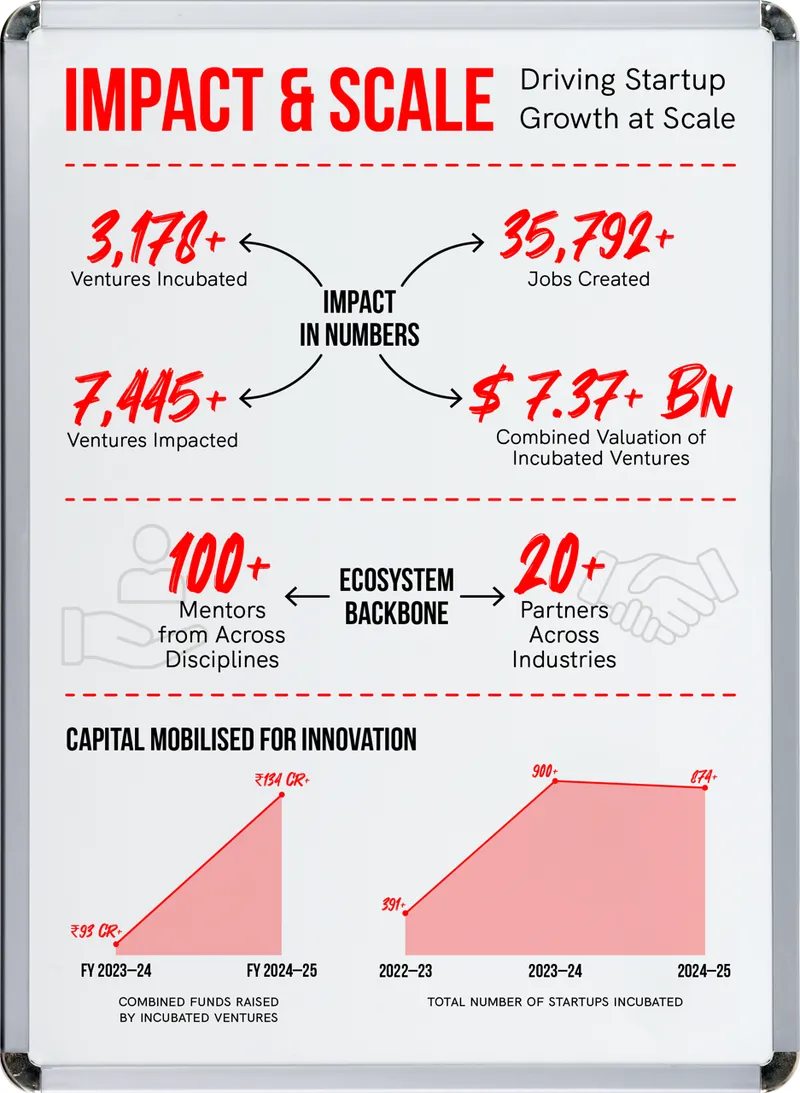
Source: IIMB-NSRCEL | Design: Nihar Apte
Where money moves
The capital environment has shifted, and Ganesh and the founders say investors now expect more rigorous governance, cleaner accounting and clearer unit economics. Ganesh shares scrutiny of legal and financial hygiene has risen sharply.
“The amount of scrutiny on legal, shareholder agreement, the quality of accounting and internal audits has significantly gone up. I wonder if anybody even asked those questions six months ago,” he adds.
Ganesh notes that certain sectors have seen policy-driven capital flows that can draw money away from other important fields.
“There are some pockets where policy is injecting capital: defence tech and some pockets of deep tech. The nature of policy is injecting capital. This is coming at a cost. That capital is also getting sucked away from a couple of other sectors,” he remarks.
This shift has made non-equity capital more relevant. Doshi and Lalwani speak of grants and CSR as crucial early resources. Such funds help hardware and service-driven companies survive early volatility and bridge gaps before venture capital is realistic.
Sector choices also carry trade-offs. NSRCEL has programmes in healthtech, mobility, climate tech and education. Ganesh worries that edtech has gone quiet after a few headline cycles and that the loss of early-stage attention is a social cost. He says he has not seen a single for-profit edtech venture incubated recently and fears this neglect affects primary and vocational learning.
Given these realities, incubators need to work across a more plural capital landscape. Ganesh points to corporate innovation budgets, CSR funds and family foundations as sources of patient capital that can support hardware and other long gestation projects.
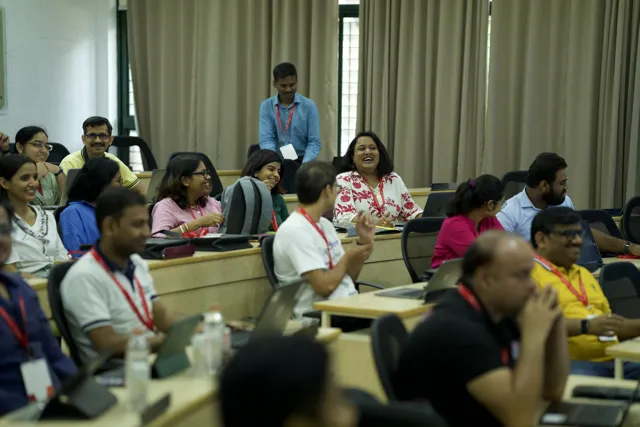
Founders and mentors in discussion during a session at IIM Bangalore’s startup and entrepreneurship centre. | Image: IIMB-NSRCEL
Shape of success
Success for an incubator is not just measured by alumni numbers or rare high-profile exits. Ganesh sees it as a mix of sustainable ventures, jobs that spread beyond major cities and the transfer of NSRCEL’s accumulated knowledge into younger incubators.
NSRCEL’s next phase mixes intimacy and reach. It wants to preserve personalised mentorship while turning 25 years of learning into something others can use. ECKNA and its work with younger incubators signal this shift.
For founders, success is more immediate. Lalwani measures it in trust, partnerships and the credibility NSRCEL confers. Doshi measures it in product rollout and manufacturing progress.
A final test is whether incubation learning can travel. Ganesh believes codifying the centre’s experience can shorten the journey for newer incubators. Success for NSRCEL, therefore, lies in two measures: the progress of its founders and the spread of its lessons to new institutions. Its value may ultimately be seen not only in startups supported but in the number of incubators and founders strengthened by its craft.
If the coming decades widen access to support and patient capital for founders like Lalwani and Doshi, NSRCEL’s impact will extend well beyond its alumni list.
(Cover image and infographics designed by Nihar Apte.)
Edited by Jyoti Narayan