




Karthikeyan Krishnaswamy: Fiction, fact, and fintech
From anime-inspired curiosity to AI-powered credit systems, Karthikeyan Krishnaswamy is building the future of digital lending at KreditBee -- where technology serves business, and innovation drives inclusion.

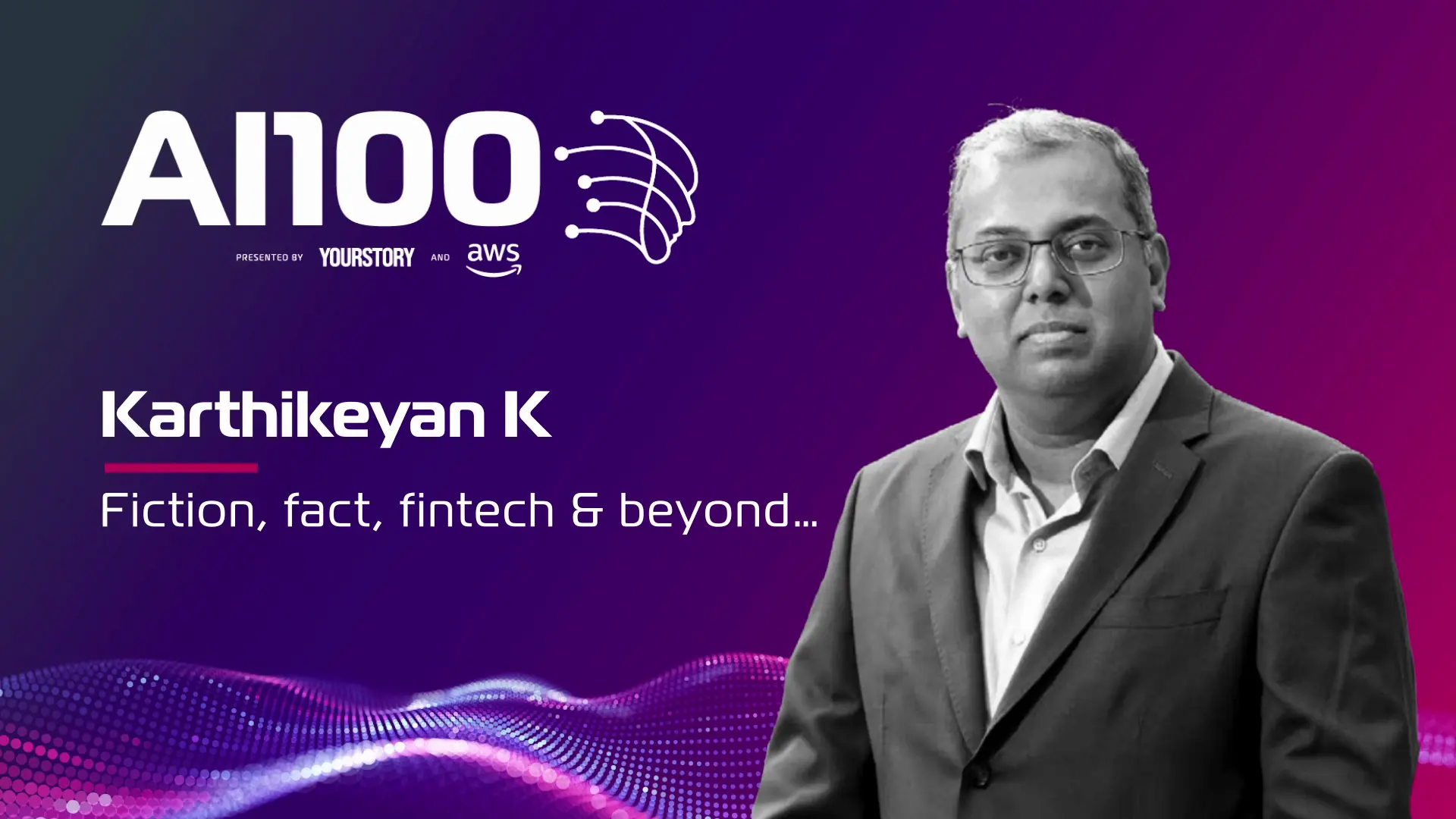

Karthikeyan Krishnaswamy, Co-founder and CTO, KreditBee, grew interested in boundary-pushing, future-ready technologies long before formal education. His fascination was sparked by the stores of science fiction and frames of Japanese anime. From Isaac Asimov’s sentient robot Daneel Olivaw to the cybernetic worlds of Ghost in the Shell, he was captivated by the possibilities of intelligent systems. At college, his curiosity evolved into research in computer vision and natural language processing, where he worked with small datasets and statistical models like Hidden Markov Model (HMM) for object and face recognition – the building blocks of today’s deep learning revolution.
If science fiction shaped his imagination, his hometown, Tirupur, the “Dollar City”, shaped his ambition. Growing up amid its energetic entrepreneurial culture, Krishnaswamy developed a strong business instinct early on. That drive matured during his college years at NUS, where he joined a startup founded by his seniors, later managing acquisitions in Bangalore and forming lasting connections with future co-founders Madhusudan Ekambaram and Vivek Veda.
How Kreditbee came to be
KreditBee, originally known as KrazyBee, began with a simple but powerful mission: to give students easier access to credit. The idea grew out of Krishnaswamy’s own circle — friends and cousins in college who struggled to get small loans for essentials like a mobile phone. As student aspirations evolved, so did KreditBee’s vision: to enable access to the digital tools of modern life, namely connectivity, learning, and seamless communication.
After graduation, many of those same students returned to KreditBee seeking financial support as young professionals. Recognizing an untapped market opportunity, the company expanded beyond student credit to serve early earners. Launched in 2018, the platform quickly gained traction, achieving in months what had once taken years. Customer feedback was central to this growth. “Our customers were our main drivers for new products. They told us what they needed. What began as phone financing evolved into a platform meeting broader financial needs,” Krishnaswamy says.
To scale rapidly and effectively, KreditBee rebuilt the system on AWS’s fully serverless architecture. With integrated fraud checks and optimized processes, it created a seamless, end-to-end digital lending experience—from application to credit disbursal—just as India’s digital economy was taking off.
Today, KreditBee has grown into a versatile financial ecosystem, offering credit, savings, and more. Krishnaswamy attributes this success to a combination of timing, technology, and deep customer insight – the three pillars that still drive the company.
Pride and purpose: Tech at KreditBee
Krishnaswamy’s philosophy as CTO at Kreditbee rests on a key principle: technology must serve the business, not the other way round. His focus isn’t on chasing the newest or flashiest tools, but on building reliable, scalable systems that meet real business needs. When KreditBee began developing its new platform, his team made a pivotal decision: to go fully serverless, using AWS Lambda to power all customer-facing compute. The result was a system that could scale seamlessly, optimize costs, and remain agile as the company grew.
“The CTO’s role,” says Krishnaswamy, “is not to showcase the best technology for its own sake, but to serve the pride and purpose of the business.” His journey at KreditBee reflects this evolution. What began as a hands-on engineering role, where he personally deployed systems and managed infrastructure, has evolved into a leadership position focused on strategic decisions, scalability, and organizational growth.
As KreditBee’s engineering team expanded from 20 to nearly 400 members, Krishnaswamy’s priorities shifted toward ensuring developer efficiency, strengthening tooling, and building process maturity. He says that technology leadership evolves with scale: what works for a small, agile team must be redefined for a large, distributed organization.
One thing, however, has remained constant: an uncompromising stance on security. “If anything works against security, it’s a no-go,” he says . Stability, reliability, and compliance are treated as foundational principles at KreditBee rather than as afterthoughts.
For Karthikeyan, the CTO’s role is a dynamic one, a continual balancing act between technology, people, and business growth. It’s about making the right technological decisions at the right time, ensuring that innovation drives impact without adding complexity.
AI/ML: Running KreditBee like a well-oiled machine
At KreditBee, Krishnaswamy delineates between the pre-GPT and post-GPT eras of AI. In the early phase, decision-making relied heavily on statistical and machine learning models that supported—rather than replaced—human judgment. In fintech, where accuracy, compliance, and risk sensitivity are critical, these systems helped process vast volumes of customer data—nearly a million customers monthly—by providing key decision-support signals.
In the post-GPT era, generative AI has transformed efficiency and adaptability. Unlike earlier models that required retraining, large pre-trained systems can now interpret new patterns—such as constantly changing SMS formats—without manual updates. “Gen-AI models have now evolved,” Krishnaswamy says. “Gen-1 focused on text, Gen-2 on image understanding, and Gen-3 on generating and interpreting voice. We are exploring all three to serve our organization and customers.”
However, he acknowledges that AI adoption isn’t without hurdles. Data quality remains a major challenge, along with the need for robust evaluation datasets to accurately train and benchmark new models. Together, these form the foundation for KreditBee’s next phase of AI-driven innovation.
Challenge, change, and caution: AI and the world
Krishnaswamy believes AI holds immense promise for solving global-scale challenges, but stresses on caution. He points to robotics as a key example, where automation is transforming industries from manufacturing to logistics, with millions of robots already deployed. “For each and everything that we do manually, there is a certain aspect where AI can be brought in,” he says.
From autonomous drones that could aid rescue operations during floods to robots capable of large-scale farming, AI’s potential to augment human capability is vast. In food and healthcare, AI could revolutionize gene editing, protein engineering, and drug discovery, running millions of simulations in seconds to accelerate breakthroughs. Yet, he counsels caution, stating that innovation must balance progress with sustainability, ensuring technology’s impact on ecosystems and human livelihoods is thoughtfully managed.
AWS and KreditBee
Krishnaswamy spoke at length about KreditBee’s enduring relationship with Amazon Web Services (AWS). Since 2018, his team has relied on a hybrid microservices–serverless architecture using AWS Lambda to power customer-facing APIs. Amazon Rekognition plays a key role in fraud detection, verifying customer photos against identity proofs with remarkable speed and accuracy. AWS Bedrock drives both developer productivity and AI model inferencing, supporting large-scale text and code processing.
For Karthikeyan, AWS provides not just scalability and performance but also peace of mind. “Their security is paramount—I can sleep better knowing it’s handled,” he says.
AI and beyond…
When it comes to keeping pace with AI developments, Krishnaswamy believes that it should be a collective effort rather than an individual pursuit. Therefore, he relies on constant reading, idea exchanges with senior colleagues, and team feedback to stay ahead in a rapidly evolving field. AI, he notes, now acts as a true co-pilot—offloading repetitive cognitive tasks and even assisting during meetings.
Outside work, his curiosity extends to comics, anime, and manga, which he says often inspire futuristic thinking. “I used to be an avid science fiction reader, but now I’ve become an avid AI news reader,” he reports, citing Ghost in the Shell as essential viewing for anyone exploring AI’s possibilities.