



What the Union Budget is likely and unlikely to offer gig workers
As India’s gig workforce is projected to reach 23.5 million by 2030, pressure is mounting on the Centre to move beyond mere announcements. Experts warn this year’s Budget may prioritise incremental welfare over long-delayed implementation.

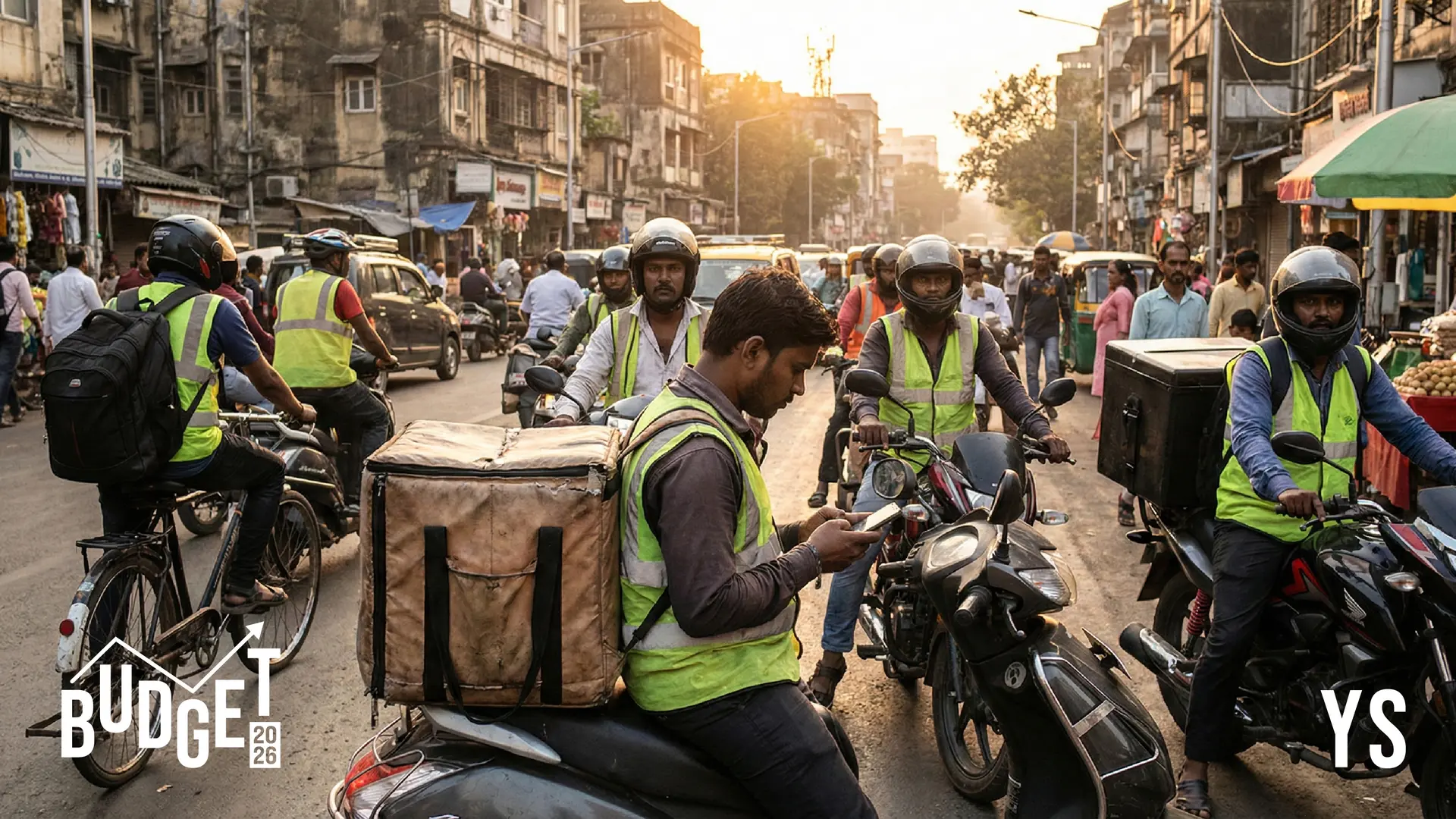

The term “gig worker” has become far more mainstream in India than it once was, especially in the past year.
As India’s gig workforce is projected to expand to 23.5 million by 2030, according to NITI Aayog, pressure is mounting on the Centre to move beyond just years of policy announcements and finally deliver tangible welfare measures, particularly at a time when platforms themselves seem ready to comply.
The new labour codes have formally recognised gig workers, promising social security, healthcare coverage, and identity registration. But, on-ground implementation remains patchy, at best. Meanwhile, platforms are still awaiting clarity on final rules and operational guidelines.
This year’s Budget comes at a moment when gig work has firmly entered mainstream economic and political discourse, driven by the rapid growth of quick commerce, rising worker unrest, and unionisation.
However, unions and labour experts broadly agree on one thing: Budget 2026 is likely to prioritise incremental welfare measures, such as insurance and access to credit, over much-needed implementation around social security, fair pay, labour rights, and platform accountability.
As Shaik Salauddin, Founder President, Telangana Gig and Platform Workers Union (TGPWU) and National General Secretary, Indian Federation of App Based Transport Workers (IFAT), puts it: “All these schemes, data, and social security have been in discussion. But five years have passed now, and there’s still no real benefit.”
The demands that are
For Salauddin, the core issue is simple: years of announcements and promises, but no implementation.
He recalls that last year, Nirmala Sitharaman, Minister of Finance and Corporate Affairs, had told him that platform workers would be covered under Employees’ State Insurance Corporation (ESIC), Pradhan Mantri Jan Arogya Yojana (PM-JAY), and Employees’ Provident Fund (EPF). “All these things were said in Parliament, but nothing has happened on the ground,” he adds.
That, he argues, is why unions are pushing for immediate, tangible measures, starting with a small-loan scheme modelled on PM SVANidhi for street vendors. “You (government) have done it for street vendors, why not for gig workers?” he asks. “Government is ready to give gig and platform workers Rs 10,000 annually as a one-time small loan. This is one positive development.”
Salauddin also wants the government to operationalise the proposed National Social Security Board and begin collecting the mandated 1–2% contribution from platforms.
Under the new labour codes announced in November, aggregators are required to contribute 1–2% of their annual turnover, capped at 5% of the amount payable to workers, towards a dedicated social security fund to finance schemes covering life, disability, health, and old-age benefits.
“If you are taking money from platforms, then whatever payment you collect, you should provide strong, meaningful schemes to workers,” adds Salauddin.
Beyond institutional reform, unions are also demanding direct income support. The IFAT has called for an annual cash transfer of Rs 10,000 to offset rising fuel, maintenance, and living costs.
“We don’t want piecemeal schemes. We want everything together—ESI, PF, maternity benefits, accident insurance, death coverage—implemented at one go,” Salauddin says. “Because five years have already been wasted. This is not charity. This is the workers’ right.”
Sunand, President of Rajdhani App Workers’ Union (RAWU), echoes this, outlining demands—ranging from concrete budgetary allocation for welfare boards and EV purchase subsidies to resting centres in cities, health insurance, retirement benefits, skilling programmes, and profit-sharing mechanisms for workers.
“There should also be a comprehensive policy to ensure workers get a share of the platform company’s dividends whenever it goes for IPO,” he adds.
What is most likely
Aniket Deogar, Founder and CEO of Haqdarshak, a tech platform that helps provide social security to gig workers, cautions against expecting sweeping reforms overnight.
“e-Shram itself has been in the works for five years,” he says. “I think that would see some continuation. The focus should also be on universal social security coverage—basic accident and life insurance, some form of pension, and access to collateral-free credit.”
Deogar expects the government to announce a framework linking e-Shram registrations to multiple welfare schemes. “It will require interlinking between different departments, but it’s feasible for the government to say that every e-Shram card holder will be eligible for a certain form of health and life insurance, accident coverage, or a pension, similar to PF or the Atal Pension Yojana,” he explains.
Among the most likely announcements, he says, are small-ticket, collateral-free loans for gig workers. “That scheme has done very well for street vendors. A similar credit line for gig workers, which has also been a long-standing demand, can be rolled out relatively quickly.”
Cash transfers, however, remain unlikely. “A framework may be announced, or maybe not.”
Deogar adds that all of this is centre-led, and that’s why the centre will pave the way for the rules. “It will then come down to what kind of social security budgets or frameworks are announced by different states,” he says.
He also expects “gig workers” to be listed as a separate line item in the Budget speech, like farmers, which could bring much-needed clarity on the proposed 1–2% platform contribution.
The bigger question is how this will be implemented, whether the money flows to the Centre first, and how it is then distributed to the states. After all, metro cities account for a disproportionately high share of both gig workers and platform revenues.
Long wait
Sunand says similar announcements have been repeated over the past two Budgets, with little to show on the ground.
“Every year, the government says it will bring social security for gig workers, but when it comes to actual spending and allocation, nothing materialises,” he says. “If you look at the broader trajectory, the trend is towards reducing government expenditure. We have seen this with schemes like MGNREGA. I don’t think even this year we will see anything concrete.”
On e-Shram, he argues that registration alone has not translated into benefits. “After the Supreme Court judgment in 2021, crores of workers have already registered. But no one is getting any new benefits. Apart from existing schemes like Ayushman Bharat, which everyone else also gets, there is nothing specific.”
“The primary bottleneck in implementing social security for gig workers is not the absence of a legal framework, but the absence of operational rules, notifications, and executive intent,” says Mayank Arora, a Delhi-based lawyer and Partner at Chambers of Bharat Chugh.
“The Social Security Code at present is largely an enabling framework and provides a broad framework on how to institutionalise and disburse benefits to the gig workers. However, in the absence of operational schemes that are notified and commencement dates for such schemes are specified, these rights for the gig workers remain only aspirational.”
While the Centre can notify schemes, implementation is likely to remain in the hands of the state machinery for registration, facilitation, and grievance redressal for the gig workers.
“This may lead to patchy and uneven implementation of the schemes across states, leading to certain gig workers being deprived of the benefits even after the schemes are notified,” he adds.
Operationalising the proposed 1–2% platform contribution within the current fiscal year, Arora says, would be challenging but not impossible. “It would require immediate notification by the government, clarity on how ‘annual turnover’ and worker payouts are to be computed, reporting standards for platforms, and a functional collection and audit mechanism.”
“But going by past lessons, mere rhetoric in the absence of concrete measures will once again render this very important and urgent issue a distant reality,” Arora cautions.
“Whether this year marks a shift depends entirely on the announcements made in the budget and post-budget speed of implementation of notifications, structures and timelines,” he adds.
Edited by Suman Singh