


A small Aligarh glass workshop shaped by skill and steady local demand
A small unit in Aligarh fabricates and installs mirrors, LED mirrors, and toughened glass fittings, balancing machine finishing with careful handwork and on-site fitting.

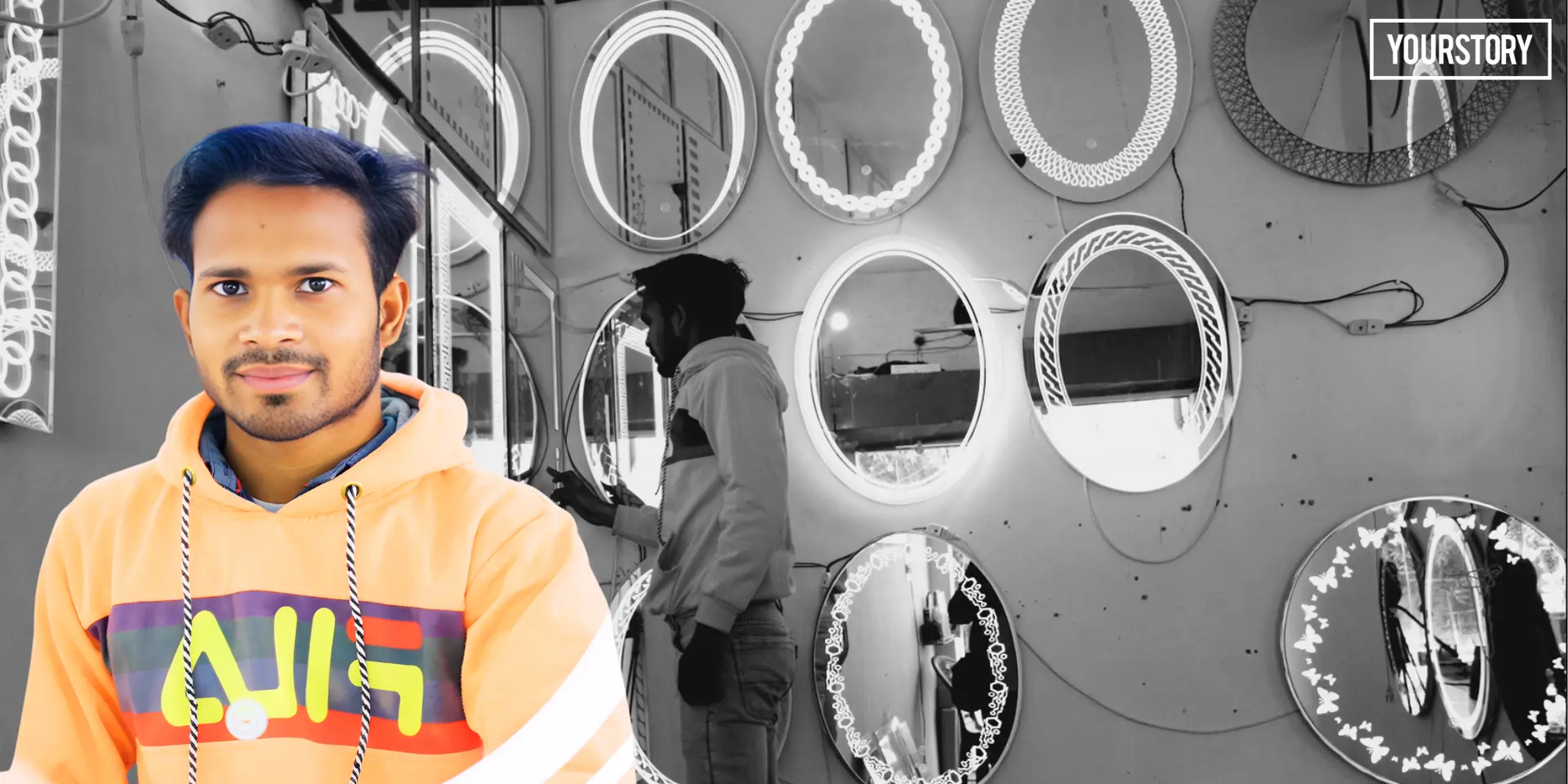

Deepak Kumar runs a small glass fitting and mirror workshop in Aligarh district, fabricating and installing tables, mirrors, designer mirrors, LED mirrors, lights, and toughened glass fittings for homes and shops.
The work involves cutting glass sheets to size, polishing edges, applying designs and completing on-site installation, depending on customer demand.
He has been in the trade for five to six years, a period that includes both learning and independent work. Kumar says the craft appealed to him because it required patience and skill rather than formal qualifications, and because it offered steady local demand.
Learning the trade away from home
Kumar’s entry into glass work began outside Aligarh when he went to work with his uncle to learn the basics of the trade. The work was physical and repetitive, involving long hours of cutting, grinding, and finishing glass.
Over time, he learned how to handle different thicknesses, avoid breakage, and customise pieces for specific requirements.
When he returned to Aligarh to start on his own, the transition was not smooth. He recalls doubts from people close to him and the difficulty of setting up without experience of managing suppliers or customers.
But he rallied ahead. “This was the only work I knew, and I wanted to do it properly,” he says.
Sourcing raw material was one of the early challenges. Glass and mirror sheets are purchased as full sheets and then cut to size, which requires upfront spending and careful planning. Finding reliable suppliers who offered acceptable quality at workable prices took time, and early mistakes led to losses that he had to absorb.
From raw sheets to finished fittings
The workshop follows a defined sequence of work.
For an LED mirror, for instance, mirror sheets are brought in and cut to size, followed by grinding and machine finishing to clean the edges. Designs are created using computer software and transferred using plotting and taping methods.
Frosting is applied under pressure to create patterns that allow light to pass through, after which LED lighting and framing are added.
Once the fabrication is complete, the finished product is packed and taken to the site for fitting.
The work combines manual handling with machine-based processes, and errors at any stage can mean starting again. Over time, Kumar says, experience has reduced wastage and improved turnaround.
Support and a steadier footing
A lack of capital once prevented Kumar from buying raw material and equipment in time, stalling work even when orders were available. He learned about the Mukhyamantri Yuva Udyami Vikas Abhiyan (CM YUVA) Yojana through a local contact and approached a bank for assistance.
The support enabled him to purchase machines and stock essential materials, helping the workshop operate without frequent interruptions.
Since then, the business has stabilised. Kumar manages household expenses, and work costs more predictably, and the workshop runs on a routine shaped by orders rather than uncertainty.
Looking back, he connects the early years of learning and struggle to the present sense of balance. The work remains demanding, but it now offers reliability, rooted in a skill he learned patiently and chose to continue when other options felt out of reach.
What is CM YUVA Scheme?
Under the leadership of Hon’ble Chief Minister of Uttar Pradesh, Yogi Adityanath Ji, the state government aims to transform youth from job seekers into job creators.
To achieve this vision, the Directorate of Industries and Enterprise Promotion, under the Department of Micro, Small & Medium Enterprises and Export Promotion, is implementing the ‘Mukhyamantri Yuva Udyami Vikas Abhiyan’ (CM YUVA) Yojana.
Under this scheme, young entrepreneurs are provided with up to Rs 5 lakh in 100% interest-free and collateral-free loans to start their industrial or service-based ventures. In addition, beneficiaries also receive a 10% margin money subsidy on the project cost.
CM YUVA is not just a financial assistance scheme; it also provides mentorship, guidance, market access, and essential resources to help youth become self-reliant entrepreneurs and generate employment opportunities for others.
Click here to know more about the CM YUVA Scheme.