


How Amroha’s Dholak Became Uttar Pradesh’s Signature Sound
From mango wood shells to hand-stretched skins, Amroha’s dholaks remain largely handmade, sustaining thousands of skilled workers across the district.

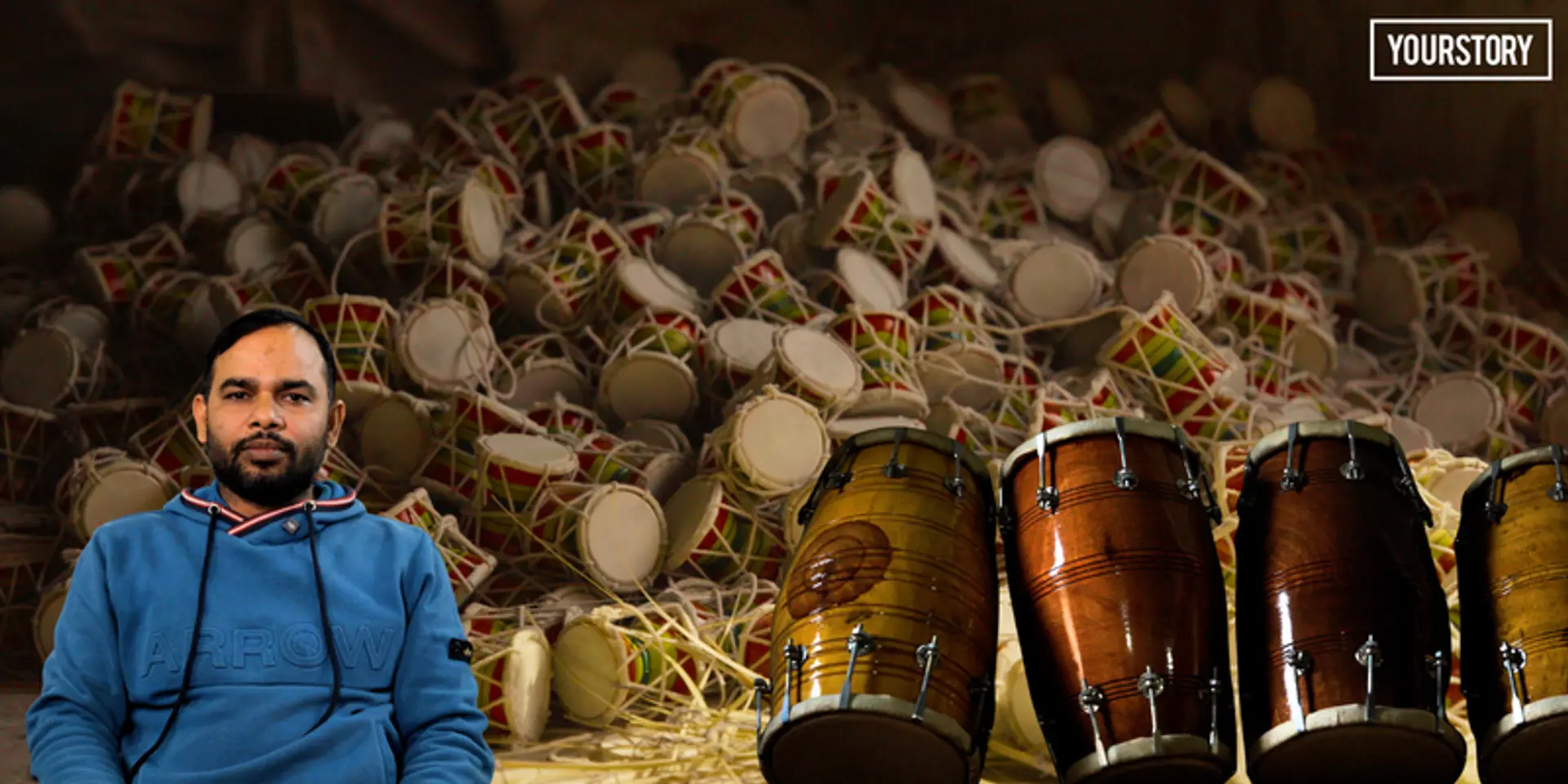

In Amroha, Uttar Pradesh, the dholak is more than a musical instrument. It is a working product, one that moves seamlessly through homes, temples, wedding processions, neighbourhood gatherings, and festival grounds across India. In doing so, it quietly sustains an entire local craft economy.
The story of Amroha’s dholak begins with wood. For generations, artisans have favoured mango wood for the drum’s frame shaped into a hollow body that is lightweight, well-balanced, and strong enough to withstand tension. Older craftsmen still recall a time before electricity and machines, when work unfolded in orchards and modest sheds, using only hand tools. Small teams would often spend an entire day shaping just a single wooden shell.
While workshops today may have access to basic machinery, the handmade nature of the dholak remains intact. Rajeev Kumar Prajapati, who runs Ram Musical Handicraft and is associated with local craft bodies, explains that machines may assist certain stages, but the instrument still relies overwhelmingly on skilled hands. By his estimate, nearly 90–95 per cent of the process continues to be manual.
Production moves in deliberate stages. Logs are cut into smaller sections, stripped of bark, shaped on a rotating setup, hollowed from within, and then painted. What follows is the most crucial phase—the finishing that defines the sound. Goat skin is carefully stretched and fitted onto the shell, determining the final tone and resonance that give the dholak its distinctive voice.
Over time, the instrument has adapted to changing tastes and markets. Rope-tied dholaks, once standard, now coexist with nut-and-bolt variants, both finding buyers. Demand also follows India’s festive calendar. Smaller percussion instruments like damrus see a spike during Shivratri and the month of Sawan, while dholaks dominate the wedding season and festivals such as Navratri. In many ways, the rhythm of the business mirrors the rhythm of celebration.
What truly sets Amroha apart is the scale of dependence on this craft. According to Rajeev, thousands across the district earn their livelihoods from dholak-making—wood cutters, shapers, painters, skin-fitters, packers, and traders. His own unit employs around 30–35 skilled artisans, depending on order volumes. Even when dholaks are sold in distant markets, the core wooden frame—the defining element of the instrument—remains firmly rooted in Amroha’s production ecosystem.
This is where the state’s One District One Product (ODOP) initiative becomes significant. Under ODOP, “Musical Instrument (Dholak)” has been officially identified as Amroha’s district product. Government listings note the presence of hundreds of small manufacturing units and a cluster that supports over a thousand artisans, highlighting the depth of livelihoods linked to the craft.
Rajeev says ODOP-linked support has helped workshops access finance and subsidy-based assistance—enabling better tools, smoother workflows, and the capacity to fulfil larger orders.
Yet, at its heart, the dholak’s story remains unchanged. A piece of wood becomes a hollow shell; stretched skin turns it into sound.
And in Amroha, that sound still comes from hands that have been shaping it—patiently and precisely—for generations.