



Ashwini Vaishnaw says AI changes are coming to schools and colleges after the Delhi summit
Vaishnaw said India’s AI scale will depend on widening the talent pipeline beyond elite campuses, backed by curriculum updates, institutional alignment, and national compute expansion including 20,000 additional GPUs.

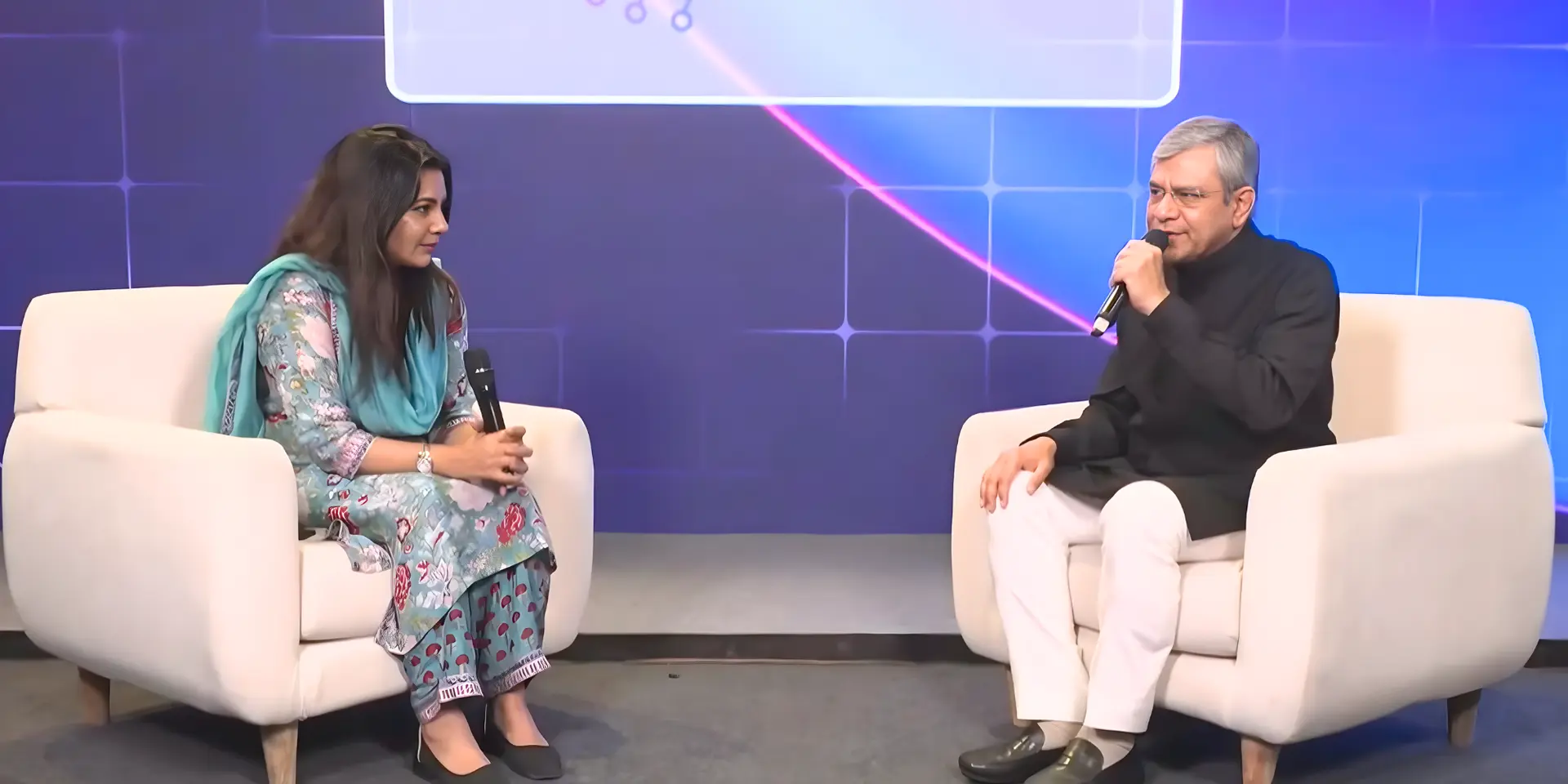

A short exchange between the Founder & CEO of YourStory, Shradha Sharma and Union IT Minister Ashwini Vaishnaw on the sidelines of the AI summit in Delhi carried a message that goes beyond investments and infrastructure: the government wants India’s AI story to be built by widening the “talent pipeline” — starting in schools and colleges.
When asked what he would like to tell entrepreneurs and developers, Vaishnaw argued that India already has strong tech talent and that this pipeline will “increase even further”. The way to get there, he said, is to prepare the education system for what he described as a new industrial wave — with course curricula being revised and learning shifting from theory to hands-on exposure.
That focus is also reflected in the government’s own summit messaging. In an official release during the event, the government said the Ministry of Education and AICTE are working on revising curriculum frameworks to keep the talent pipeline aligned with emerging AI needs.
The minister also flagged what could be the more practical part of the plan: after the summit ends, he said work will begin on the next version of the AI mission. He compared the intended approach to previous national technology pushes, such as semiconductors and telecom — where policy, ecosystem-building, and real-world deployments move in parallel. In that framing, students are not just future employees; they are potential builders. Vaishnaw said the idea is to provide AI solutions and “AI technology-based devices” that students can use to create solutions, learn the technology, and become familiar with the tools early.
His phrase “AI diffusion is going to be a big thing in our country” is a clue to the broader goal: AI adoption should not remain concentrated among a few companies, top-tier campuses, or metro ecosystems. The aim is a wider spread of capability — across institutions, geographies, and disciplines — so more people can participate in building and deploying AI.
Alongside the education push, the summit has also been framed around scaling India’s AI capacity. The same official release said India will add 20,000 GPUs over and above 38,000 already onboarded as part of national compute expansion, signalling a larger effort to strengthen the infrastructure layer that supports AI development.
The education track is also being positioned at the level of institutions and policy alignment. The Ministry of Education has highlighted efforts such as consultations across academia and industry, and the creation of a Centre of Excellence in AI for education at IIT Madras.
The takeaway from Vaishnaw’s remarks is straightforward: if India’s AI moment is to be sustained, it cannot rely only on funding announcements or a small pool of elite talent. It needs scale — and that scale begins with what students learn, what tools they can access, and how early they are encouraged to build.