



Banda’s Shazar Stone: Nature’s Patterns, Artisan’s Craft
From riverbeds in Banda to wedding jewellery and home décor, Shazar stone stands out for its natural tree, leaf, and landscape-like patterns—each piece shaped by skilled cutting and polishing, not artificial design.

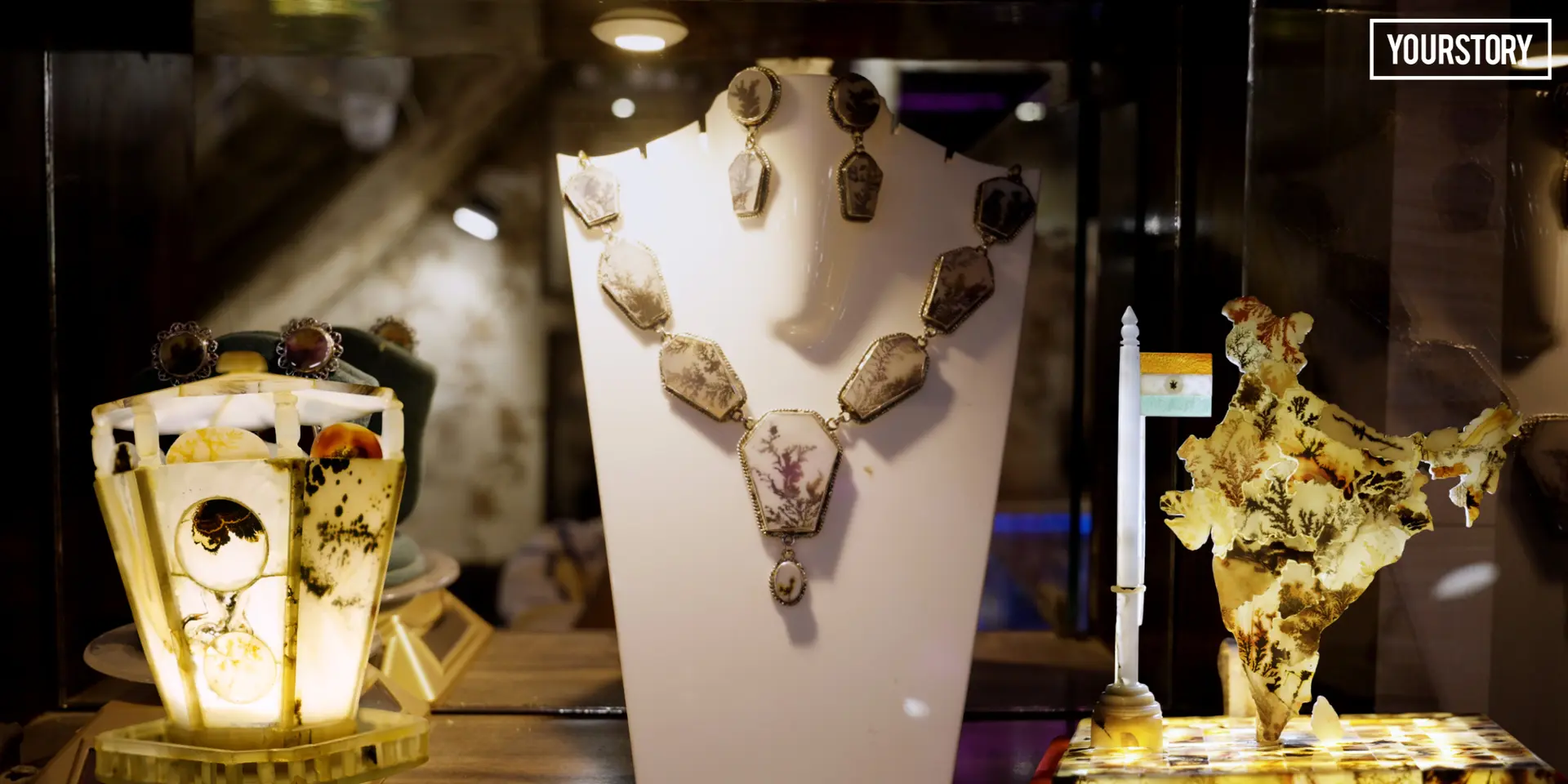

In Banda, Uttar Pradesh, Shazar stone is more than a stone collected from riverbeds. Once cut and polished, it reveals natural formations that resemble landscapes, foliage, and abstract art—patterns (specifically of a tree, flower or leaves) created by nature itself. No two surfaces are alike, and that uniqueness defines its appeal.
Shazar appears as jewellery at weddings, cufflinks & brooch, small keepsakes at fairs, and handcrafted décor pieces placed in homes and prayer spaces. Around this rare stone operates a network of cutters, polishers, mount-makers, and workshop owners who transform raw stone into finished products.
Through the One District One Product (ODOP) framework, Shazar has gained structured market exposure via exhibitions and formal platforms, helping artisans connect with wider buyers.
A Life Shaped by Stone
Dwarka Prasad Soni, a Banda-based artisan, has dedicated decades to Shazar craftsmanship. Coming from a jewellery-making family, he entered the trade early, leaving formal education after Class 8 due to financial constraints. “Each stone carries its own picture,” Soni says. “We do not create the design—we reveal it.”
He recalls a time when Banda had a stronger cluster of small Shazar workshops. As many units shut down, he persisted, particularly disturbed by the waste of stone offcuts discarded during jewellery production. Over time, he began exploring ways to expand the material’s use beyond traditional settings.
Recognition followed. Soni received a State Award in 2001 and a National Award in 2011 for a Shazar-crafted table lamp, demonstrating the stone’s potential beyond small ornaments.
From River to Refinement
The process begins with selecting stones found along riverbeds. Earlier, slicing was done manually—a slow and labor-intensive task. After observing diamond-cutting techniques during training in Jaipur, Soni migrated to diamond cutting machine that significantly reduced cutting time.
Quality depends on clarity of pattern, precision cutting, and polishing that enhances the natural design without altering it. Buyers are often surprised by the organic shapes visible within the stone’s surface.
Soni credits ODOP-supported exhibitions and institutional exposure for reviving interest in Shazar. He has trained over 400 individuals through structured programmes, helping expand the artisan base.
For him, the future remains practical and optimistic. “The stone is still here. The skill can be taught,” he says. “With stronger market access, Shazar can travel far beyond Banda.”