



Peace Isn’t Avoiding Conflict: Epictetus on Facing It Wisely
Epictetus argues that lasting peace comes from meeting tension with clarity, not escaping it. Here’s how wise conflict reduces resentment and builds real stability.

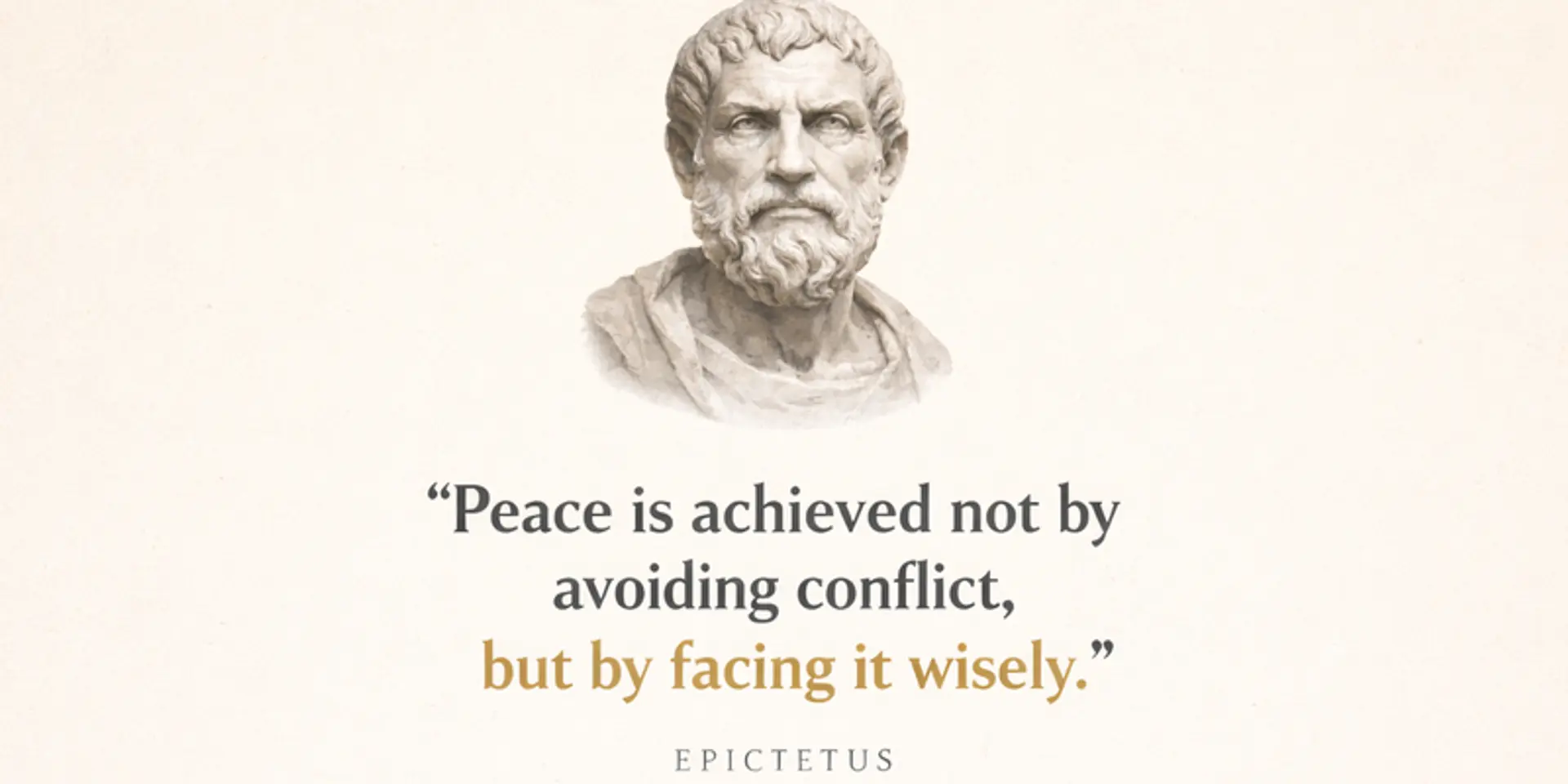

“Peace is achieved not by avoiding conflict, but by facing it wisely,” Epictetus reminds us. It is a line that runs against a common modern instinct: if tension appears, step back, mute the conversation, change the subject, or wait for the storm to pass. Avoidance can feel like maturity because it looks calm from the outside. But very often, it is simply delay.
Epictetus, a Stoic philosopher, lived in a world where uncertainty was not occasional, it was routine. His point is not that conflict is good, or that confrontation should be chased. It is that peace built on denial is fragile. It depends on everyone staying quiet, on problems staying small, and on reality cooperating. The moment something breaks that arrangement, the “peace” collapses.
Real peace, the kind that lasts, is more demanding. It asks for clarity, responsibility, and the willingness to do the uncomfortable work of facing what is true.
The hidden cost of avoidance
Avoiding conflict does not erase it. It often relocates it. A disagreement left unspoken becomes resentment. A boundary not stated becomes a pattern. A hard decision postponed becomes a crisis with fewer options.
In relationships, avoidance can look like politeness while quietly draining trust. In workplaces, it can look like harmony while problems spread through silence, misalignment, and passive resistance. Even within the self, conflict avoidance can turn into constant mental noise, the feeling of carrying unfinished conversations everywhere.
This is why Epictetus frames wisdom as the key. Conflict is not solved by reacting faster or speaking louder. It is solved by understanding what the conflict is actually about, and then responding with intention rather than impulse.
What it means to face conflict wisely
Facing conflict wisely begins with separating facts from assumptions. Many arguments are fuelled less by what happened and more by what people believe it meant. Wisdom asks, what do I know for certain, what am I interpreting, and what am I feeling.
It also demands timing and tone. A wise response does not pick the worst moment to prove a point. It chooses a setting where people can listen and speak without an audience or pressure. It is direct without being cruel.
Most importantly, it focuses on outcomes, not victory. The goal is not to win a debate. It is to protect what matters, correct what is wrong, and reach a clearer agreement about what happens next.
This approach turns conflict into information. It reveals priorities, values, and mismatched expectations. When handled well, it strengthens relationships because it replaces guessing with honesty.
Peace as a practice, not a mood
The Stoic idea of peace is not comfort. It is steadiness. It is the ability to stay grounded even when something is tense. That steadiness comes from practising restraint, self-awareness, and accountability.
Wise conflict is not dramatic. It can be as simple as stating a boundary early, asking a clear question, or admitting a mistake without excuses. It is a decision to deal with reality while it is still manageable.
In that sense, peace is not achieved by running from conflict. Peace is achieved by meeting conflict with clarity, courage, and control. Epictetus offers a standard that is difficult, but realistic: peace is not the absence of problems, it is the presence of wisdom.