



Goals Don’t Change Your Life. Systems Do. Here’s Why
James Clear explains why ambition collapses without systems, and how habits quietly determine success when motivation fades.

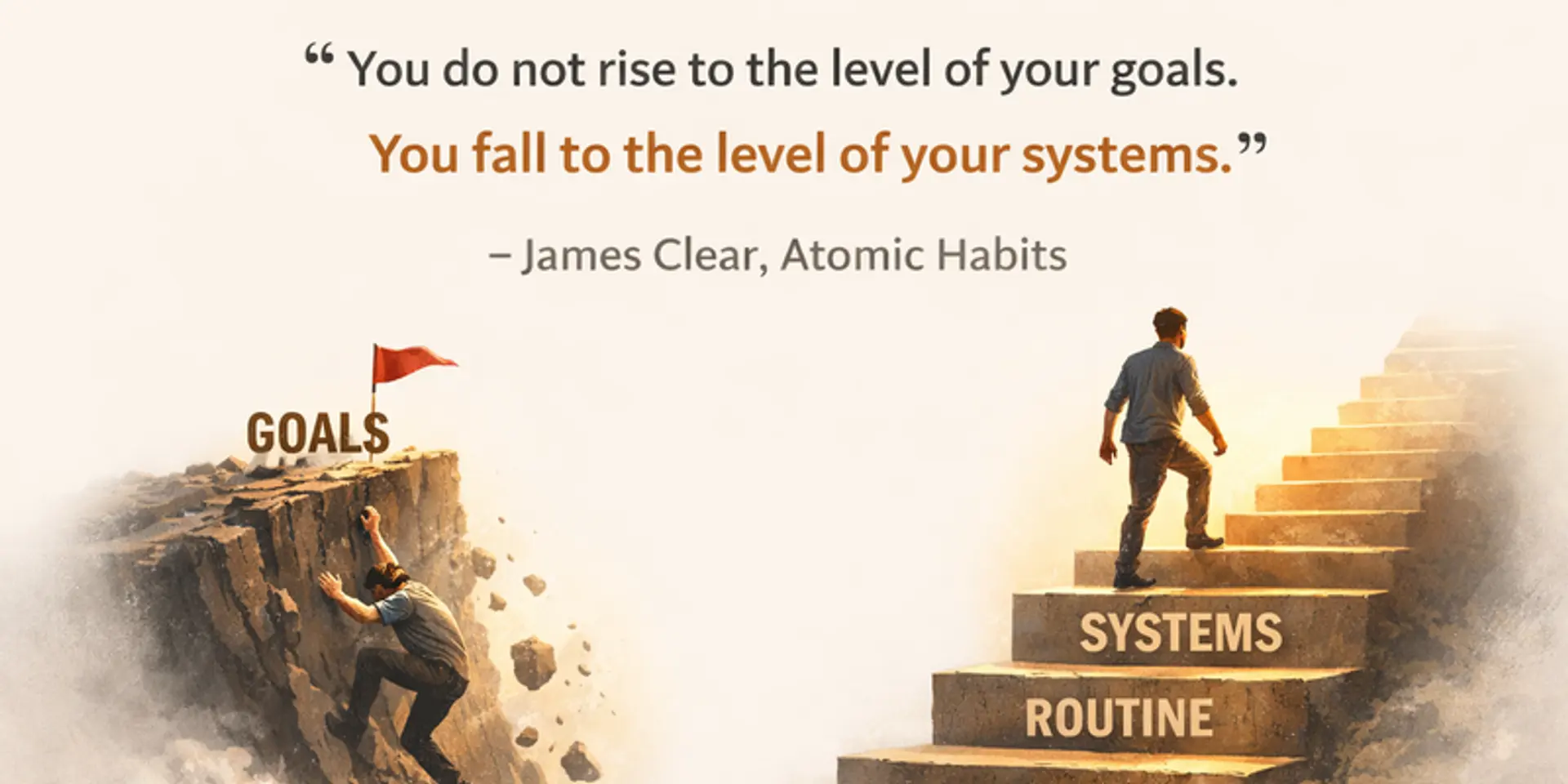

“You do not rise to the level of your goals.
You fall to the level of your systems.”
— James Clear, Atomic Habits
Why Goals Feel Powerful — and Still Fail
Goals are seductive. They give direction, ambition, and a sense of identity. A promotion, a fitter body, a successful startup, a finished book — goals promise transformation. Yet most people experience a familiar pattern: enthusiasm at the start, effort for a while, and eventual drift.
This is not a failure of motivation. It is a failure of structure.
James Clear’s insight cuts through the noise of hustle culture. Goals define outcomes, but systems define behaviour. When pressure builds, willpower fades. What remains is the system you return to by default.
The Hidden Problem With Goal Obsession
Goals are momentary. You either achieve them or you don’t. Once achieved, they stop providing direction. Once missed, they often lead to guilt and abandonment.
Systems, by contrast, are ongoing. They shape how you spend your time, what you do when tired, and how you act when nobody is watching. A goal might be “write a book.” A system is “write 300 words every morning before checking email.”
The difference matters because life rarely cooperates with perfect plans. Stress, deadlines, family, health — these variables expose weak systems. In those moments, people don’t rise to ambition. They revert to habit.
Systems Decide Who You Become
Every system is a vote for the type of person you are becoming. A daily walk is a system that builds an identity of someone who prioritises health. Reviewing finances weekly builds the identity of someone who manages money intentionally.
This is why systems are more honest than goals. They show what you truly value through repetition, not intention.
Clear’s idea reframes progress as something quiet and often invisible. Systems don’t create dramatic overnight change. They compound. Small behaviours repeated consistently create outcomes that appear sudden but are built slowly.
When Motivation Disappears, Systems Remain
Motivation is unreliable. It spikes after a podcast, a book, or a burst of inspiration, then fades. Systems do not depend on mood. They reduce friction for good habits and increase friction for bad ones.
A system might mean keeping workout clothes ready, blocking time on the calendar, or removing distractions from your workspace. These choices decide behaviour long before motivation enters the picture.
In this sense, systems are not restrictive. They are liberating. They remove the daily burden of decision-making and replace it with default action.
The Quiet Discipline That Wins Long Term
Most people overestimate what they can do in a month and underestimate what systems can do in a year. The quote is a reminder that success is rarely a heroic leap. It is a series of ordinary actions done consistently.
If goals define where you want to go, systems determine whether you get there.
In the end, the question is not how ambitious your goals are. It is how well-designed your systems are — because when life pushes back, that is what you will fall to.