



In Hapur’s Local Market, Repairs Became a Reliable Livelihood
A Hapur entrepreneur transforms limited job prospects into a growing electronics repair and resale business.

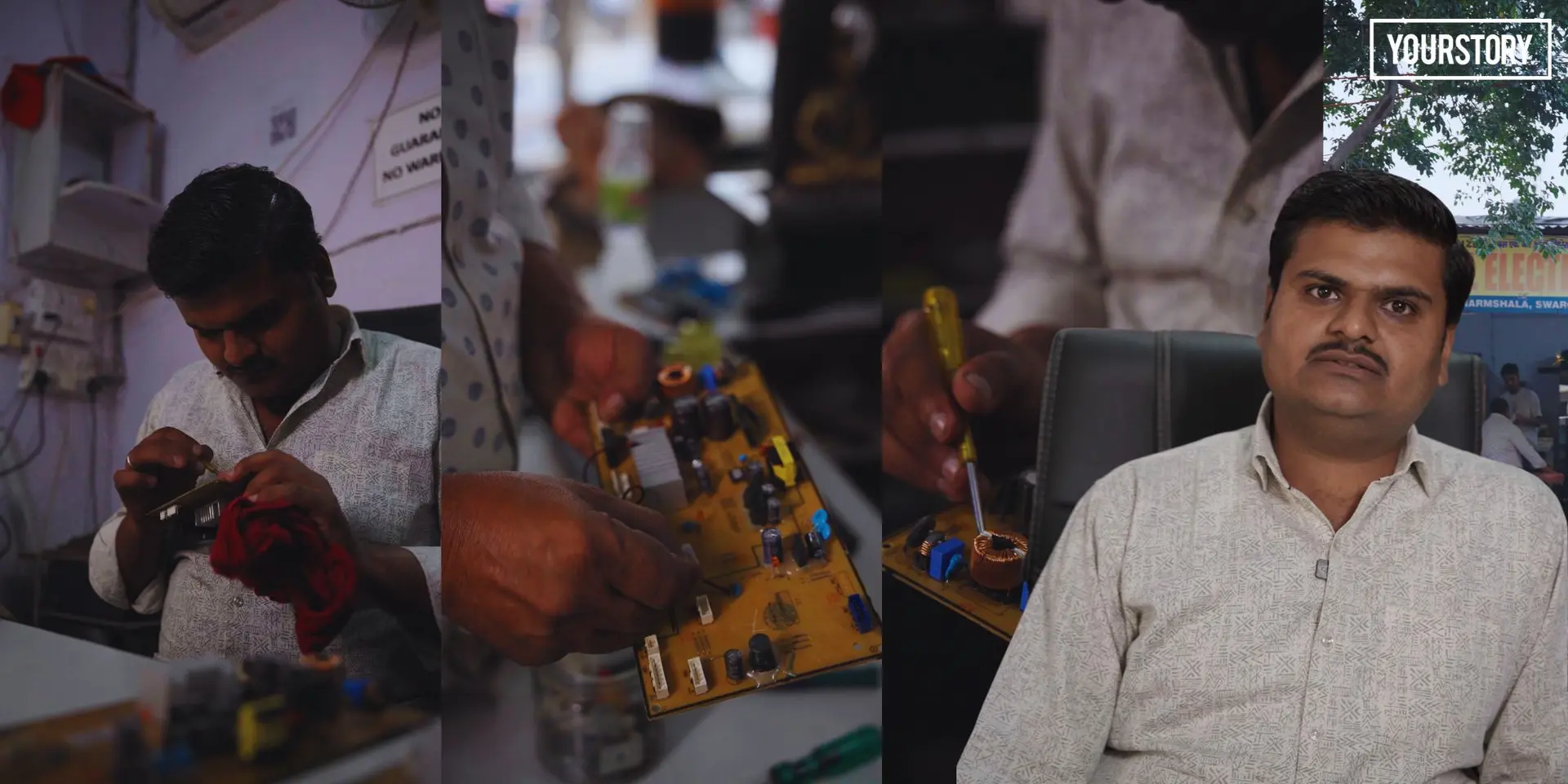

In 2022, when steady employment proved elusive after completing his BCom degree, Aditya Jindal decided he would not wait indefinitely for an opportunity. Instead, he chose to create one.
Jindal, a resident of Hapur, lives and works on Garh Road, where his shop, Jindal Electronics, now serves a steady stream of customers. His business focuses on electronic repair and resale. He sources appliances and electronic goods in bulk from warehouses, repairs them, and sells them in the local market. In addition, customers visit his shop for repair services ranging from refrigerator gas refilling to washing machine motor, and pipe replacements.
Turning uncertainty into opportunity
After completing his BCom, Jindal initially looked for a job but found limited options. “When jobs were not coming through, I realised I had to start something of my own,” he says.
While exploring ideas, he turned to YouTube to understand small-scale business models that required relatively low capital. That is when he discovered the concept of purchasing defective or surplus electronic goods, repairing them, and reselling them at competitive prices. Compared to other businesses that demanded significant upfront investment, electronic repair appeared more accessible and practical.
He began modestly, purchasing small quantities of goods and repairing them himself. Having previously worked briefly with a local mechanic, he had some foundational knowledge. Over time, he strengthened his skills through hands-on practice and online tutorials.
For Jindal , the decision was not purely financial. “Money is important, but you must also enjoy the work you do. I felt I could become good at electronic repair,” he explains.
Financial support and expansion
As demand grew, so did the need for working capital. Regular procurement of goods required consistent funds, and in the early days, Jindal often relied on friends and relatives for short-term financial support.
It was during this phase that he came across information about the Mukhyamantri Yuva Udyami Vikas Abhiyan (CM YUVA) Yojana, online through social media advertisements. After researching further and completing the application process, his documents were forwarded to the department. He was later contacted, asked to submit the required paperwork, and eventually sanctioned a loan of Rs 5 lakh.
According to Jindal , the process in Hapur was relatively smooth. Officials at the District Industries Centre (DIC) guided him through the documentation process, and within 15–20 days, the loan was disbursed through the bank. The loan, offered without interest and without requiring property as collateral, significantly eased his financial pressure.
With access to structured funding, his operations scaled up. Instead of purchasing two or three small items at a time, he began buying in bulk at better rates. He also hired two assistants, enabling him to increase repair capacity and generate additional local employment.
Lessons for aspiring entrepreneurs
Reflecting on his journey, Jindal advises first-time entrepreneurs to start small and understand market demand before making large investments. “Buy in small quantities, repair, sell, and learn what customers want. That way, risks remain manageable,” he says.
From struggling with limited capital and sourcing challenges to managing a growing repair business, Jindal views his journey as one of steady progress rather than overnight success. His future plans remain focused on expanding his current operations and leveraging any relevant government schemes that can support further growth.
For him, entrepreneurship has offered not just income, but control over his work and the satisfaction of building something of his own in Hapur’s local market.