



How Jhansi’s jute bags carry Bundelkhand’s chiteri art to a steady market
What began as a fine-arts practice during college became steady work after 2022, with women stitching and finishing pieces at the centre and from home as orders grow.

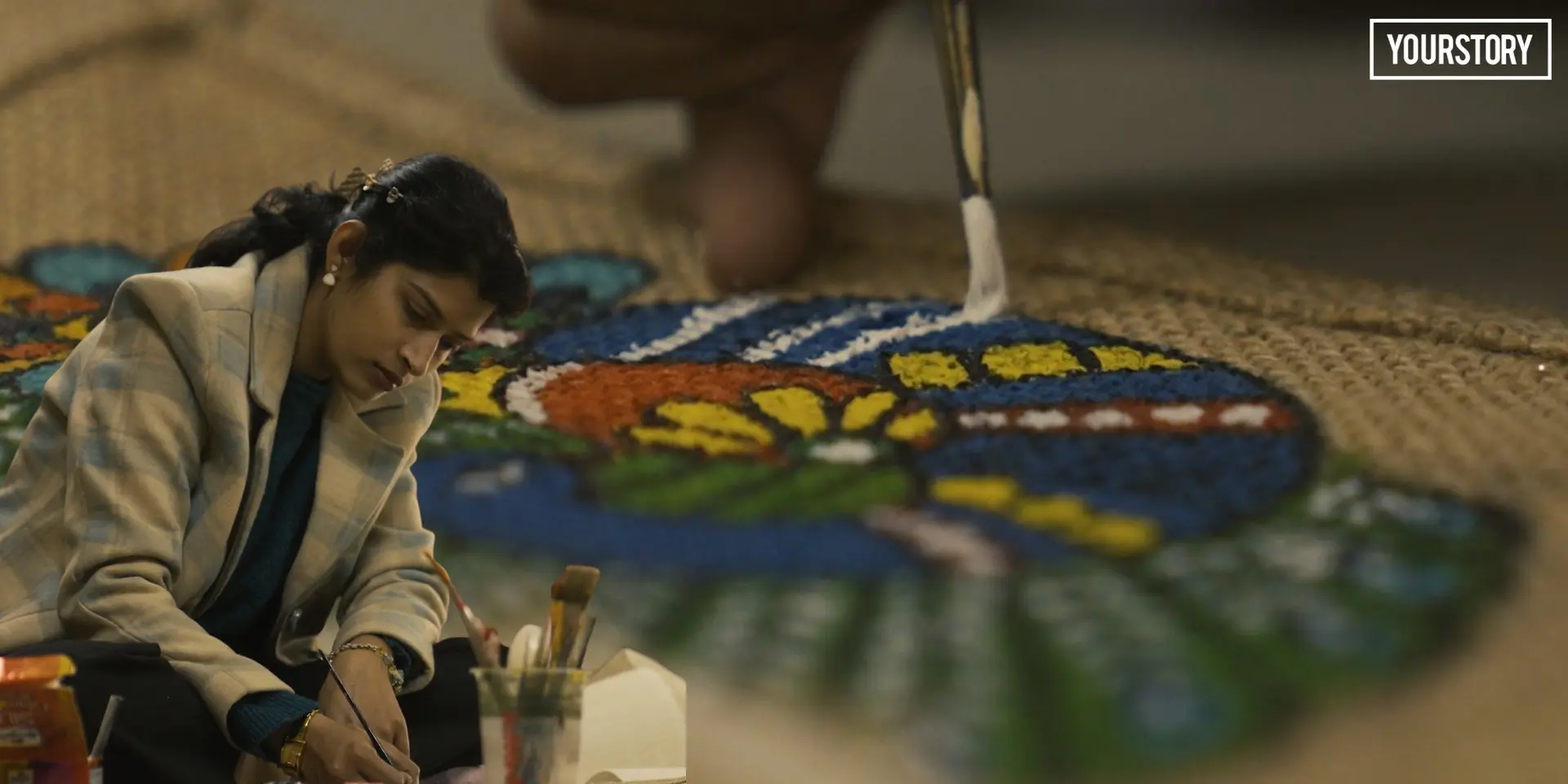

When customers place an order with Rachnatmak Arts at the Rise Incubation Center in Jhansi, the first discussion is rarely about “products” . It is about purpose, size, colour, and how the bag will be used—gifting at a conference or school event, part of corporate kits or a local felicitation programme.
Only after that does the work begin: jute is sourced, measured, cut, stitched, and finished with painted motifs drawn from Bundelkhand’s folk art tradition.
Run by Pratibha Dongre of Jhansi, the centre’s core offering is jute-based utility and gifting items—bags in different formats, gamchas, handmade mementos, and medals—customised to the buyer’s requirements.
The distinguishing layer is chiteri art painted onto the surface, turning plain jute into an object that carries local visual memory into modern, everyday use.
A craft seen in childhood, adapted for products
Dongre describes chiteri as something she grew up seeing around her, especially in villages, where it would be painted on doorframes and windows during weddings and auspicious occasions.
She recollects how the imagery—often of deities—signalled welcome and protection for guests entering a home. Over time, she noticed that the practice was becoming less visible in towns, surviving more in pockets of rural Bundelkhand.
In her workshop, this is the visual language getting adapted to jute items that travel beyond the district. She says orders come through a mix of institutional and organisational networks, including schools and colleges, government offices, and corporate gifting.
Her clients include banks and local offices, signalling how such products often enter circulation through formal events rather than retail shelves.
From solo work to a shared production line
Dongre has a bachelor's and master's degree in fine arts from Raja Mansingh Tomar University in Gwalior. While she began working since her time in college in 2014, it was only in the COVID-19 lockdown during her master’s that she began taking it more seriously as a business from home, responding to growing interest in her designs.
As orders increased in 2022, she realised she could not manage production alone and started bringing others into the process.
Some women come to the centre to learn and work; others, she says, receive raw material at home and return finished pieces for collection, a model that allows participation for those who cannot travel regularly.
“Women who cannot step out still complete the work at home, and we collect the material from them,” she says.
At present, around 25 women work with her consistently, while training continues alongside production so new hands can join when demand rises.
Support that helped formalise the unit
In December 2024, Dongre was recognised at the Rise Incubation Center in December 2024, and that's when she learned about the Mukhyamantri Yuva Udyami Vikas Abhiyan (CM YUVA) Yojana. She used the scheme's support to add machinery and set up a more organised unit in Jhansi, where she felt customised jute bags were not easily available locally.
The shift has not removed long workdays—she still describes late nights when deadlines pile up—but it has made the work more predictable.
For Dongre, the stability is measured in small, concrete changes: a fixed workspace, a clearer routine, and a team that can share the load. What began as an individual practice—art made between studies and household constraints—now holds together as steady work, shaped by orders, repetition, and a growing circle of women who can rely on the same rhythm.
What is CM YUVA Scheme?
Under the leadership of Hon’ble Chief Minister of Uttar Pradesh, Yogi Adityanath Ji, the state government aims to transform youth from job seekers into job creators.
To achieve this vision, the Directorate of Industries and Enterprise Promotion, under the Department of Micro, Small & Medium Enterprises and Export Promotion, is implementing the ‘Mukhyamantri Yuva Udyami Vikas Abhiyan’ (CM YUVA) Yojana.
Under this scheme, young entrepreneurs are provided with up to Rs 5 lakh in 100% interest-free and collateral-free loans to start their industrial or service-based ventures. In addition, beneficiaries also receive a 10% margin money subsidy on the project cost.
CM YUVA is not just a financial assistance scheme; it also provides mentorship, guidance, market access, and essential resources to help youth become self-reliant entrepreneurs and generate employment opportunities for others.
Click here to know more about the CM YUVA Scheme.