


How a small pagdi-making unit in Mathura district supports local livelihoods
In Mathura’s Billa Mandir area, Kusum Saini runs a home-based unit crafting pagdis and decorative mukuts for Krishna traditions, supplying Vrindavan, Barsana, and Nandgaon through steady, confirmed orders.

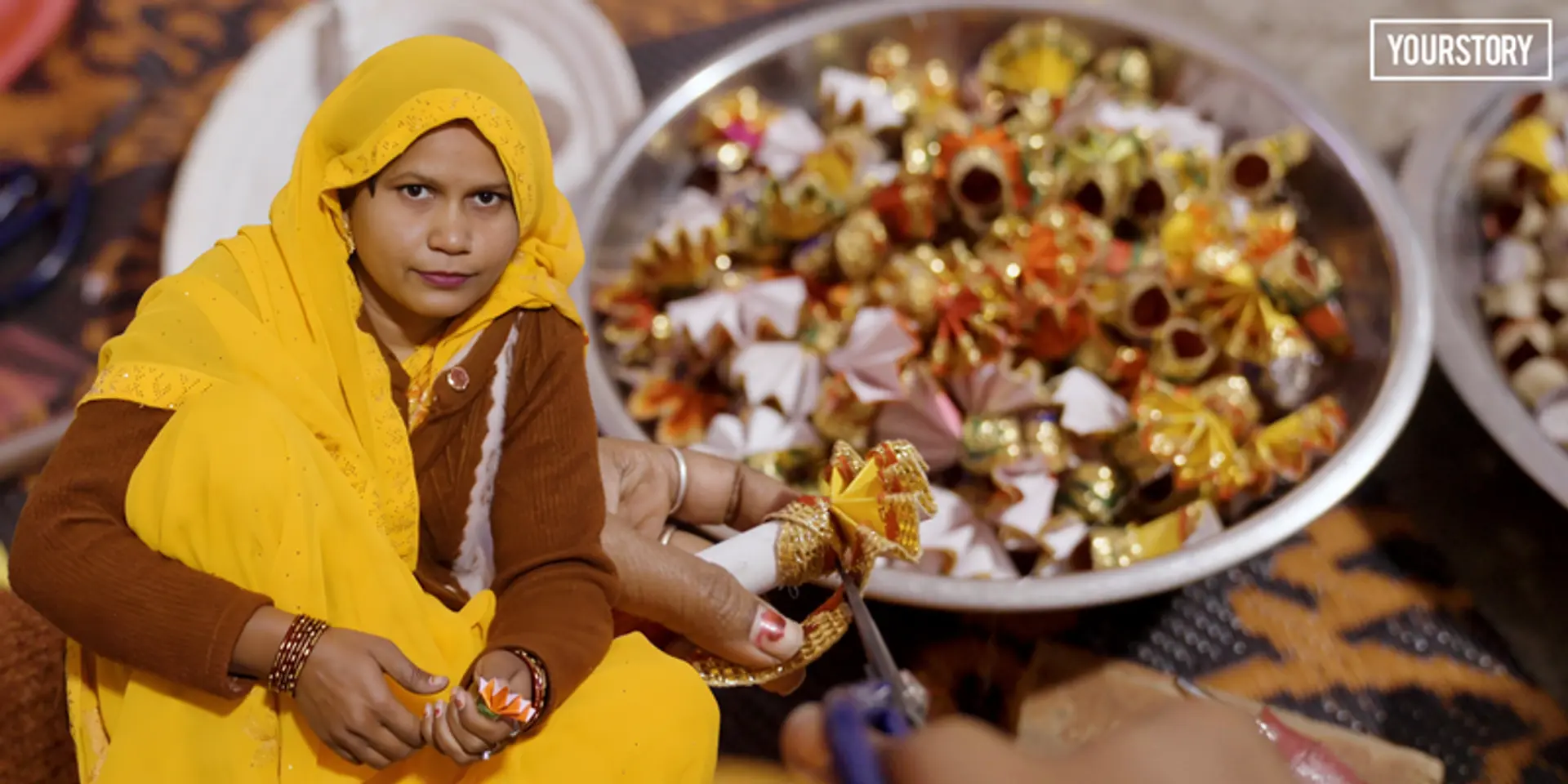

In a narrow residential pocket near the Billa Mandir area of the Mathura district, a small home-based unit quietly produces pagdis and decorative mukuts used in religious performances and temple traditions. The work involves cutting fabric, marking patterns, stitching, shaping the base, and finishing each piece with lace, beads, stones, and pearls before packing them for delivery. Along with pagdis, the unit also crafts crowns and ornamental headgear, mostly for Krishna and related traditions, following designs supplied by buyers.
The unit is run by Kusum Saini, a resident of Mathura district, who has been engaged in this work for around five years. What began as a skill learned informally has gradually taken the shape of a regular livelihood, supporting her household and providing work to others nearby.
Learning the craft at home
Saini did not enter the work through formal training. She learned the process by observing and assisting someone experienced in pagdi making, then practising on her own at home. In the early period, production was slow and limited to what two people could manage. Materials were sourced in small quantities, and finished items were supplied cautiously to nearby buyers.
Over time, familiarity with the craft improved both speed and confidence. Saini began handling more complex designs, including mukuts with layered decoration and detailed embellishment. Orders began arriving from places such as Vrindavan, Barsana, and Nandgaon, where demand for traditional headgear remains consistent for religious use. Production decisions continue to be guided by orders rather than speculation, with larger or more elaborate pieces made only when confirmed demand exists.
Support and gradual expansion
Information about government-backed support reached Saini during a local training interaction, where multiple livelihood options were discussed. She chose to continue with the work she already knew rather than shift to something new. Through the Mukhyamantri Yuva Udyami Vikas Abhiyan (CM YUVA) Yojana, she received financial support that allowed her to purchase materials in bulk and add basic equipment to improve output.
The loan helped stabilise the unit’s operations. From an initial team of two, the work now involves five people, mostly engaged in cutting, stitching, and decorative finishing from home. Referring to the change, Saini says, “Isse humne apna kaam badha liya aur ghar ka kharcha chalne laga,” which translates to, “Through this, we expanded our work and were able to manage household expenses.”
Subsequent references to the CM Yuva Yojana remain practical rather than aspirational. The support is described as enabling rather than transformative, giving the unit breathing room to grow at its own pace.
Looking ahead with caution
Saini’s plans are modest. She wants to continue expanding the work slowly, involve a few more people, and keep production aligned with steady demand. The focus remains on consistency rather than scale, with attention given to maintaining quality in handcrafted pieces that depend heavily on manual skill.
From learning the craft informally to running a small unit that now supports multiple households, the journey reflects a gradual shift from uncertainty to stability. The work has not altered life overnight, but it has provided a dependable base, allowing Saini to look ahead without the constant pressure of starting over.
What is CM YUVA Scheme?
Under the leadership of Hon’ble Chief Minister of Uttar Pradesh, Yogi Adityanath Ji, the state government aims to transform youth from job seekers into job creators.
To achieve this vision, the Directorate of Industries and Enterprise Promotion, under the Department of Micro, Small & Medium Enterprises and Export Promotion, is implementing the ‘Mukhyamantri Yuva Udyami Vikas Abhiyan’ (CM YUVA) Yojana.
Under this scheme, young entrepreneurs are provided with up to Rs 5 lakh in 100% interest-free and collateral-free loans to start their industrial or service-based ventures. In addition, beneficiaries also receive a 10% margin money subsidy on the project cost.
CM YUVA is not just a financial assistance scheme; it also provides mentorship, guidance, market access, and essential resources to help youth become self-reliant entrepreneurs and generate employment opportunities for others.
Click here to know more about the CM YUVA Scheme.