




Why Okta believes trust, not speed, will define India’s AI-first enterprises
As enterprises race to adopt AI, leaders from Okta argued at a recent webinar that long-term success will hinge less on how fast AI is deployed and more on how securely and responsibly it is built – with identity and trust at the core.


India’s AI momentum is both remarkable and complex. Enterprises across sectors are embedding AI into customer journeys, internal workflows, and automation strategies at speed. But as adoption accelerates, so does the risk surface such as identity-based attacks and credential misuse. Insights from Okta’s Businesses at Work report highlight that security and identity tools are among the fastest-growing categories in enterprise tech stacks. As digital ecosystems expand across cloud and AI-powered applications, identity has effectively become the new security perimeter.
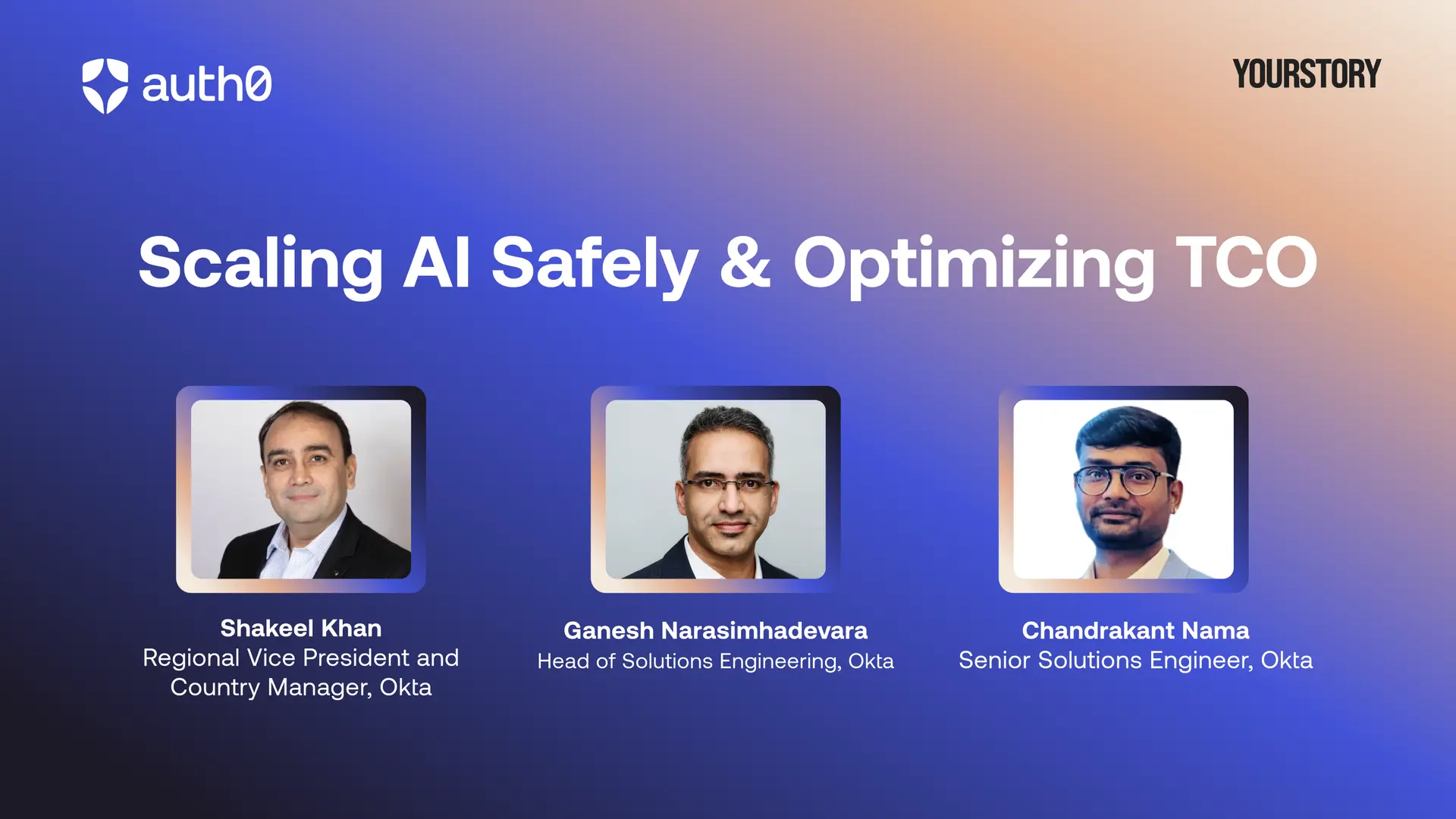
This raises a pressing question: How can organizations scale AI-driven experiences without compromising trust, security, or cost efficiency? Okta, in collaboration with YourStory, conducted a webinar, ‘Scaling AI safely and optimizing TCO’ to unpack what it truly takes to build secure, scalable, AI-powered digital experiences, especially in a fast-growing, high-risk market like India.
AI adoption is exploding but trust is lagging
Opening the session, Shakeel Khan, Regional Vice President and Country Manager for India, Okta, set the context for why identity has moved from a backend requirement to a strategic business enabler. “AI is growing faster than ever before. What used to take years to operationalize now happens in months, and increasingly, in weeks,” he said.
Cloud computing, richer datasets, and more powerful models have dramatically lowered the barrier to AI adoption. But that speed has also surfaced new vulnerabilities. “As AI takes on more work and starts making decisions, the question becomes very simple. Who, or what, is allowed to access which resources? That’s the core problem identity needs to solve,” Khan noted.
The stakes are particularly high in India. According to data shared during the session, 81% of Indian users are concerned about identity fraud, 54% say they are extremely worried, the highest globally, yet 91% of organizations are already using AI in some form.
“Trust in India is contextual,” Khan explained. “Users are willing to share data with regulated, familiar entities like banks or government bodies but they are deeply wary of misuse. Trust has to be earned through visibility, regulation, and security.”
Despite AI’s rapid integration into everyday workflows, user confidence hasn’t kept pace. “70% of users still prefer interacting with humans, compared to just 16% who favour AI agents,” he shared. “That’s a 4.4-to-1 preference, and it exists across age groups and demographics.”
Digging deeper, two fundamental barriers stood out: 44% of users don’t trust AI agents with their personal data and 35% question the accuracy and reliability of AI systems. “These aren’t minor concerns. They are fundamental roadblocks to adoption. Even the most advanced AI will fail if users don’t trust it,” Khan emphasized.
Identity, the invisible infrastructure powering AI at scale
Taking the conversation forward, Ganesh Narasimhadevara, Head of Solutions Engineering, Okta, highlighted why identity is no longer optional or something organisations should try to build themselves.
“AI has become the default way users interact with digital systems,” he said. “But as businesses grow, identity requirements grow faster and complexity compounds very quickly.”
From username-password logins to API security, AI agent access, consent management, and cross-channel continuity, identity needs to evolve at every stage. “DIY identity solutions quickly turn into white elephants – hard to maintain, risky, and slow to scale,” Narasimhadevara explained. Citing industry research, he added, “83% of companies reduce time-to-market by using a SaaS identity platform instead of building identity in-house.”
One of the key shifts discussed was the evolution from chatbots to autonomous AI agents. “AI agents don’t just respond to queries anymore,” he said. “They act on behalf of users, call APIs, execute tasks, and make decisions, sometimes asynchronously.”
This autonomy introduces new risks. To secure AI agents from the ground up, four foundational controls are essential:
- Strong authentication – knowing exactly who the agent is acting for
- Secure API access – managing tokens without exposing credentials
- Asynchronous user consent – keeping humans in the loop for sensitive actions
- Fine-grained authorization – enforcing least-privilege access at all times
“Security has to be built into the foundation of AI, not added later as an afterthought,” Narasimhadevara said.
What secure AI looks like in practice
Bringing theory to life, Chandrakant Nama, Senior Solutions Engineer, Okta, demonstrated how Auth0, a product unit of Okta, enables developers to build secure AI agents without slowing innovation.
Using a fictional AI financial advisor called MarketZero, he demonstrated how developers can authenticate users through passkeys and other passwordless methods, securely store and refresh tokens without hardcoding secrets, and enforce user consent for sensitive actions through push-based approvals. He also showed how AI access to documents can be restricted using fine-grained authorization, while still maintaining seamless, consistent user experiences across devices and channels.
“Every additional line of custom security code increases risk,” Nama explained. “With Auth0 for GenAI, developers can secure AI agents with just a few lines of configuration without compromising user experience.”
For end users, the experience remained intuitive and frictionless. For developers, security was abstracted, automated, and scalable. “This is about letting developers focus on building great AI experiences without worrying about identity plumbing,” he added.
Secure AI is a business advantage
As the session wrapped up, one message resonated strongly: AI success is more than just about intelligence; it’s about trust. “AI is the new human-computer interface,” Nama concluded. “But without strong identity and access controls, adoption slows, risks increase, and value erodes.”
Auth0’s approach in securing both human and non-human identities positions identity as a growth enabler rather than a bottleneck. “With the right identity foundation, organizations can scale AI safely, reduce operational overhead, and accelerate innovation all at the same time,” he said.
As intelligent systems take on greater autonomy, leaders must ensure security, identity, and accountability are designed from day one. Those who get this right are set to define the next phase of enterprise transformation. When users feel safe, respected, and in control of their data, adoption follows naturally. Building trust into AI isn’t just good security—it’s good business.