



Revenue before hype: Prateek Maheshwari’s advice to India’s 0–1 founders
At India AI Impact Summit 2026, Physics Wallah co-founder Prateek Maheshwari tells founders to keep users at the center, reach revenue early, and redesign products with an AI-first mindset.

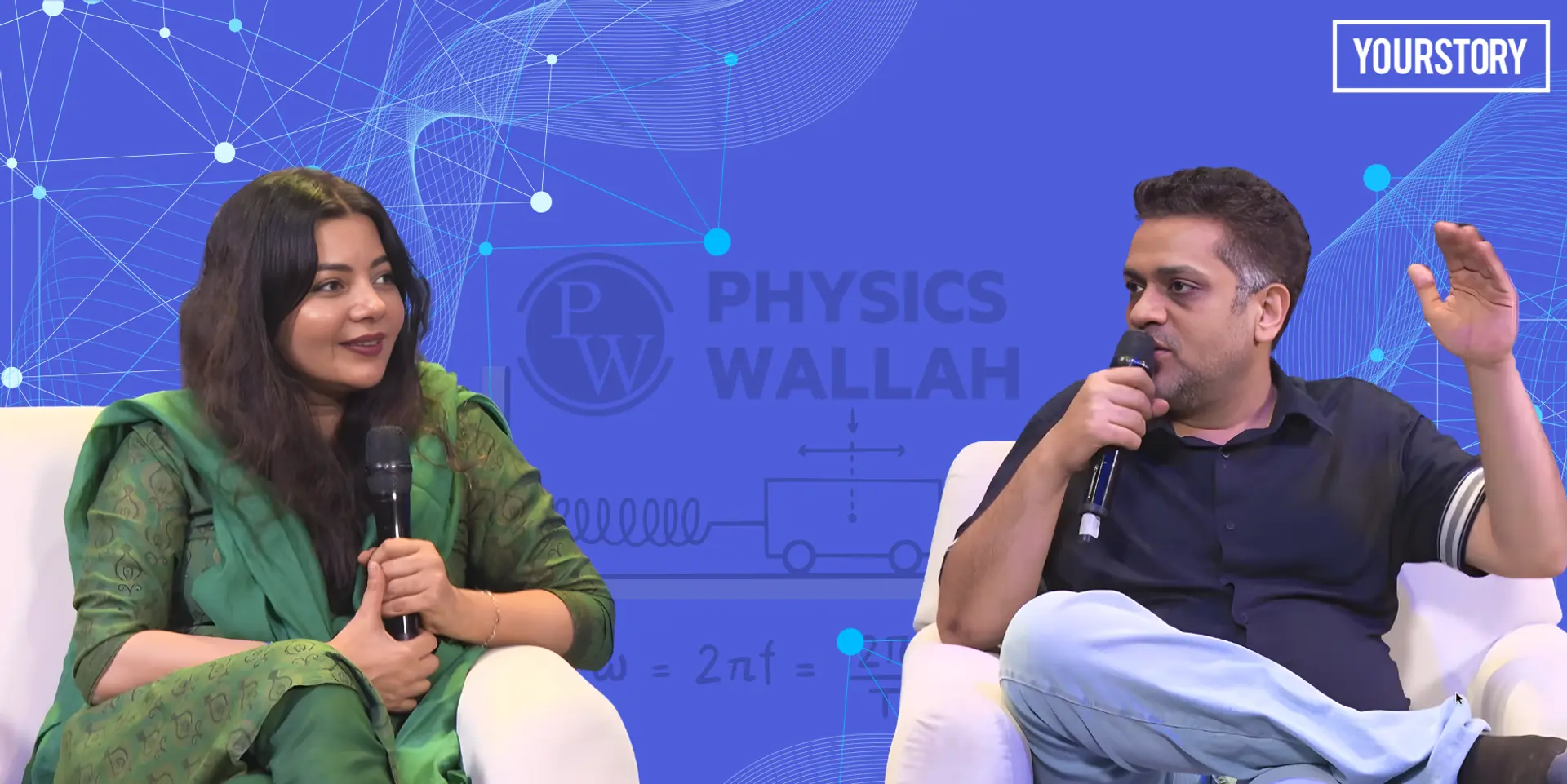

In a candid on-stage conversation with Shradha Sharma, founder and CEO of YourStory, Prateek Maheshwari - co-founder of Physics Wallah (PW) laid out a simple operating principle that, he argued, holds up even when markets feel “fully occupied”: keep the customer at the center, and get to revenue early.
The exchange took place at the India AI Impact Summit 2026, held in New Delhi. With thousands of early-stage founders and builders in the audience, Shradha asked Prateek what entrepreneurs should keep at the heart of everything they do.
His answer was direct: at Physics Wallah (PW), “we keep students at the center of everything we do.” And for anyone building from scratch, he added a second test that often gets ignored in the rush of ideation—move towards a revenue stage. “It’s very important you make revenue, you make profits, you have active paying customers,” he said, especially for founders still in the “zero to one” phase.
The point landed with added weight because PW is now a listed company, after its shares were listed on Indian exchanges on November 18, 2025.
Finding a niche in a “decided” market
Shradha then pushed the conversation into a question most founders wrestle with: how do you win in a space that appears dominated by incumbents—well-funded, well-known, and seemingly “decided”?
Prateek’s response was less about outspending competitors and more about narrowing the problem. He recalled that in 2017–18, it felt like the top four education-tech players were already set, “and there was no room for any new player.” PW, he said, found a large gap in the market: students preparing for exams who were outside the organised coaching ecosystem and lacked access to quality education. The company chose that segment, stayed with it, and went “deep, deep, deep” rather than trying to be everything to everyone at once.
Along the way, he offered a line that doubled as a warning against founder anxiety: “Sometimes ignorance is bliss.” The idea, in his telling, is to keep watching the user closely, create value consistently, and let results accumulate.
The “Chinese bamboo” years and an AI-first lens
Prateek also challenged the common perception that PW’s rise was sudden—something that simply happened during COVID. He described a longer, less visible phase before 2020 as the “Chinese bamboo” period: years of effort that appear quiet on the surface, and then suddenly show growth.
In his version of the backstory, Alakh Pandey built distribution and trust over years through online teaching, while Prateek worked on a separate business track—building PenPencil, a SaaS company serving educators and coaching institutes, and dealing with the rejections and slow adoption that came with trying to build B2B tech in India early. Those learnings, he suggested, became an advantage when the market shifted and online education adoption accelerated.
On AI, Prateek’s message was blunt: using AI only to cut costs is not a strategy. If founders treat AI as a layer of automation—support tickets, minor workflow shortcuts—without rethinking the product itself, they risk missing the real shift. Instead, he urged builders to think “AI-first”: redesign the workflow from the ground up as if AI is native to the process, not bolted on.
He described an ideal near-future where AI prepares meeting questions, records discussions, assigns tasks, and even offers a second opinion before and after leadership conversations—while still acknowledging that some human needs and relationships will remain fundamental.
For a crowd chasing speed and scale, the throughline of his conversation with Sharma stayed consistent: pick the user, build real value, reach revenue, and let the long game do its work.