



Union Budget 2026: FM Nirmala Sitharaman presents her ninth Budget in Lok Sabha
Welcome to our live coverage of Union Budget 2026, where we bring you real-time updates, expert insights, and key takeaways.

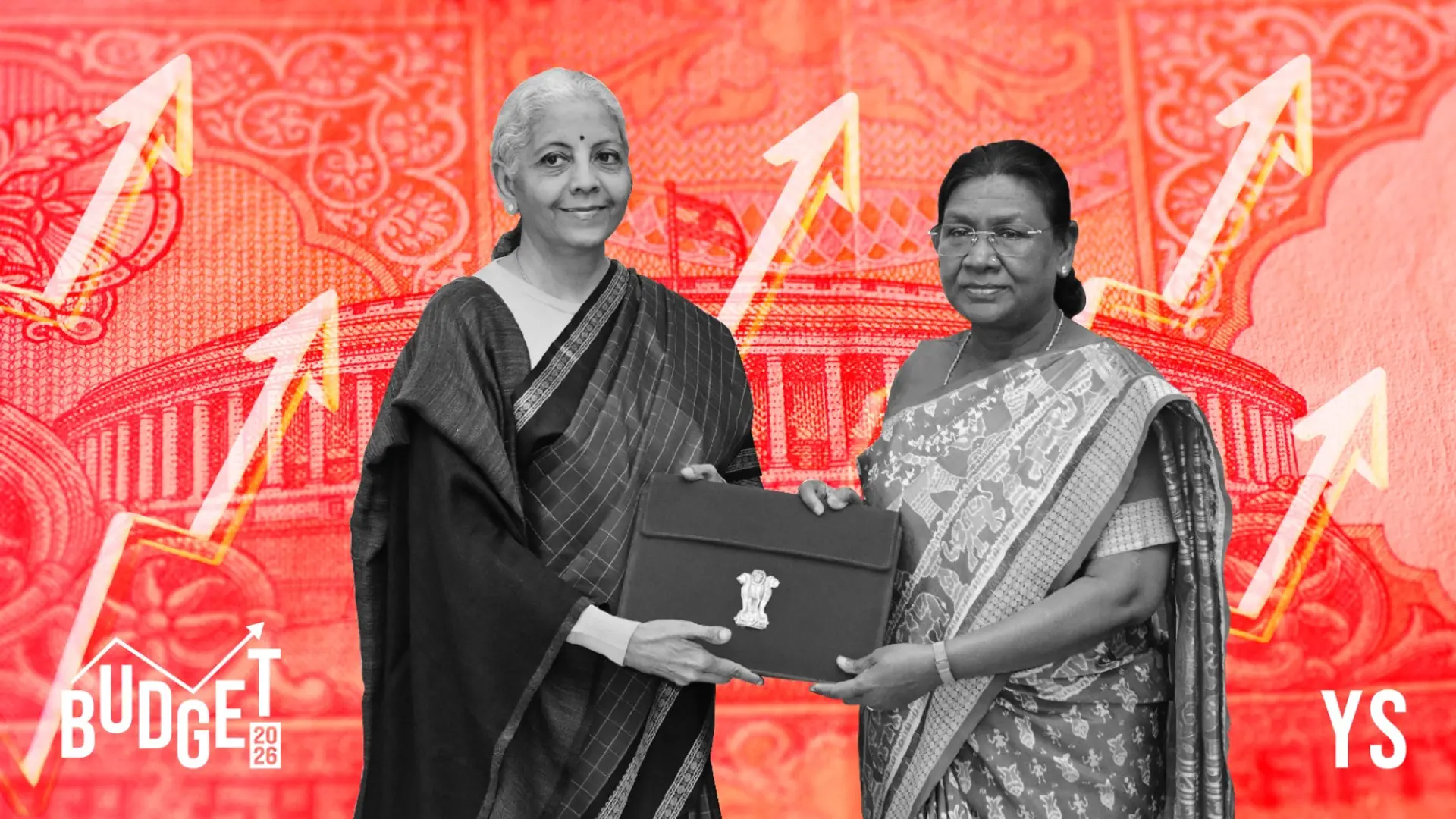

Finance Minister Nirmala Sitharaman presented the Union Budget 2026 in the Lok Sabha on Sunday—her ninth consecutive Budget.
FM Sitharaman is the longest-serving finance minister to hold the post continuously. She completed six years and eight months in office on January 31, 2026.
Ahead of the Budget session, Prime Minister Narendra Modi had said that Sitharaman presenting the Union Budget for the ninth consecutive time would be recorded as a matter of pride in India’s parliamentary history.
The FM met with President Droupadi Murmu to seek her approval for the Budget. Following this, the Union Cabinet approved the Budget ahead of Sitharaman's speech in Parliament at 11 am on February 1, 2026.
On January 29, the Economic Survey 2025–26 was tabled in the Parliament. The Survey said India remains among the fastest-growing major economies, with real GDP growth estimated at about 7.4% in FY26 and projected at 6.8 to 7.2% in FY27, supported by strong domestic demand. It highlighted improved macroeconomic stability, marked by moderating inflation, higher revenue mobilisation, and a healthier banking system with non-performing assets at multi-decade lows.
Private consumption and public capital expenditure continued to drive growth, while services remained a key engine of expansion. At the same time, the Survey flags risks from global uncertainty, geopolitical tensions, and trade disruptions, and stresses the need for sustained structural reforms to support long-term, inclusive growth.
Our coverage on major developments from Union Budget 2026 can be found here.
12:26 pm – FM concludes Union Budget 2026 presentation by seeking the introduction of Finance Bill 2026.
12:08 pm – Data centres: Proposal to provide tax holiday till 2047 to any foreign company that provides cloud services to customers globally by using data centre services from India. It will, however, need to provide services to Indian customers through an Indian reseller entity.
Proposal to provide a safe harbour of 15% on cost, in case the company providing data centre services from India is a related entity.
12:07 pm – Information technology services: With a common safe harbour margin of 15.5% applicable to all, the threshold for availing safe harbour for IT services is being enhanced from Rs 300 crore to Rs 2,000 crore rupees.
Safe harbour for IT services will be approved by an automated rule-driven process, without any need for a tax officer to examine and accept the application once supplied by an IT services company. The safe harbour can be continued for a period of five years at a stretch.
12:01 pm – A one-time, six month foreign asset disclosure scheme proposed to disclose income or assets below a certain size. It will address the practical issues of small taxpayers, like students, young professionals, tech employees, relocated NRIs, and others.
The scheme will be applicable for two categories of taxpayers: a) those who did not disclose their overseas income or assets, and b) those who disclosed their overseas in overseas income and or paid due tax but could not declare the asset acquired.
11:59 am – Revising returns: Extension of time available for revising returns from December 31 to up to March 31, with the payment of a nominal fee.
Proposal to stagger the timeline for filing of tax returns: Individuals with ITR-1 and ITR-2 returns will continue to file till July 31, while non-audit business cases or trusts have until August 31 to file their returns.
11:58 am – Scheme for small taxpayers: Role-based automated process will enable obtaining a lower or nil deduction certificate, instead of filing an application with the assessing officer, to ease burden on taxpayer holding securities in multiple companies.
Proposal to enable depositories to accept Form 15 G or Form 15 h from the investor and provide it directly to various relevant companies.
11:57 am – Reduction of TCS (tax collected at source) rate from 5% to 2% for remittances made under Liberalised Remittance Scheme for education and medical purposes
11:50 am – Fiscal deficit: The government has met its commitment, announced in 2021–22, to bring the fiscal deficit below 4.5% of GDP by 2025–26: Finance Minister
The revised estimate for the fiscal deficit in 2025–26 stands at 4.4% of GDP, in line with the Budget Estimate. For 2026–27, the fiscal deficit is projected to decline further to 4.3% of GDP: FM
11:47 am – Building on the success of the Lakhpati Didi programme, the government will support women in moving from credit-led livelihoods to being owners of enterprises. She (Self-Help Entrepreneur) MARTS will be set up as community-owned retail outlets run by women self-help entrepreneurs.
11:42 am – Proposal to launch Khelo India Mission to facilitate an integrated talent development pathway and systematic development of coaches and support staff. The mission will also facilitate integration of sports science technology and competitions and leagues to promote sports culture. It will provide platforms and development of sports infrastructure for training and competition.
11:38 am – Tourism sector has the potential to play a large role in employment generation and expanding the economy. Towards this, a National Institute of Hospitality Tourism will be set up by upgrading the existing National Council for Hotel Management and Catering Technology. It will function as a bridge between academia, industry and government.
11:37 am – Support will be given to the Indian Institute of Creative Technologies, Mumbai in setting up AVGC (Animation, Visual Effects, Gaming and Comics) Content Creator Labs in 15,000 secondary schools and 500 colleges across the country. A new National Institute of Design will be set up to boost design education and development in the eastern region of India.
11:35 am – Three new All India Institutes of Ayurveda will be set up. The FM also announces the upgrading of Ayush pharmacies and drug testing labs for higher standards of certification and to make more skilled personnel available. The WHO global traditional medicine centre in Jamnagar will be upgraded to bolster evidence-based research training and awareness for traditional medicine.
11:32 – Existing institutions for Allied Health Professionals (AHP) will be upgraded and new AHP institutions will be established in the private and government sectors. This will cover 10 selected disciplines, including optometry, radiology, anaesthesia, applied psychology and behavioural health, and add 100,000 AHPs over the next five years.
11:31 am – An 'Education to Employment and Enterprises Standing Committee' will be set up to optimise potential for growth, employment and exports. It will also assess the impact of emerging technologies, including AI, on jobs and skill requirements and propose measures.
11:20 am – SME Growth Fund: A dedicated Rs 10,000-crore SME Growth Fund to create future champions, incentivising enterprises based on select criteria. Proposal announced to top up the Self-Reliant India Fund set up in 2021 with Rs 2,000 crore, to continue support to micro enterprises and maintain their access to risk capital.
11:18 am – Mahatma Gandhi Gram Swaraj Initiative – to strengthen the khadi, handloom, and handicraft sectors. The initiative will focus on global market access and branding, alongside streamlined training, skilling, and quality standards. It is expected to benefit weavers, village industries, the One District One Product programme, and rural youth.
11:14 am – Rare Earth Corridors: A scheme for rare earth permanent magnets was launched in 2025 November. The FM announces a proposal to support the mineral rich states of Odisha, Kerala, Andhra Pradesh, and Tamil Nadu to establish dedicated rare earth corridors to promote mining, processing, research and manufacturing to enhance domestic chemical production and reduce import dependency. A scheme will be launched to support states in establishing three dedicated chemical paths through challenge route, on a cluster-based plug-and-play model.
11:12 am – India's Semiconductor Mission 2.0: to produce equipment and materials design full-stack Indian IP and fortify supply chains. The focus will be on industry-led research and training centres to develop technology and skilled workforce. The electronics components manufacturing scheme launched in April 2025, with an outlay of Rs 22,919 crore, already has investment commitments and doubled the targets. The FM has proposed to increase it to Rs 40,000 crore.
11:10 am – Biopharma SHAKTI (Strategy for Healthcare Advancement through Knowledge, Technology and Innovation), with an outlay of Rs 10,000 crore over the next five years, will build the ecosystem for domestic production of biologics and biosimilars. The strategy will include a biopharma focus network with three new National Institutes of Pharmaceutical Education and Research, popularly known as NIPER, and upgrading seven existing ones. It will also create a network of 1,000 accredited India clinical clients sites. Proposal to strengthen the Central Drug Standard Control Organisation to meet global standards announced.
11:07 am – FM highlights three kartavyas (duties): First kartavya is to accelerate and sustain economic growth by enhancing productivity and competitiveness and building resilience to volatile global dynamics. Second kartavya is to fulfill aspirations of people and build their capacity, making them strong partners in India's path to prosperity. The third kartavya is to ensure that every family, community, region, and sector has access to resources, amenities, and opportunities for meaningful participation.
11:04 am – Since assuming office 12 years ago, India's economic trajectory has been marked by stability, fiscal discipline, sustained growth, and moderate inflation. This is the result of conscious choices we have made, even in times heightened uncertainty and disruption: Finance Minister
11:03 am – Uproar in Parliament as FM Nirmala Sitharaman begins her Union Budget 2026 speech.
11:02 am – The Finance Minister commences Union Budget 2026 speech.
11:00 am – Budget session begins with an address by Lok Sabha speaker Om Birla.
10:40 am – The Union Cabinet, chaired by Prime Minister Narendra Modi, approved the Union Budget 2026.
10:15 am – Union Cabinet meeting commences in Parliament ahead of the Union Budget 2026 presentation.
10:05 am – Prime Minister Narendra Modi arrives at Parliament ahead of Union Budget 2026 presentation.
09:47 am – The Finance Minister takes photos with the digital tablet wrapped in a traditional ‘bahi-khata’ style pouch to present paperless Union Budget 2026.
09:45 am – The Finance Minister arrives at Parliament.
09:30 am – The Finance Minister arrives at Rashtrapati Bhavan to meet President Droupadi Murmu to seek her approval.
09:15 am – Stock markets open on trade flat at open ahead of the Budget 2026.
09:09 am – The Finance Minister, accompanied by her team, is seen outside the Ministry of Finance with the Budget tablet.
08:42 am – The Finance Minister arrives at Kartavya Bhavan.
08:30 am – Finance Minister Nirmala Sitharaman leaves her residence for the Ministry of Finance.