



Can AI help healthcare systems make sense of their data?
At DevSparks 2026 in Pune, Gaurav Tripathi, Co-founder and Group CTO at Partex.AI, shared how federated learning, knowledge graphs, and agentic AI can help healthcare institutions analyze fragmented medical data without compromising patient privacy.

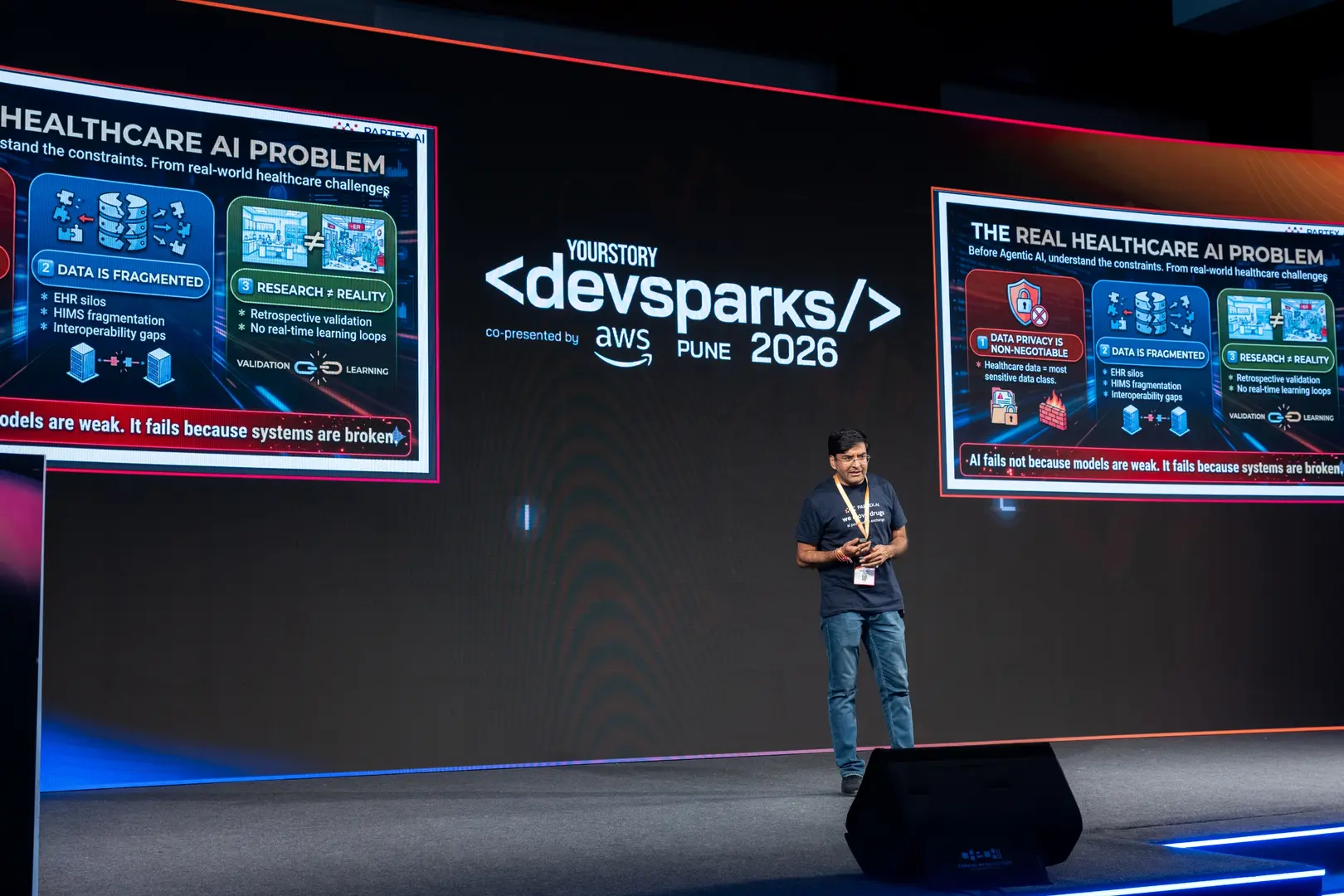

Healthcare systems generate vast amounts of patient information across hospitals, laboratories, diagnostic centers, and pharmacies, yet more data does not always lead to better healthcare outcomes. Medical records are often scattered across multiple systems that were designed for administrative functions rather than research or analysis, making it difficult for healthcare providers to identify patterns across patient histories or population health trends.
At DevSparks 2026 in Pune, a nationwide movement by YourStory focused on empowering India’s developer ecosystem with next-generation technologies, discussions explored how emerging AI architectures can help organizations work with complex data environments. One session examined how these technologies could address the challenge of fragmented medical information while protecting sensitive patient records.
In a talk titled ‘Agentic AI Impact Case Study Building Sovereign Healthcare Resilience’, Gaurav Tripathi, Co-founder and Group CTO at Partex.AI, explained how new approaches to AI development can allow healthcare institutions to analyze medical data without transferring it across systems or exposing sensitive information.
Drawing from Partex’s work on India’s first sovereign healthcare foundation model, Tripathi outlined how federated learning, knowledge graphs, and agentic AI can help bridge one of the most complex challenges in healthcare, using data effectively while keeping it private and secure.
The fragmented nature of healthcare data
Healthcare organizations rely on multiple digital systems to manage patient information, including electronic health records, hospital information management platforms, prescription databases, laboratory reporting tools, and appointment scheduling systems. Each of these systems captures valuable medical information, but they often operate independently, creating fragmented datasets that make it difficult to develop a unified view of patient histories or population health trends.
At the same time, advances in medical research increasingly depend on analyzing large datasets. Identifying patterns across diagnostic reports, treatment outcomes, and patient histories can help clinicians detect diseases earlier, understand how treatments perform across populations, and develop more effective therapies.
However, sharing this information across institutions introduces serious privacy concerns. Healthcare data is among the most sensitive categories of personal information, and organizations must ensure that patient records remain protected even when they are used for research or analytics. Tripathi described this challenge directly, noting that “data privacy is non-negotiable in healthcare”.
Sovereignty beyond data localization
Discussions around digital sovereignty often focus on where data is stored. Many countries emphasize keeping sensitive data within national borders to maintain regulatory oversight and reduce the risk of misuse.
Tripathi argued that sovereignty in healthcare involves more than simply controlling where data resides. Healthcare systems differ widely across regions, and AI systems trained primarily on international datasets may not accurately reflect local healthcare realities.
India’s healthcare infrastructure, patient demographics, and disease patterns differ significantly from those in Europe or the United States. As a result, AI models designed for global markets may struggle to capture the nuances of Indian healthcare systems.
Tripathi explained that sovereign healthcare models must account for these differences, supporting multilingual environments, adapting to regional clinical workflows, and complying with regulatory frameworks such as India’s Digital Personal Data Protection law.
Trust is also a critical component of sovereignty. Healthcare ecosystems involve patients, hospitals, research institutions, pharmaceutical companies, and regulators, all of whom must be confident that sensitive medical data is being handled responsibly.
Training AI models without moving the data
One technology that enables this approach is federated learning. Traditional AI development often requires collection of data from multiple organizations and storing it in centralized repositories where models can be trained. This approach can be effective in many industries, but it has risks when applied to healthcare because transferring patient records increases the likelihood of exposing sensitive information.
Federated learning changes this process by allowing models to be trained where the data already exists. Instead of sending patient records to a central system, AI models are deployed within hospital networks or research environments, where they can learn from local datasets while keeping the underlying information secure.
Tripathi explained: “We are not moving the data to the model. We are bringing the model to the data.”
In this architecture, only encrypted parameters or model updates are shared across systems. Patient data remains within its original environment, allowing organizations to collaborate on AI development while maintaining strict privacy protections.
Structuring knowledge before model training
Tripathi also discussed the importance of knowledge graphs in healthcare AI systems. While large language models receive significant attention in discussions about artificial intelligence, healthcare applications often require structured representations of biomedical knowledge.
Medical systems involve complex relationships between genes, proteins, diseases, drugs, and treatments. Knowledge graphs map these relationships, allowing AI systems to understand how different biomedical entities interact with one another.
Tripathi explained that this structured representation plays a crucial role in the sovereign healthcare foundation model developed by Partex. By integrating knowledge graphs with multimodal healthcare data such as laboratory reports, medical images, and patient histories, AI systems can generate insights that align more closely with clinical reasoning.
He said that the effectiveness of healthcare AI depends heavily on this stage of system design, noting that “the real strength is not in the model. The real strength is in what happens before the model”.
From data pipelines to agentic systems
Another major theme of the session was the role of agentic AI in managing healthcare data pipelines. Healthcare information often arrives in inconsistent formats, ranging from handwritten prescriptions and scanned documents to structured digital records.
Preparing this information for analysis traditionally requires significant manual effort. Data must be cleaned, validated, and standardized before it can be used for machine learning models.
Agentic AI helps automate many of these tasks. Agents collect data from multiple systems, detect errors, remove duplicate entries, and convert unstructured inputs into structured datasets that can be analyzed by AI models.
Tripathi explained that such systems can significantly accelerate scientific workflows, enabling research teams to process large volumes of healthcare data more efficiently while continuously improving data quality.
Implications for drug discovery and clinical research
The impact of these technologies extends beyond hospital operations into pharmaceutical research and drug development. Developing a new therapy typically takes more than a decade and requires billions of dollars in investment. Even after years of research, many clinical trials fail because researchers struggle to identify the right patients or detect meaningful treatment signals early enough.
AI systems built on federated healthcare data can help address these challenges by analyzing patient data across institutions while preserving privacy. These systems can identify patterns in treatment outcomes, disease progression, and genetic factors, helping researchers understand how therapies perform across different populations.
Such insights can improve clinical trial recruitment, accelerate drug discovery, and potentially connect patients with experimental treatments that may offer new therapeutic options.
Designing AI systems for the real world
Tripathi concluded the session by shifting the conversation back to developers. While much of the discussion around AI focuses on individual models or user interfaces, real-world applications increasingly depend on integrated systems that combine multiple technologies.
Modern AI architectures often involve orchestrating several components, including domain-specific models, knowledge graphs, federated-learning frameworks, and autonomous agents. Rather than relying on a single model to perform complex tasks, these systems coordinate multiple tools to solve real-world problems.
Tripathi said building effective healthcare AI will require systems that combine federated learning, knowledge graphs, and autonomous agents. Designing these architectures could allow healthcare institutions to analyze fragmented medical data while preserving privacy, opening new possibilities for clinical research, drug discovery, and data-driven healthcare decisions.