


Bareilly’s Cane & Bamboo Craft: Reimagining Tradition Through Contemporary Design
Bareilly’s cane and bamboo artisans are redefining traditional craft with modern design, structured production, and growing domestic and international demand, supported by ODOP initiatives.

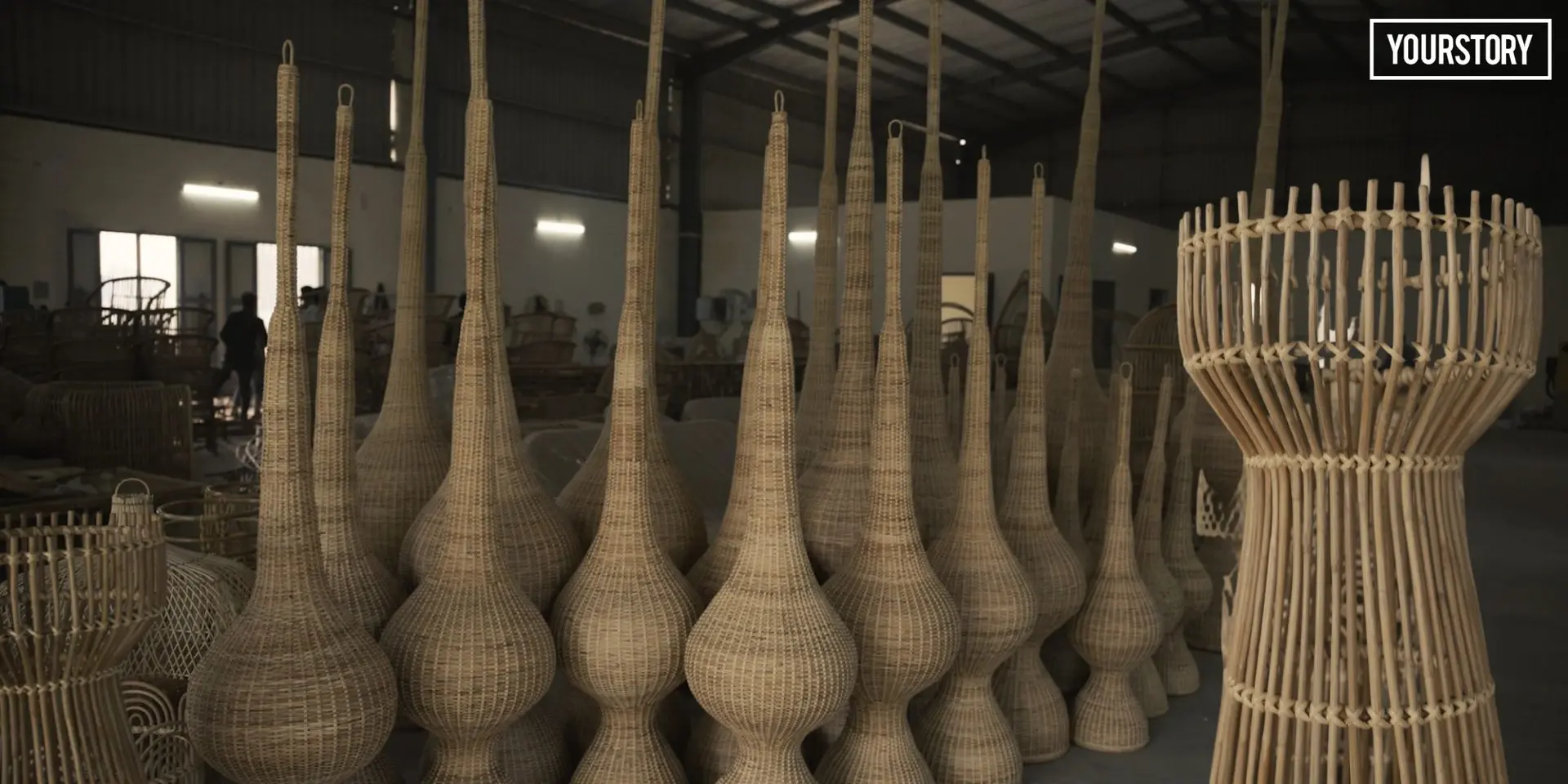

Across hospitality spaces, contemporary homes, and design-led retail, cane and bamboo furniture is finding renewed relevance. Buyers today are not only looking for handcrafted products but also expect refined finishes, modern proportions, and designs that align seamlessly with evolving interior aesthetics.
In Uttar Pradesh’s Bareilly district, this shift is being addressed through a growing cluster of cane and bamboo artisans who are blending traditional weaving techniques with contemporary design thinking. The result is a product range that retains the essence of handcrafted work while adapting to present-day market expectations.
The production ecosystem integrates multiple stages — from sourcing and treatment of raw materials to shaping, weaving, prototyping, and final execution. Cane is largely sourced from Assam, while bamboo is procured from nearby regions such as Pilibhit, Khatima, and the Gorakhpur tarai belt. The material undergoes a careful preparation process: cleaning, soaking, and heat-moulding to achieve the desired forms before weaving and assembly begin.
Production remains largely order-driven and prototype-led. Each product is first developed as a sample, shared with clients for feedback, and refined accordingly before moving into batch production. This ensures alignment with client expectations while maintaining consistency in quality.
Supported under the One District One Product (ODOP) programme, Bareilly’s cane and bamboo units have gained access to institutional platforms, including trade fairs and exhibitions. For entrepreneur Anurag Sonkar, participation in such platforms proved to be a turning point, enabling market linkages that translated into both domestic and international orders, including exports to Australia.
A graduate of the National Institute of Fashion Technology (NIFT), Sonkar established his unit in 2019 with a design-led approach. Rather than replicating traditional formats, he focused on developing contemporary furniture and décor products — chairs, benches, lamps, coffee tables, planters, and mirrors — using cane and bamboo in ways suited to modern interiors.
From an initial team of four to six artisans, the unit has expanded to a workforce of 20–30 individuals. Work is now organised based on skill specialisation: some artisans focus on weaving, others on structural furniture-making, while a separate group handles smaller products. This structured division has improved both efficiency and product quality, allowing artisans to deepen expertise in their respective areas.
A dedicated product development effort further strengthens the unit’s market responsiveness. New designs are regularly tested through client networks, with successful prototypes quickly moving into production. In one instance, a newly introduced planter design received over fifty orders shortly after being shared.
The enterprise caters to architects and interior designers across multiple Indian cities and has begun establishing its presence in international markets. Alongside production, a skill development initiative engages women from nearby villages in basketry work, creating additional livelihood opportunities and supporting flexible production capacity.
In Bareilly, cane and bamboo as materials have long been part of the craft tradition. Today, through design innovation, organised production, and institutional support, this craft is steadily finding its place in contemporary markets while preserving its core identity.