



Can Doubt Lead to Truth? Descartes Thought So
French philosopher René Descartes argued that questioning everything is the first step toward discovering truth. His idea shaped modern philosophy, science, and critical thinking.

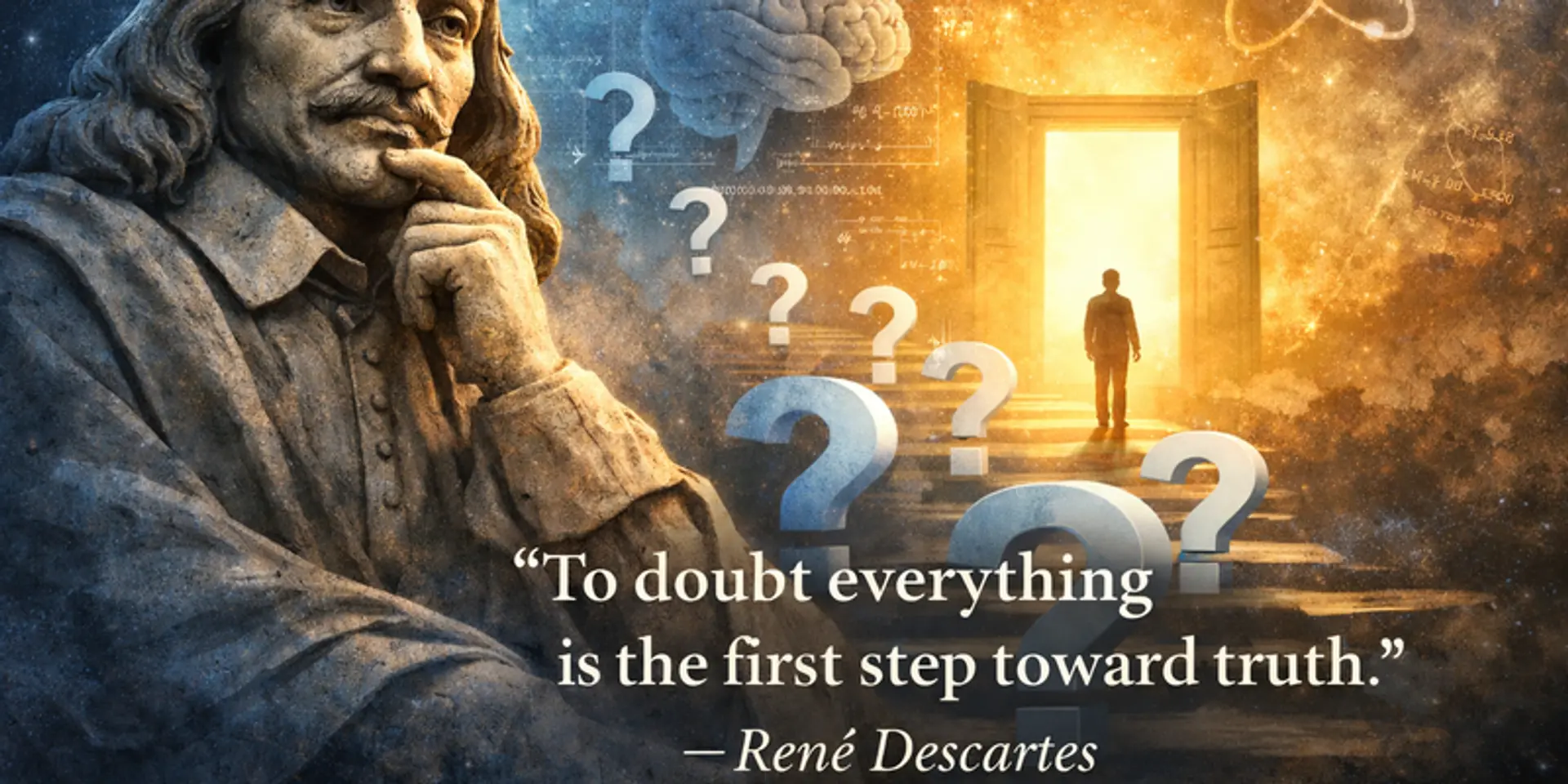

French philosopher René Descartes once wrote, “To doubt everything is the first step toward truth.” The statement, simple on the surface, sits at the heart of modern philosophy and scientific thinking. In an age flooded with information, opinions, and algorithms, Descartes’ message feels more relevant than ever: doubt is not a weakness of thought but its beginning.
Why doubt matters in the search for truth
Descartes lived in the 17th century, a time when European intellectual life was dominated by inherited beliefs and religious authority. Rather than accepting ideas simply because they were widely held, he proposed a radical approach: question everything that can possibly be doubted. His method, often called methodical doubt, was not meant to create endless scepticism but to identify knowledge that could withstand questioning.
In his famous work Meditations on First Philosophy, Descartes asked whether our senses could deceive us. Dreams, illusions, and errors suggested that perception alone could not always be trusted. From this process of questioning emerged his most famous conclusion: Cogito, ergo sum — “I think, therefore I am.” The act of doubting itself became proof that a thinking mind exists.
What Descartes demonstrated was powerful: when beliefs are tested rigorously, only the strongest ideas survive. Doubt, therefore, acts like a filter, removing assumptions and leaving behind clearer understanding.
Doubt as the engine of science and knowledge
Descartes’ philosophy did not remain confined to academic debate. His ideas influenced the development of modern science, which is built on questioning existing theories and testing them through evidence. Scientists routinely challenge hypotheses, run experiments, and invite criticism from peers. Knowledge advances precisely because certainty is treated with caution.
Consider how scientific breakthroughs emerge. Established ideas are questioned, data is re-examined, and unexpected results are investigated. Without doubt, discoveries ranging from medical treatments to space exploration would never have occurred.
In this sense, doubt is not destructive but constructive. It pushes thinkers to ask better questions and seek stronger evidence. Even in everyday life, questioning information — whether from social media, news sources, or public figures — can help people make more informed decisions.
The balance between scepticism and cynicism
However, Descartes’ idea should not be confused with cynicism or the rejection of all knowledge. Endless scepticism can lead to paralysis, where nothing is trusted and meaningful conclusions become impossible.
The goal of doubt is not to deny truth but to approach it more carefully.
Healthy scepticism encourages individuals to ask: What is the evidence? Who is providing the information? Are there alternative explanations? These questions strengthen understanding rather than undermine it.
In the digital age, where misinformation spreads quickly, Descartes’ advice offers a useful framework. Questioning claims, verifying sources, and examining assumptions can help navigate a complex information landscape.
Doubt as intellectual courage
At its core, Descartes’ statement is about intellectual courage. Doubting widely accepted ideas requires confidence and curiosity. It asks individuals to step beyond tradition and examine beliefs with fresh eyes.
More than three centuries later, the principle still holds. Progress in philosophy, science, journalism, and public debate often begins with someone willing to ask a simple but powerful question: Is this really true?
In that moment of questioning, the search for truth truly begins.