


1575367080560.png?format=auto&w=1920&q=75)
Flipkart
View Brand PublisherFrom being Flipkart’s backbone to scaling Bharat’s D2C brands, Ekart is building the new supply chain OS
For India’s fast-growing D2C brands, cracking the product is only half the battle; getting it to customers quickly and cost-effectively is the real test. Ekart is betting its nationwide logistics network can help brands scale across Bharat.


India has roughly over 11,000 D2C brands today, and a growing number of them are emerging from beyond the metros. Many founders have cracked product and distribution, but logistics, the unglamorous backbone of commerce, is often where ambition runs into operational reality.
Getting a package from a warehouse in Ludhiana to a customer’s doorstep in Nashik the next day, without destroying unit economics, is exactly the kind of problem Ekart was built to solve.
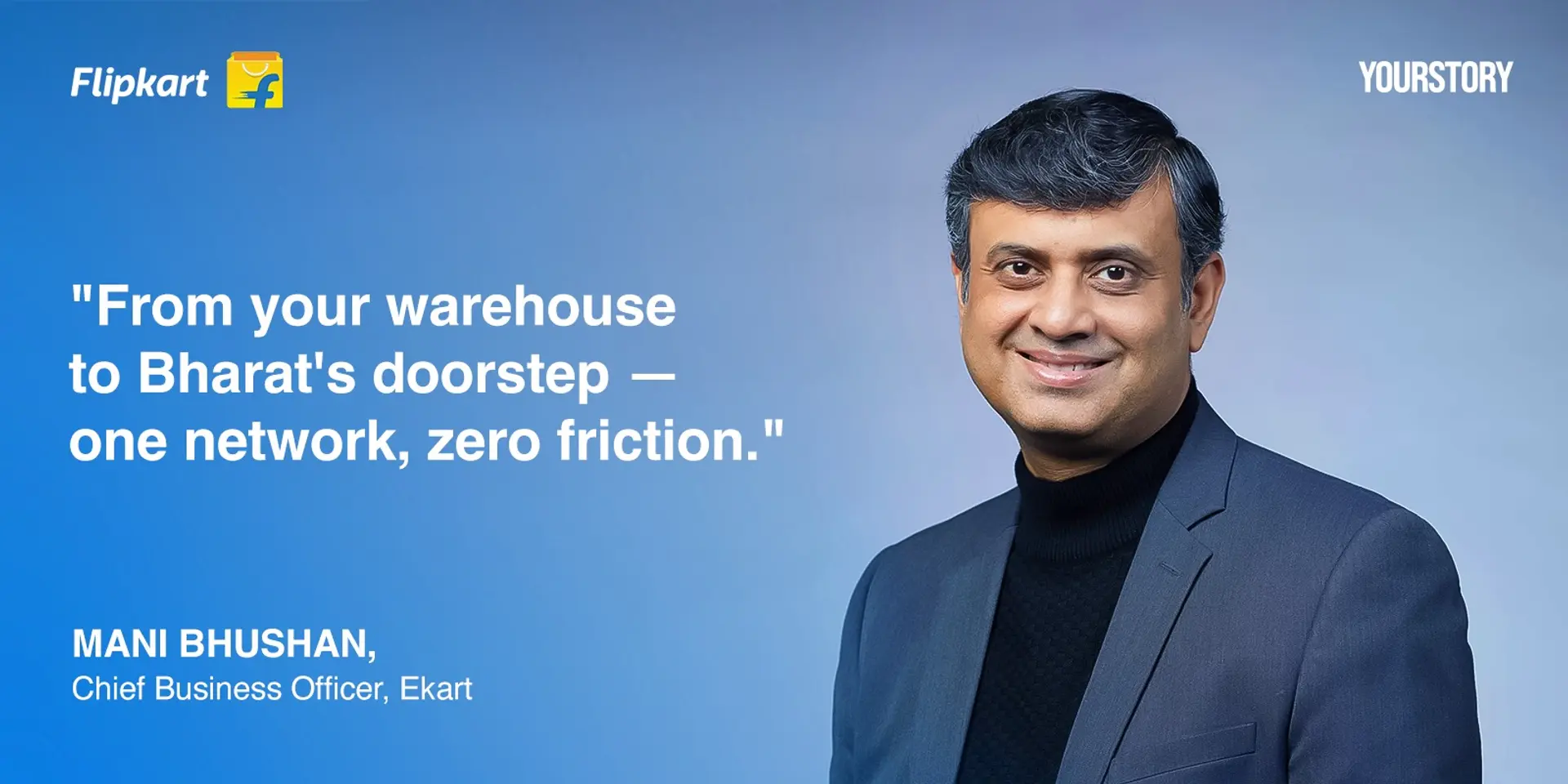
We spoke with Mr. Mani Bhushan, CBO of Ekart about what it takes to run logistics at scale in Bharat, why fragmented supply chains cost brands more than they realize, and how delivery expectations are likely to evolve in the coming years.
Edited excerpts:
India’s D2C ecosystem is expanding rapidly, especially beyond metro cities. From a logistics standpoint, what shifts are you seeing?
Three shifts stand out. First, Tier II cities are becoming operational bases, not just markets. Cities like Jaipur or Coimbatore offer significantly lower operating costs than metros, and many founders are deliberately building their businesses from these locations. What was once considered a compromise is now a strategic advantage.
Second is the shift in speed expectations. Same-day delivery (SDD) and next-day delivery (NDD) are no longer metro-only expectations. Customers across the country now expect faster delivery timelines, regardless of where the product ships from. If a brand cannot meet that expectation, it risks losing the sale.
Third, brands increasingly want to simplify their logistics stack. Managing separate partners for warehousing, linehaul, and last-mile delivery creates operational complexity. Many founders now prefer working with a single partner who can handle the entire supply chain.
How is Ekart helping D2C brands scale across Bharat and reach beyond the top cities?
One advantage Ekart brings is experience at scale. Built within Flipkart, the network has handled logistics across more than 80 ecommerce categories and under a wide range of operating conditions.
On the infrastructure side, Ekart operates a nationwide storage footprint that allows brands to position inventory closer to customers, which directly improves delivery timelines. The network currently supports next-day and D+2 deliveries across more than 15,000 pincodes, covering metros as well as Tier I, II, and III cities.
Ekart also manages bulk cargo movement through PTL services, picking up from manufacturing and import hubs and distributing inventory across retail channels. A particularly useful capability for growing brands is the ability to break bulk shipments into smaller lots and push them to multiple distribution points, ensuring inventory sits closer to demand. Ekart is one of the only players who offer this capability.
For D2C companies looking to unlock demand beyond the top cities, this reach can make a significant difference.
Can you walk us through Ekart’s end-to-end capabilities and how it helps a D2C brand?
Most D2C founders understand their product and customer extremely well. Running a nationwide supply chain, however, requires a different operational capability.
Ekart’s model is to manage the full journey, from manufacturing or import to the customer’s doorstep. Brands that move to this integrated stack typically see an 8-10% reduction in supply chain costs, largely because inefficiencies between multiple logistics partners disappear.
Beyond core logistics services, Ekart also offers value-added solutions such as Open-Box-Delivery, Hand-in-Hand Exchange, and air-network express deliveries for time-sensitive shipments.
For categories such as electronics or premium fashion, these services can influence whether customers trust a brand enough to complete a purchase.
How does technology help brands with inventory placement and faster deliveries?
Inventory placement is one of the most powerful levers in logistics, yet many brands underestimate its impact. When stock is positioned close to demand centers, delivery timelines improve, working capital requirements drop, and inventory turns faster. Brands that get this right build a structural advantage.
Ekart uses demand prediction systems to analyze order patterns and automate inventory placement across its warehousing network. Incoming inventory can be broken into smaller batches and distributed across nodes in near real time.
Instead of manually deciding where to place stock, brands benefit from continuous optimization based on demand signals. The result is faster deliveries, lower logistics costs, and less inventory sitting idle in the wrong locations.
Over time, logistics stops being just a cost center and becomes a key part of the customer experience.
Speed is critical for customer satisfaction. How does Ekart maintain delivery performance across India’s varied geographies, especially during peak seasons?
Warehouse infrastructure plays a key role. Ekart operates Grade A warehouse space across the top 20 towns in India, enabling brands to store inventory closer to consumption clusters.
Peak seasons, particularly festive periods, can place enormous pressure on logistics networks. Ekart’s approach is to work with brands well before the surge begins, helping them plan inventory placement and inward shipments ahead of time.
The company also provides visibility into warehouse capacity across its clusters, allowing brands to plan placements early. Brands that have worked with the network over multiple seasons often use this visibility to avoid last-minute bottlenecks.
Can you share an example of a D2C brand that saw measurable growth through logistics improvements?
One example involved a large new-age women’s ethnic fashion brand. After placing its North India inventory within Ekart’s warehousing network, the brand saw a 33% increase in demand within a short period. The only change was a one-to-two day improvement in promised delivery timelines.
Nothing else changed – same product, same pricing. But faster delivery promises increased customer confidence, which directly translated into higher sales.
Within six months, the brand expanded from one region to three zones, illustrating how quickly demand can respond when logistics efficiency improves.
What is the real advantage of having warehousing, fulfilment, linehaul, and last-mile delivery under one network?
The biggest advantages are cost efficiency and accountability. Fragmented supply chains create friction at every handoff between partners. Each transition introduces delays, coordination challenges, and potential damage risks. Consolidating the full journey under a single provider removes many of these inefficiencies, which is where the 8-10% cost savings often come from.
It also improves operational clarity. When one network manages warehousing, linehaul, and last-mile delivery, planning becomes sharper and there is clear ownership across the supply chain.
Brands can start with specific services such as last-mile delivery or warehousing and expand into the full stack as they scale.
Where do you see logistics taking India’s D2C growth over the next few years?
Customer expectations around delivery speed are only getting faster. Same-day and next-day delivery were once considered premium experiences. Today, they are increasingly becoming baseline expectations across categories.
Quick commerce has accelerated this shift. In some markets, 10-30 minute deliveries are gaining traction, while next-day delivery is becoming the minimum expectation for most ecommerce orders.
Building the infrastructure to support this shift requires long-term investment in logistics networks, warehousing, and technology across both large and smaller cities.
With nearly two decades of operational experience and a nationwide network, Ekart aims to help brands across India deliver faster to customers whether that means a 10-minute delivery in dense urban markets or a next-day shipment across states.