



Want better decisions? Start by making mistakes
Good decisions are not luck or talent. They are built through mistakes, reflection, and experience that sharpen judgement over time.

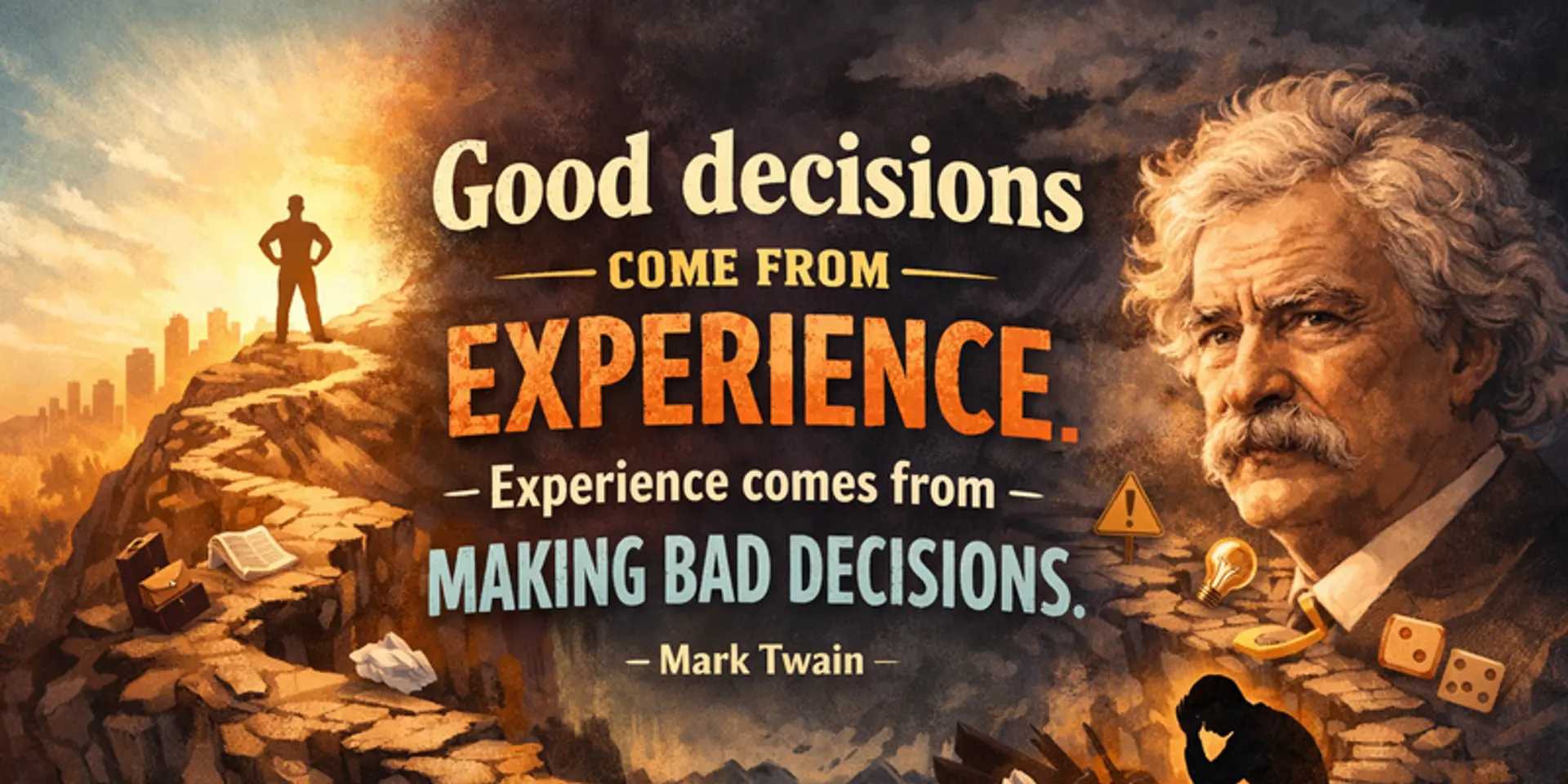

Good decisions come from experience
In a world obsessed with instant success, the quote by Mark Twain lands like a quiet truth bomb: “Good decisions come from experience. Experience comes from making bad decisions.” It is simple, almost obvious, yet deeply uncomfortable. Because hidden inside this wisdom is a reality most people try to avoid—failure is not a detour, it is the road.
From boardrooms to classrooms, we are conditioned to celebrate outcomes, not processes. We admire the founder who “got it right” or the professional who “made the smart call.” What we rarely see is the messy trail of wrong turns, misjudgements, and risks that led there. Experience, as Twain suggests, is not a gift handed out neatly. It is earned, often painfully.
Bad decisions are not inherently failures. They are feedback. Each poor choice exposes blind spots—gaps in judgement, biases, or incomplete information. When someone invests in the wrong opportunity, trusts the wrong partner, or misreads a situation, the immediate result may be loss. But the long-term gain is clarity. That clarity sharpens instinct, making future decisions more informed and grounded.
Consider how decision-making evolves over time. Early in a career, choices are often driven by external validation—salary, titles, or trends. Mistakes at this stage can feel costly, but they serve as calibration points. Over time, individuals begin to recognise patterns. They understand risk better, weigh trade-offs more effectively, and develop a sense of timing. This is not intuition in the magical sense. It is accumulated experience disguised as instinct.
The irony is that people often try to avoid mistakes altogether, believing that caution leads to better outcomes. In reality, excessive caution can limit exposure to learning. Without making decisions—good or bad—there is no data to learn from. Growth stalls not because of failure, but because of the fear of it.
However, not all bad decisions are equal. The key lies in reflection. Experience is not simply what happens to you; it is what you do with what happens. Two people can make the same mistake, but only one learns from it. The difference lies in the willingness to analyse what went wrong, take responsibility, and adjust behaviour accordingly.
This is especially relevant in fast-moving environments like startups, technology, or creative industries, where uncertainty is constant. Here, decision-making is less about certainty and more about adaptability. Leaders who succeed are not those who never fail, but those who fail intelligently—quickly, cheaply, and with lessons extracted.
Twain’s insight also reframes how we view success stories. What appears as a “good decision” is often the visible tip of an iceberg built on past missteps. The seasoned professional does not avoid risk; they navigate it better because they have seen what happens when things go wrong.
Ultimately, the quote is less about mistakes and more about resilience. It reminds us that bad decisions are not endpoints, but building blocks. Each one, when understood, adds depth to judgement.
In a culture that demands perfection, this perspective is liberating. It allows room for trial, error, and growth. Because in the end, good decisions are not born out of perfection—they are shaped by experience. And experience, as Twain rightly points out, is forged in the moments we would rather forget.