



Risk, resilience, growth: Lessons from three founders building high-trust businesses
At SheSparks 2026, three women who built companies in healthcare, aviation, and consumer hardware, sat down to talk about credibility and what it really takes to lead in industries where the margin for error is almost zero.

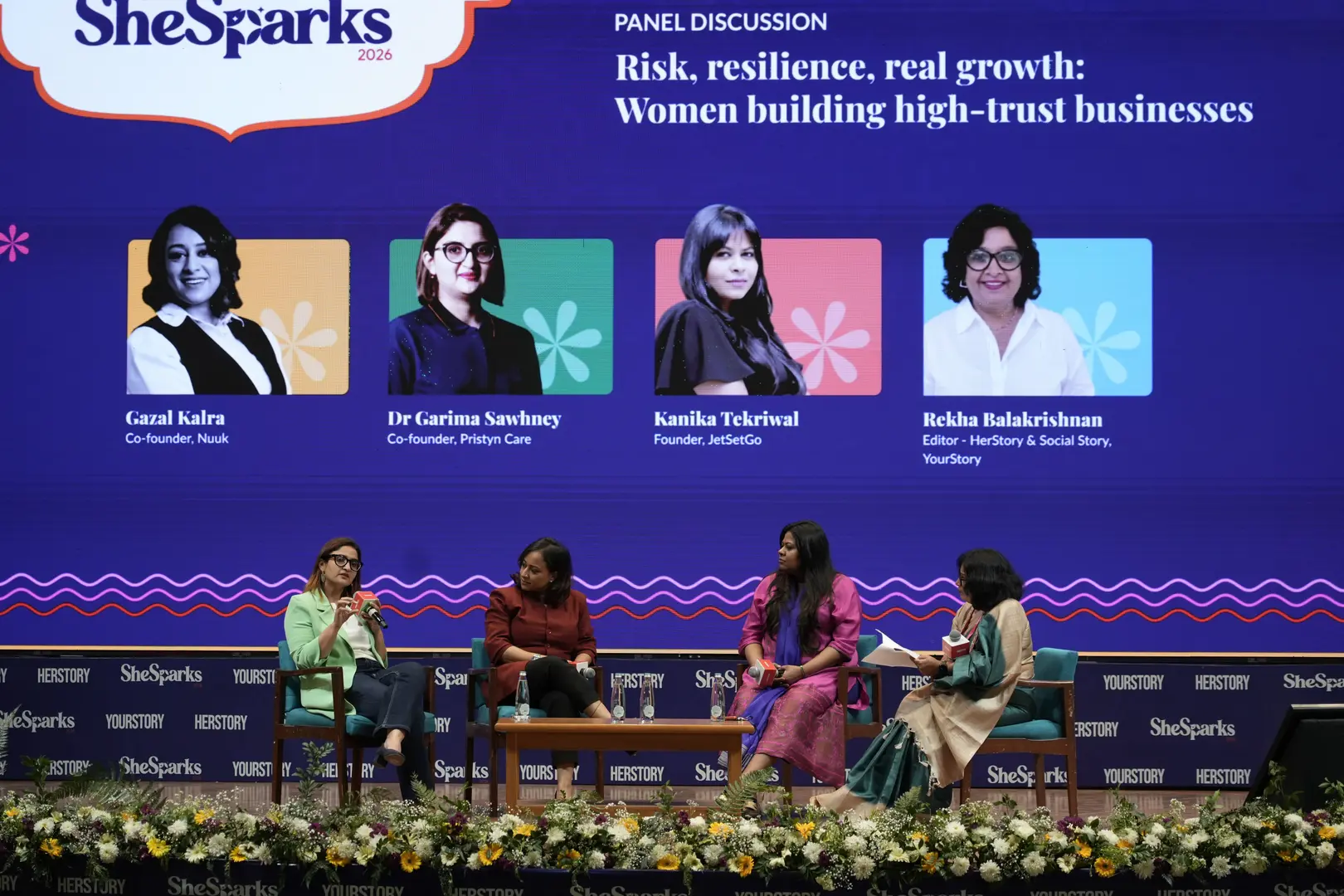

Some businesses are challenging because markets are competitive. Others are difficult because people's safety and well-being depend on them. Healthcare, aviation, and consumer hardware are industries where trust is not a brand value but a baseline requirement. The margin for error is small, capital demands are high, and credibility takes years to earn. They are also historically male-dominated spaces.
At SheSparks 2026, three founders building in these sectors—Dr Garima Sawhney of Pristyn Care; Gazal Kalra of Nuuk and previously Rivigo; and Kanika Tekriwal of JetSetGo, sat with Rekha Balakrishnan, Editor of HerStory and Social Story at YourStory. They unpacked the real journey: unexpected hurdles, closed-door dynamics, and their case for redefining leadership their way.
The problem that couldn't wait
Each of the three founders was drawn into their sector by a problem they couldn't unsee.
Dr Garima Sawhney, once a surgeon, saw patients fighting not just sickness, but messy insurance and scattered care that wore out families first. “One doctor helps one patient. An ecosystem reaches millions,” she said. Pristyn Care makes surgical care easy across India.
Gazal Kalra observed that most home appliances, largely designed by men, ignored the everyday realities of women, who are often the primary users. While functional, they missed real needs. Nuuk aims to change that as a design-first brand focused on simplifying everyday life across India’s diverse households.
Kanika Tekriwal got started from a customer's complaint: people were ready to pay a premium but were stuck with cold sandwiches and no real aircraft choices. India's private aviation was broken. Her first booking app crashed on launch when a plane pulled out at the last minute. She pivoted to fleet management, service, and trust, building JetSetGo into India's biggest private fleet in two years, without owning any planes.
Not risk-averse. Risk aware.
But stereotypes followed them everywhere. The biggest stereotype that women are risk-averse, too timid for bold calls, and too indecisive to lead when the stakes are high, questions their place in male-dominated fields most directly.
Dr Sawhney countered directly: “I believe women are more risk aware.” She added, “And there is a big difference between the two.” In a surgical context, you don't avoid risk; you prepare for every possible thing that could go wrong. That's not timidity.
Gazal said, women think more multidimensionally. They account for more variables, more outcomes, more people in the equation, and that broader thinking is precisely what high-trust sectors need.
Kanika made the same argument with a number. JetSetGo places a woman in every cockpit. With two male pilots, aircraft tyres lasted around 85 to 88 landings. Put a woman in the cockpit, and that number climbed to 140 to 150, saving thousands of dollars in a year.
Smart decision-making, applied consistently, shows up in the balance sheet. The panel's broader argument: women don’t dodge risk. They manage it smarter with more dimensions, better prep, and safer downside.
Being heard in rooms that weren't built for you
But being risk-averse is just one stereotype. In boardrooms, women get talked over, dismissed as coffee makers, their words questioned mid-sentence. All three entered such rooms as the only woman, the youngest, or both. How did they get taken seriously?
Dr Sawhney's rule was simple: lead with numbers, close with patience. “There is no gender discrimination when you present the number; it is the person presenting the number.” And when you are interrupted, which you will be, go silent. Let the room run. Restart from exactly where you stopped.
Kanika’s battle was a step before that, being seen as the person who belongs in the room at all.
She recalls walking into a sales meeting at 21, clueless, nervous, and the last person to enter the room. Before she could say a word, someone asked her if she wouldn't mind taking coffee orders.
She paused, sat down, and said: “I'm here to sell you planes”. She conquered that deal, and today, that client is one of her biggest champions. “I've been the only skirt in a sea of suits,” she said. “I wear that skirt with a lot of pride.”
Her survival guide? Find a way around it, make everyone a bhaiya, a sir, an uncle if you have to. “It's up to you whether you use it to your favour or disfavour. Because 'I couldn't get this done because I'm a woman' is the easiest excuse to give.”
Gazal's take went deeper. “Women are the first to judge themselves when they look in the mirror and think about how they look, and more.” As long as you don't label yourself internally and reduce yourself to just that, what the world says, it stops having the same hold. When her presence was questioned early on, she made it her story, and it opened more doors than it closed.
Empathy is the edge, and it's not going away
While pushing back against labels like “female entrepreneur” and constant dismissal, women are told that empathy is a weakness, and a heart-led style is unfit for leadership, and that business needs ruthlessness.
“Men talk numbers. Women lead with heart,” Gazal said. “That was our ‘flaw’.” But command-control is shifting to care cultures.
She built Nuuk with empathy at its core. Their research revealed that cleaning responsibilities still fall largely on women, an everyday burden often overlooked by teams. Nuuk’s vacuums address this in practical ways: printed attachments, sticker guides, and made for dummies who keep asking “what goes where” even after repeated instructions.
As one user wrote: “I never have to touch it.” Half of Nuuk’s designers are women, not as a side note, but as a core element to the product. A step to gender-neutral design that fits real lives.
Recent Anthropic data backs her: Empathy-driven jobs like social services and care are least likely to be replaced by AI, perfect for high-trust industries. “Give it 10 years,” she said. “What was called women's weakness becomes our biggest superpower.”
Success in high-trust fields goes beyond cash or bold risks. It's credibility, grit, and empathy, the toolkit these women used to reshape their sectors.
Edited by Megha Reddy