



The Voynich manuscript: History’s strangest unsolved book
A 600-year-old book no one can understand. Meet the Voynich Manuscript, which looks like science, reads like language, and still defeats experts and AI!


Meet the book that no person can interpret. For over 6 centuries, the Voynich Manuscript has remained one of history’s most baffling mysteries. It looks like a scientific text. It behaves like a language. Yet no one has been able to understand a single sentence.
Not modern scholars. Not World War II codebreakers. Not even today’s most advanced AI systems. Here's everything you need to know about the Voynich manuscript.
A discovery that sparked a century of curiosity
The manuscript entered public attention in 1912 when rare book dealer Wilfrid Voynich acquired it from a Jesuit collection in Italy. That is where it gets its name.
Historical records suggest the manuscript may have once belonged to Rudolf II, Holy Roman Emperor, who reportedly purchased it for 600 ducats, believing it held significant value. Today, it is preserved at the Beinecke Rare Book and Manuscript Library at Yale University, catalogued as MS 408.
Despite decades of study, it remains officially classified as an undeciphered manuscript.
What does the manuscript actually contain?
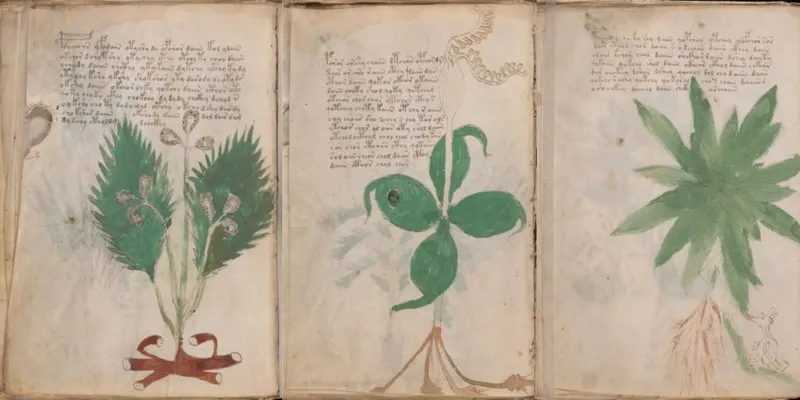
At first glance, the manuscript appears structured, almost like a scientific or medical text. Radiocarbon dating places its vellum between 1404 and 1438, confirming its medieval origin. The book contains around 240 pages, filled with detailed illustrations and dense text written in an unknown script often referred to as “Voynichese”.
Credit: https://www.voynich.nu/index.html
The content is typically divided into sections:
• Botanical drawings of unknown plants
• Astronomical diagrams
• Illustrations of human figures
• Pages that look like herbal or medical recipes
The illustrations feel familiar yet strange. Plants do not match known species. Diagrams resemble real systems but do not align with existing knowledge. It is as if the manuscript belongs to a world that almost makes sense, but never fully does.
A language that looks real, but isn’t understood
One of the most fascinating aspects of the Voynich Manuscript is its script. The text follows patterns similar to natural languages. Word lengths vary. Certain symbols repeat in predictable ways. Statistical studies even show that it follows patterns like Zipf’s law, a property commonly found in real languages.
And yet, no one can translate it. This has led researchers to believe that the manuscript is not random. It is structured, intentional, and possibly meaningful. But the key to decoding it remains missing.
Theories that almost explain it
Over the years, scholars have proposed multiple theories about what the manuscript might be. Some believe it is a herbal or medical guide, based on its plant illustrations. Others argue it could be an alchemical text or an astronomical manual.
There have also been suggestions that it is a coded language, possibly designed to conceal sensitive knowledge. Hoax theories have emerged as well. Some speculated that Wilfrid Voynich himself may have forged it.
However, radiocarbon dating and the complexity of the manuscript have largely dismissed this idea. Creating such a detailed and consistent document would have required extraordinary effort and historical accuracy. No single theory has been universally accepted.
Why can't experts decode it?
The manuscript has attracted some of the best minds in cryptography. During World War II, professional codebreakers attempted to decipher it, applying techniques used to crack military cyphers. They failed. The challenge lies in the absence of a reference point. There is no known language to compare it to, no bilingual text, and no clear cypher system. Without a starting key, even the most advanced methods struggle.
Can artificial intelligence solve it?
In recent years, researchers have turned to AI. Teams have used natural language processing models to compare the text against hundreds of known languages. One such attempt suggested Hebrew as a possible base, but the resulting translations were inconsistent and largely meaningless.
More advanced models, including transformer-based systems, have identified patterns in the text. They confirm that the manuscript behaves like a real language rather than random noise. But pattern recognition is not the same as understanding.
As of 2026, no AI system has successfully decoded the manuscript in a way that is verified by experts. Claims of breakthroughs continue to appear online, but none have been independently validated. The manuscript remains unreadable.
Closing thoughts
600 years later, the Voynich manuscript remains silent. It has survived empires, technological revolutions, and the rise of artificial intelligence without revealing its meaning. And perhaps that is what makes it so compelling. In a world obsessed with answers, it continues to ask a question no one can solve.