



India’s next phase of growth will be driven by innovation
As India moves towards Viksit Bharat 2047, its next growth phase will depend on how effectively universities, startups, industry and policy turn research into scalable global technologies.

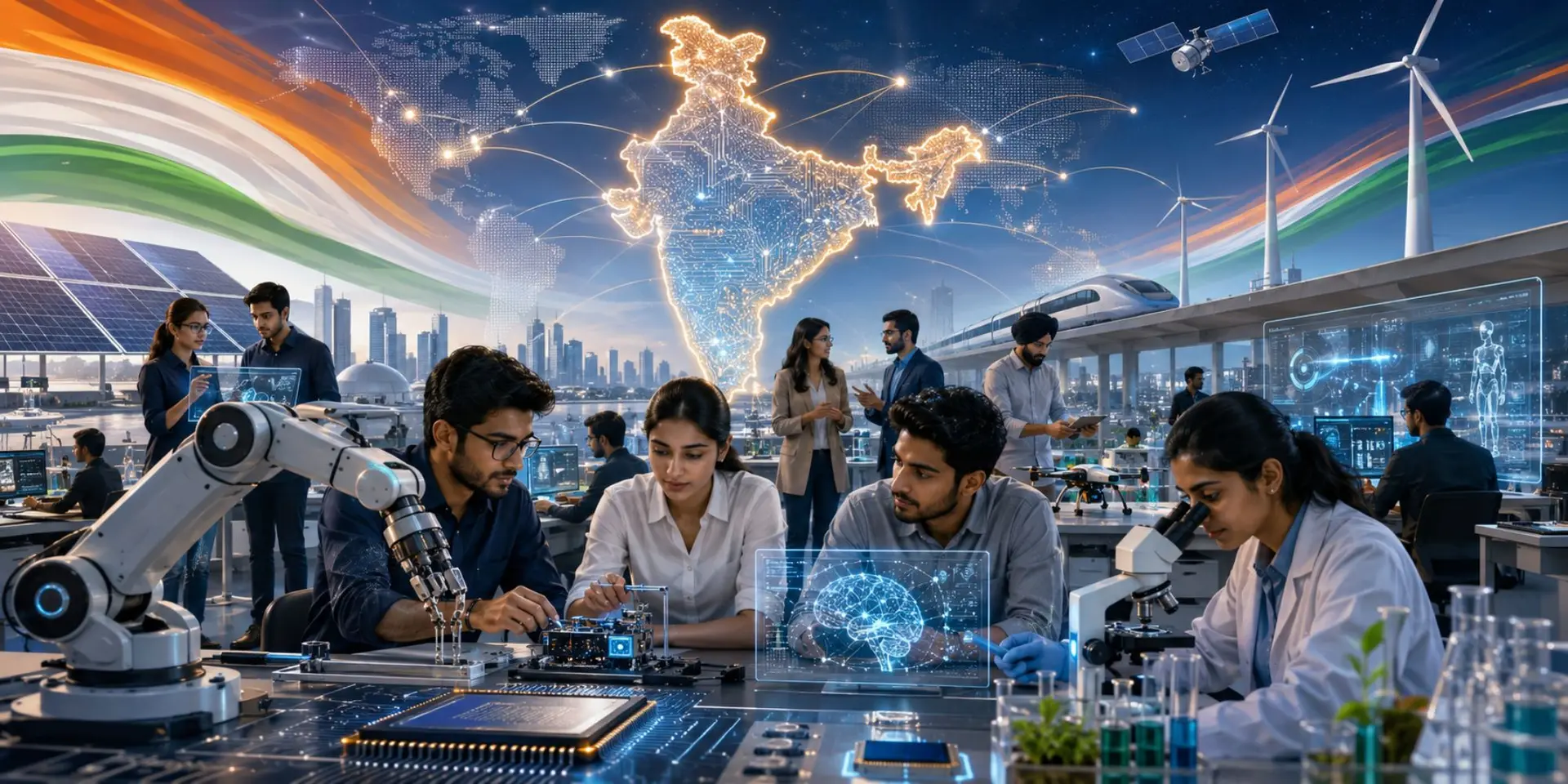

India’s next phase of growth will be shaped by how effectively it turns ideas into institutions, enterprises and technologies for the world.
From policy intent to innovation infrastructure
Over the last decade, India has built many of the foundations required for an innovation-led economy. The number of Government of India recognised start-ups has grown from around 500 in 2016 to more than 2 lakh by December 2025. Recognised start-ups have also created more than 21 lakh jobs, showing how policy support has translated into enterprise creation and employment.
This momentum has been supported by investments in digital infrastructure, entrepreneurship, research, higher education and innovation-led policy. India’s innovation capacity is also gaining global recognition. In the Global Innovation Index 2025, India ranked 38th among 139 economies and first among lower middle-income economies.
Initiatives such as Startup India, Atal Innovation Mission, iDEX, BIRAC and the IndiaAI Mission have helped create stronger pathways for entrepreneurship and research-backed innovation. The Atal Innovation Mission has supported 10,000 Atal Tinkering Labs of the Ministry of Education and run by NITI Aayog, engaging more than 1.1 crore students, while the IndiaAI Mission has been approved with an outlay of ₹10,371.92 crore over five years.
The next challenge is execution
Policy has created the base. The next phase will depend on how effectively ideas move from frameworks to real-world solutions.
Across the country, a new generation of founders, researchers and students is building with a confidence that feels distinctly Indian. Ambitious, globally aware and practical, this generation is solving for scale from day one because India itself demands scale. Their work spans healthcare, clean energy, manufacturing, mobility, AI, semiconductors, agriculture, biotechnology and deep-tech, each area critical to the country’s future.
Innovation cannot thrive in silos
There is growing recognition that innovation cannot be built by one part of the system alone. Governments can create enabling frameworks. Industry can provide scale, market access and operational understanding. Universities and research institutions can nurture talent, experimentation and discovery.
Real progress happens when these parts work together.
Public institutions are showing the way
India’s public Higher Education Institutions, like IITs and IISc, have played an important role in building this innovation base. IIT Madras and IIT Bombay have emerged as strong deep-tech incubation hubs have over 1000 startups, with a combined valuation exceeding over 9 billion dollars creating tens of thousands of direct jobs. In FY 2024–25 alone, IIT Madras incubated over 100 deep-tech start-ups.
This matters because it shows how universities can move beyond teaching and become centres for research, product development, enterprise creation and industry collaboration.
Private universities must deepen the innovation culture
Private institutions also have an important role to play in expanding India’s innovation ecosystem. Universities such as Shiv Nadar University, Delhi-NCR and KREA University can help build environments where interdisciplinary learning, research, entrepreneurship and real-world problem-solving come together.
At Shiv Nadar University, Delhi-NCR, this means encouraging students to question assumptions, work across disciplines and engage with complex challenges. Innovation cannot be treated only as an output. It has to become a mindset shaped through curiosity, rigour and execution discipline.
Taking Indian innovation to the world
Bharat Innovates 2026, an initiative by the Ministry of Education captures this moment well. Announced during the India-France Year of Innovation, the initiative reflects a larger national effort to take ideas born in India’s education and research ecosystem to global markets, investors, institutions and industry partners.
This aligns closely with the vision of Viksit Bharat 2047, the national aspiration to build a developed India by the centenary of independence. Its focus on pilots, co-development, research partnerships, investment and market access is important because this is where innovation becomes real. Ideas have to leave the lab, find users, meet industry needs and prove that they can go beyond India.
This matters because it creates resilience, adaptability, and execution discipline, qualities evident in the ventures showcased at Bharat Innovates 2026 in France. The range is remarkable. Indian companies are building quantum cybersecurity platforms, AI systems for industrial safety, advanced robotics, multilingual AI models, climate technologies and next-generation healthcare solutions. Many of these ventures have emerged from India’s academic and research ecosystem, reflecting the growing relationship between higher education and enterprise creation.
What India must strengthen now
As India moves towards the vision of Viksit Bharat 2047, the ability to convert knowledge into practical, scalable outcomes is important. Economic growth alone will not define a nation's status as a developed nation. The ability to create original technology, strengthen research capability and build globally competitive institutions will matter just as much.
There are a few areas that deserve attention as India strengthens its innovation ecosystem. Industry-academia partnerships need to become more sustained and long-term. Many breakthrough technologies require patient capital, deeper research cycles and continuous collaboration between scientists, entrepreneurs and industry leaders.
India also needs stronger pathways that accelerate research from the laboratory into products and enterprises. Young innovators often struggle during the transition from early experimentation to commercial deployment. Better support systems for testing, mentoring, funding and market access can help bridge this gap. Finally, innovation ecosystems grow stronger when they remain globally connected.
International collaboration in research, technology and education creates opportunities for shared learning and faster progress. Platforms such as Bharat Innovates are important because they allow Indian innovators to engage with global investors, institutions and industry leaders at a meaningful level.
Innovation will shape India’s global role
India has entered a phase where innovation is becoming part of the national imagination. It can be seen in classrooms, start-ups, research labs, manufacturing facilities and young companies trying to solve problems with ambition and speed. The opportunity now is to sustain this momentum with patience, institutional depth and long-term thinking. The countries that shape the future will build ideas, talent and institutions that influence the world. India has every opportunity to become one of them.
By: Shikhar Malhotra, Trustee, Shiv Nadar Foundation