



Morning Owl bets on trust and transparency in India’s crowded mattress market
Kerala-based natural latex mattress brand Morning Owl is cutting through industry noise with a simple promise: show customers exactly what they’re buying.



Walk into a Morning Owl showroom and the sales pitch begins differently. Before anyone speaks about comfort, firmness, or price, a staff member lets you unzip a mattress cover and see what's inside: certified natural Dunlop latex, made from rubber sourced from farms in Kerala. No hidden foam layers. No mystery fillings. No glossy claims standing between you and the product.
That small moment says a lot about Morning Owl’s larger philosophy. In an Indian mattress market packed with terms like “orthopedic”, “smart grid”, “advanced sleep technology”, and even “natural”, the brand is choosing proof with verification. Instead of asking customers to believe the marketing, it invites them to inspect the material for themselves.
The Kerala advantage
Morning Owl is manufactured in Kottayam, Kerala, in the heart of India's natural rubber belt. The location is central to the company’s identity. For generations, Kottayam and its surrounding districts have supplied the global rubber industry, with smallholder farmers continuing to drive much of India's natural rubber production.
Morning Owl sources latex locally, and uses the traditional Dunlop process to shape it into mattress cores. In a category where many premium brands either import latex or remain vague about sourcing, the brand’s ability to point to a specific region, a clear production process, and a specific farming ecosystem offers something uncommon: transparency
Why latex became the anchor
India's mattress market has expanded rapidly over the past decade, but so has the gap between branding and material reality. Mattresses with only thin latex comfort layers are often sold as full latex products. Standard polyurethane foam is repackaged with premium-sounding language. Certifications, health claims, and technology buzzwords may impress, but they often leave buyers no clearer about what they are actually sleeping on.
That model is beginning to wear thin. Consumers today are better informed, more skeptical, and increasingly willing to question what they are paying for. A mattress is no longer seen only as a household purchase; it is becoming part of the broader wellness conversation, linked to, posture, comfort, recovery and quality of life. As a result, buyers are looking past discounts and branding toward materials, durability, certifications, and long-term product experience.
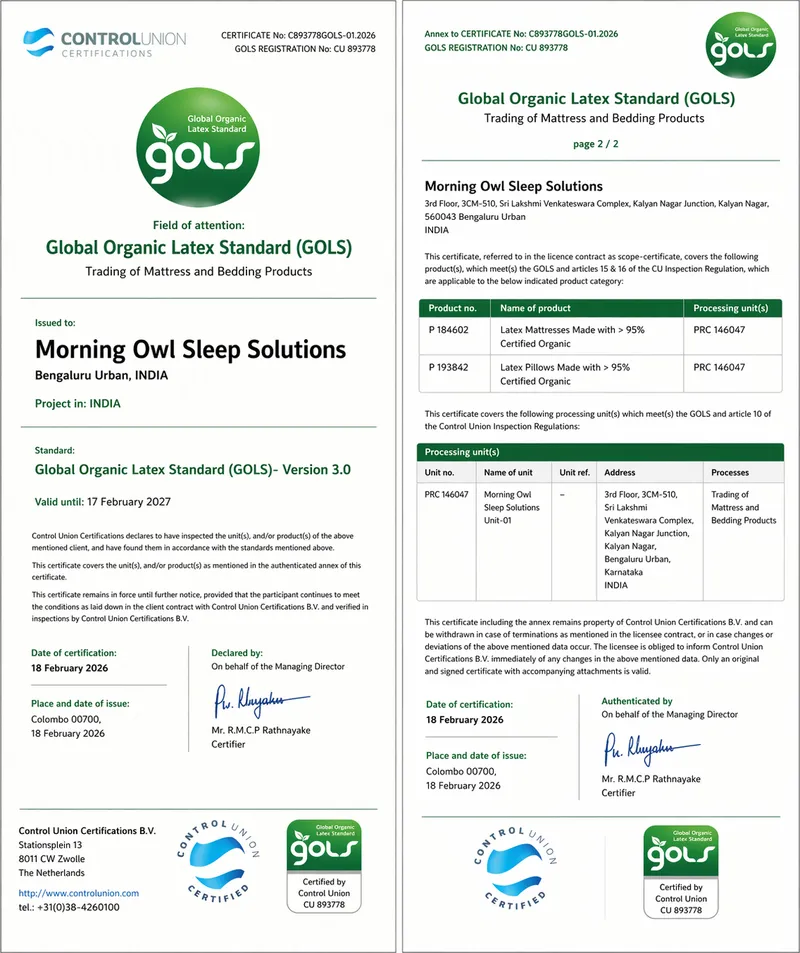
Morning Owl has made latex the non-negotiable center of its offering. The brand's mattresses use 100% natural Dunlop latex and carry three globally recognized certifications: GOLS (Global Organic Latex Standard), OEKO-TEX Standard 100, and Eco-INSTITUT. Together, they address different parts of the trust equation: organic sourcing, tested absence of harmful substances, and low-emission finished products.
Its flagship mattress, ComfortCraft, builds on that foundation with three adjustable Dunlop latex layers of varying densities, allowing customers to change firmness over time instead of replacing the mattress. The wider range includes Orthopedic Extra Firm and Medium Firm models for different sleep preferences, and Little Nest, a dual-sided baby and crib mattress with a waterproof bamboo cover.
Accessibility without compromise
The founders recognized early that a pure natural latex mattress, honestly priced, would not be within reach of every buyer looking to move beyond generic foam. Rather than dilute the flagship proposition, Morning Owl introduced a hybrid range as an entry point —combining latex with other supportive layers at a lower price, while maintaining clear material disclosure and product integrity.
The company has also expanded into adjacent sleep categories, including latex pillows, toppers, bamboo sheets, and mattress protectors, with more bedroom essentials planned. The larger ambition is to build a complete sleep ecosystem rather than remaining a single-product brand.
Morning Owl sells through its D2C website and a growing network of experience-led showrooms in cities including Bengaluru, Chennai, Hyderabad, Delhi, and Pune.
A maturing market, a different kind of brand
India’s mattress category appears to be at an inflection point. As buyers grow more informed and more skeptical of broad industry claims, the conversation is shifting from persuasion to verification. Consumers increasingly link sleep with wellness, recovery, and long-term health — and are asking sharper questions about what a mattress is made of, where materials come from, and how long the product will last.
The shift is not unique to India. In more mature global sleep markets, some of the strongest brands have succeeded not just by selling comfort, but by combining premium positioning with transparent sourcing, verifiable standards, and a clear product philosophy.
Morning Owl is betting that this new phase will reward brands that can prove more, not merely say more. Certified natural latex, Kerala-sourced raw material, transparent construction, hybrid entry-level options, and showroom-led experiences are all designed for that emerging customer.
The proposition appears to be gaining traction. Morning Owl says it has seen strong growth, increasing word-of-mouth referrals, and more customers arriving after disappointing experiences with heavily marketed alternatives - buyers who first chose on branding or discounts, only to find that the product did not match the promise.
As the market matures, the brands that endure may not be the ones telling the loudest stories, but those telling the truest ones.
(Disclaimer: The views and opinions expressed in this article are those of the author and do not necessarily reflect the views of YourStory.)