



Backed by Nikhil Kamath, Lina Ashar’s Dreamtime Learning is reimagining K-12 education
With microschools, a 2,000-strong online base, and global expansion plans, Hyderabad-based startup Dreamtime Learning is betting on curiosity-led learning over rote.

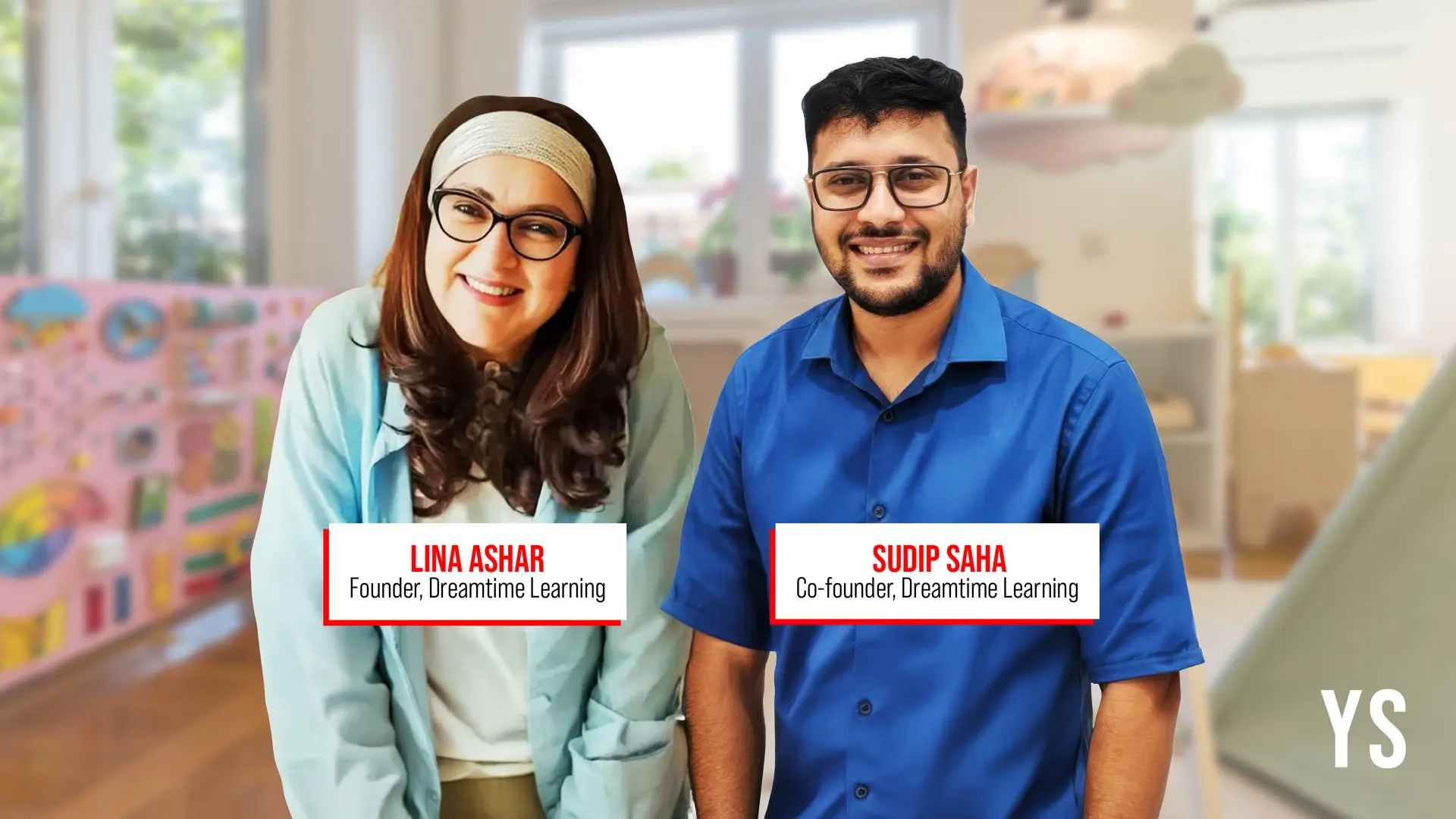

Lina Ashar has always had the ability to spot trends. When she founded Kangaroo Kids Preschool and Billabong High International School in the early ’90s, she had the pre-Google foresight to understand that the internet would complement a more holistic approach to education.
In 2016, she attended a lecture by renowned American engineer, physician, and entrepreneur Peter Dimandis on where the world was headed with AI. In that pre-LLM era, she sensed another shift coming and realised that everything she had planned for the near future could become redundant.
“Soon after, I sold my company with a golden handshake, and spent the next five years interviewing about 100 thought leaders across different industries — from neuroscience and behavioural science to understanding childhood trauma, spirituality and hypnotherapy,” she tells YourStory.
As she interviewed experts, she began creating a blueprint for what would eventually become Dreamtime Learning, an educational establishment challenging the traditional K-12 learning system, in 2023.
With an expansive team led by Ashar and Co-founder Sudip Saha, Dreamtime is also backed by the VC firm Gruhas, founded by Nikhil Kamath and Abhijeet Pai.
A bold alternative to traditional learning
The philosophy of the educational institute starkly contrasts with the conventional learning system. Illustrating the difference through the example of a general English class teaching Roald Dahl’s Charlie and the Chocolate Factory, Ashar says her primary goal is to make children excited to learn.
“In a traditional school, reading is for the sake of reading comprehension and grammar. We help our students understand the differences between first- and third-world diets, the economics and branding of a chocolate, trade, and its history,” she says. “Then we ask questions that lead them towards critically thinking about the source material — creating value out of learning.”
She adds that with a focus on behavioural science, students are also taught how characters in the Dahl classic might grow up, what parenting styles lead to entitlement and what behaviours stem from it.

Dreamtime offers two modes of learning: an online platform and microschools — academies that cater to a smaller number of students per class. It has established two such schools so far, in Hyderabad and Pune.
“In our microschools, there are only 10 kids per class. A child could be studying Grade 2 English and Grade 3 math, learning based on their competency,” she says.
Saha says the nature of a microschool allows them to guide students more directly towards an education that will remain relevant when they come of age.
“Many jobs that existed 30 years ago don’t exist anymore. Who’s to say what will happen in the next 30 years? Students certainly don’t have an idea.. With microschooling, you can break barriers that anchor students in traditional [systems],” he says.
Saha shares that while the Hyderabad hub has about 120 students, the Pune centre has 200. The curriculum remains the same for the online school, which has about 2,000 active students.
Dreamtime also licenses its curriculum with 80 other schools. Online students pay an annual fee of about Rs 60,000-80,000, while microschool students pay between Rs 2 lakh and Rs 5 lakh.
The education sector in India
Since Ashar moved to India from Australia in 1993, she has opposed test prep and tuition centres, while closely observing shifts in the sector.
During the edtech boom of the 2010s, she had invested in one such platform. When Covid hit, the platform pivoted immediately to test prep, which she says is the quickest way to sell to parents.
“If you look at any edtech companies that failed, they often did so after moving into test prep. In education, the consumer (students) and the customer (parents) are two different entities. We always need to do right by the consumer and educate the customer,” she explains.
Ashar argues that as knowledge and skills become less stable in terms of value, learning for its own sake will define future relevance. However, the country remains focused on traditional learning — over 76% of students focus on rote learning to clear exams and 75% of Grade 3 students are unable to read Grade 2 textbooks.

So how are Dreamtime students, receiving a different kind of education, expected to compete in the job market?
“The value of a human in the workforce is changing. Many IIT alumni are now jobless. Companies are laying off employees. Four types of people will remain valued in the future: those with high EQ, specialists, solution-driven entrepreneurs, and individuals with a personalised monopoly who can create something entirely different,” Ashar says.
Plans for the future
Competing with other educational institutes such as 21K School and GoSchool, Dreamtime differentiates itself through its interactive curriculum, microschools and Ashar’s reputation in the education sector. In 2025, it raised an undisclosed pre-Series A round led by Kamath’s VC firm Gruhas.
With a broader goal of impacting 1 billion learners, Saha says the institute has so far focused on India and the Middle East. The team is now exploring new markets.
“We started a pilot in Malaysia called Dreamtime Learning Asia. We have only onboarded about 50 students and will soon expand to countries like Australia and New Zealand,” he says.
A 2.5-year-old organisation, Saha says Dreamtime generated about Rs 10 crore in revenue last year and aims to hit Rs 20 crore in FY27.
Ashar sees Dreamtime Learning as her way of giving back to society. Beyond this, she has also set up the Zarna & Anil Somaia Family Foundation — named after her parents —to educate underprivileged children at a cost of Rs 10,000 per student per year.
“We want 50 children in the first cohort. We are also providing social-emotional learning to any government school for free of cost. My mother’s entire wealth and 50% of my wealth is committed to this foundation,” Ashar says.
Edited by Affirunisa Kankudti