


Cabinet Approves ECLGS 5.0 for MSME Credit Boost
The Union Cabinet has approved ECLGS 5.0 to unlock Rs 2.55 lakh crore in credit support for MSMEs and airlines amid global disruptions.

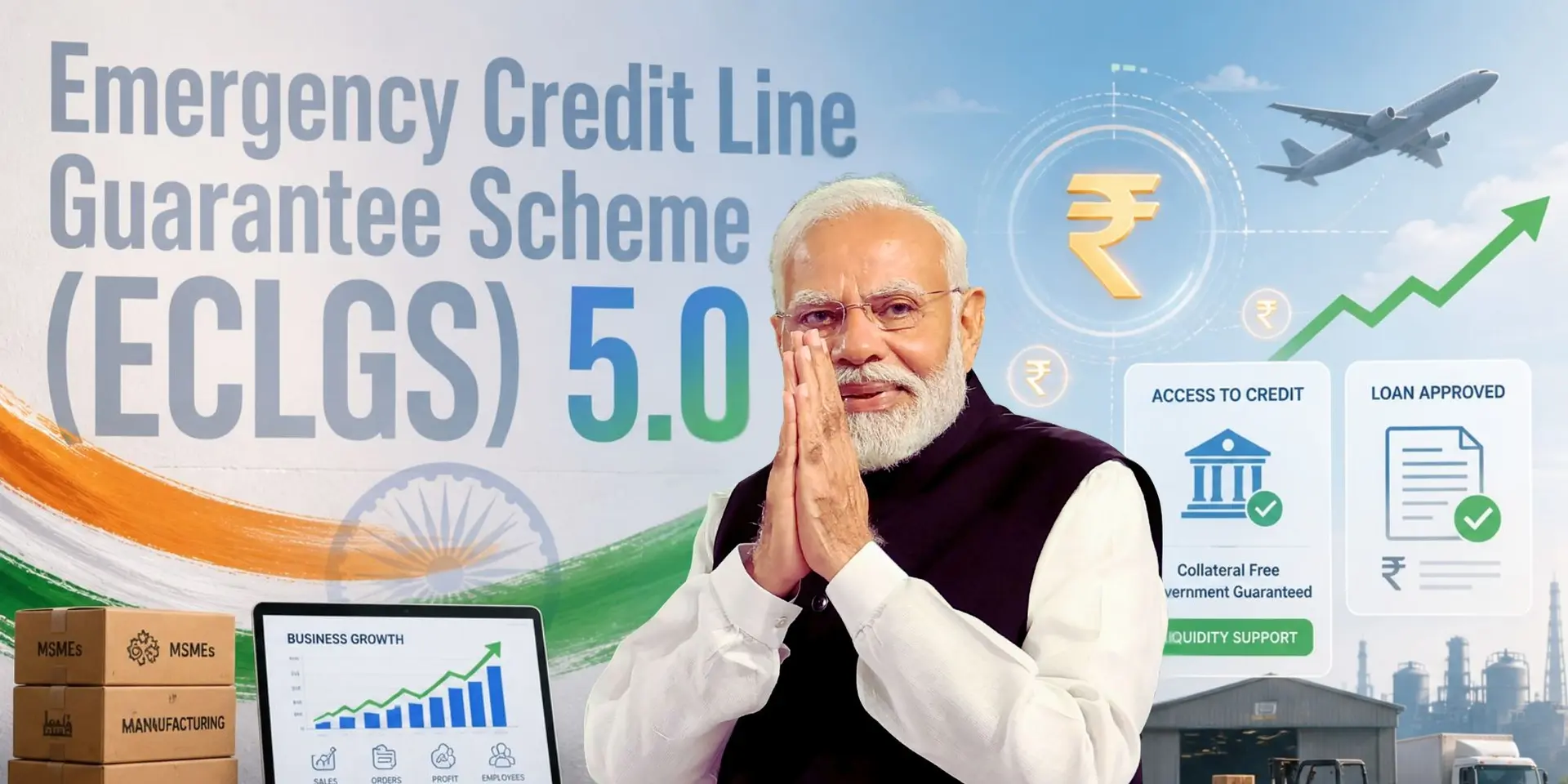

India’s small businesses are once again at the centre of a government relief push. The Union Cabinet has approved the Emergency Credit Line Guarantee Scheme (ECLGS) 5.0, aiming to improve access to credit for businesses affected by disruptions linked to the ongoing West Asia crisis.
The latest phase of the scheme is expected to facilitate additional credit support of up to Rs 2.55 lakh crore, including Rs 5,000 crore earmarked for airlines. According to the government, the scheme is designed to help businesses facing supply disruptions, rising fuel prices and pressure on working capital cycles.
The scheme is estimated to involve a government outlay of around Rs 18,100 crore, according to multiple reports. The move revives a programme that first became a major policy tool during the COVID-19 pandemic, when emergency credit guarantees helped businesses survive lockdown-led disruptions.
This time, the focus is on cushioning businesses from geopolitical uncertainty and rising input costs.
What the scheme includes
Under ECLGS 5.0, the government will provide guarantee coverage through the National Credit Guarantee Trustee Company Limited (NCGTC) for loans extended by banks and financial institutions to eligible borrowers. The scheme offers:
- 100% guarantee coverage for MSMEs
- 90% guarantee coverage for non-MSMEs and airlines
- Additional loans of up to 20% of peak working capital utilisation during the Jan–Mar quarter of FY26
- Loan support capped at Rs 100 crore for eligible businesses
- Separate support for airlines up to Rs 1,500 crore per borrower
- Nil guarantee fee for borrowers
The government has also capped interest rates under the scheme. Lending rates for banks and financial institutions will be capped at 9%, while rates for non-banking financial companies will be capped at 13% or benchmark-linked rates plus 0.75%, whichever is lower.
The scheme will remain open until 31 March 2027. Loans for businesses will carry a five-year tenor with a one-year moratorium, while airlines will receive a seven-year repayment structure with a two-year moratorium.
Why MSMEs remain vulnerable
India’s MSME sector contributes nearly 30% to the country’s GDP and supports millions of jobs across manufacturing, trade and services. Yet smaller businesses often remain vulnerable to disruptions because of limited cash reserves and restricted access to affordable credit.
Even moderate increases in transportation costs, fuel prices or raw material expenses can disrupt working capital cycles for smaller firms. The government hopes that by reducing lending risk for banks, ECLGS 5.0 will help ensure credit continues flowing during a difficult period.
Officials have said the scheme is intended to help firms maintain operations, protect employment and sustain supply chains. The broader concern is the economic impact of prolonged instability in West Asia. India remains heavily dependent on imported crude oil, making the economy sensitive to fluctuations in global energy prices.
The aviation sector also included
Alongside MSMEs, the aviation industry has also been included under the scheme. Airlines have been dealing with higher aviation turbine fuel costs and uncertainty linked to regional tensions. The government has allocated Rs 5,000 crore within the overall scheme framework for airlines.
Passenger carriers will be eligible to borrow against existing credit facilities, subject to prescribed conditions and caps. The extended repayment window reflects the sector’s longer recovery cycle and higher capital requirements compared to many other industries.
A familiar policy returns
The Emergency Credit Line Guarantee Scheme was first introduced in 2020 as part of India’s pandemic-era economic response. Over multiple phases, it enabled collateral-free loans backed by government guarantees and became one of the country’s most widely used business support measures.
ECLGS 5.0 adapts the same framework for a different set of economic conditions. Instead of pandemic restrictions, businesses are now dealing with geopolitical uncertainty, rising commodity prices and global supply chain disruptions.
While economists caution that credit support alone cannot fully offset broader economic risks, the scheme offers temporary liquidity relief for businesses prioritising operational continuity and cash-flow stability. Its effectiveness, however, will depend on how quickly banks process loans and how efficiently the funds reach businesses requiring immediate support.