



From chatbots to autonomous agents: How Hostinger built AI into its core business
At DevSparks 2026 Bengaluru, Hostinger's AI Tech Lead Mantas Lukauskas traced the company's journey from early chatbot experiments to Kodee, an agentic system that now handles most customer interactions.


Artificial intelligence may feel like an overnight revolution, but for companies building with the technology, the journey has been years in the making.
Long before ChatGPT entered the mainstream, AI quietly powered spam filters, recommendation engines, and voice assistants. But the arrival of large language models changed how businesses viewed the technology. AI became accessible, conversational, and capable of handling tasks that previously required human intervention.
For Hostinger, that shift marked the beginning of a major transformation.
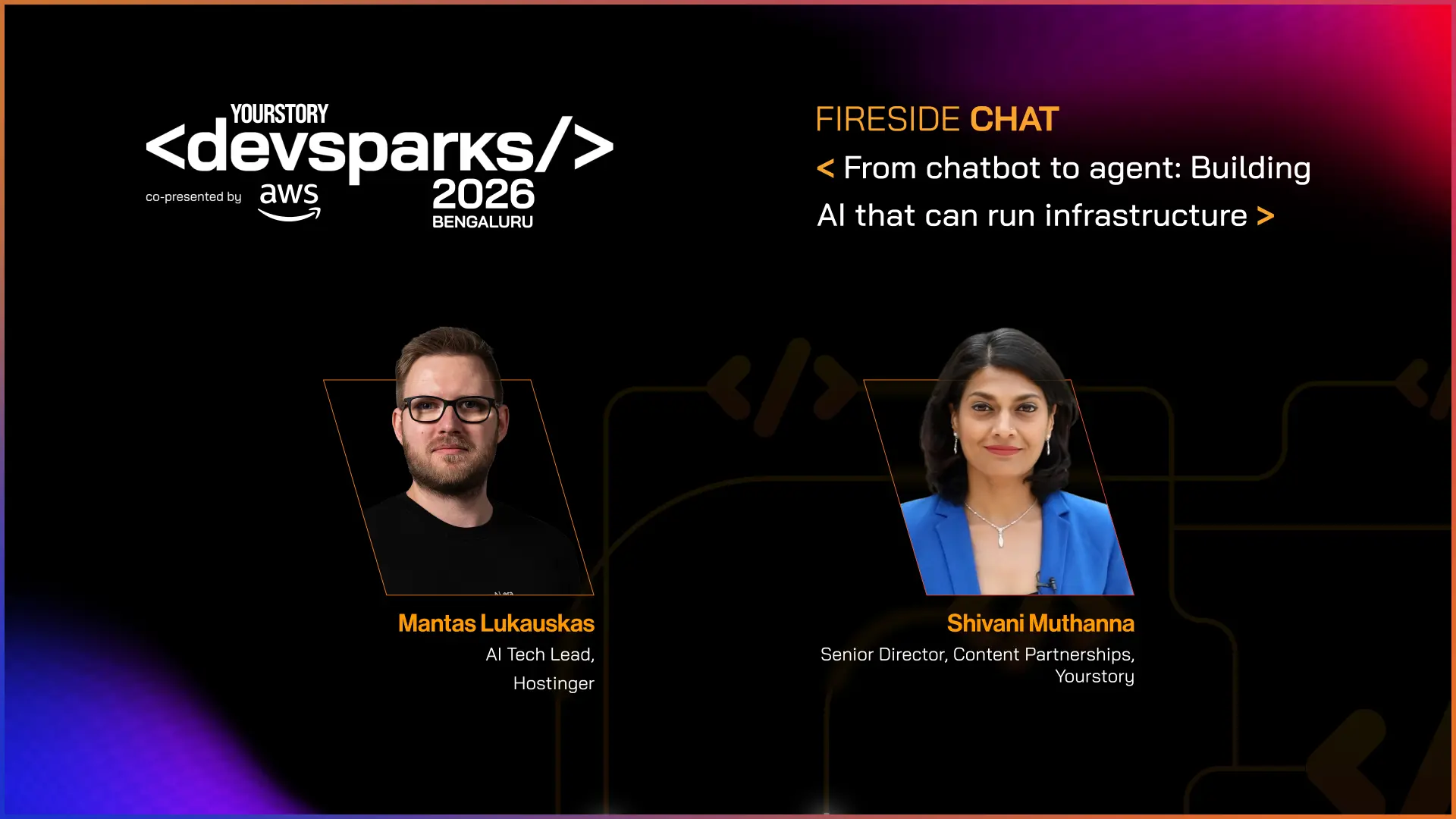
Speaking at DevSparks 2026 Bengaluru, Mantas Lukauskas, AI Tech Lead at Hostinger, joined Shivani Muthanna, Senior Director – Strategic Partnerships & Content, YourStory, for a session titled 'From Chatbot to Agent: Building AI That Can Run Infrastructure'. The discussion explored Hostinger's evolution from a traditional hosting provider to an AI-enabled platform, the challenges of building production-grade AI systems, and the rise of agentic experiences.
From hosting to AI
Founded in 2004, Hostinger built its reputation as a web hosting company. Today, AI is embedded across much of its platform, helping customers build websites, run marketing campaigns, and manage hosting-related tasks.
According to Lukauskas, AI adoption is no longer simply a technology decision. It has become a competitive advantage for businesses and even nations.
Yet amid the excitement, he challenged the audience with a simple question: are organizations truly using AI, or simply talking about it?
The real challenge, he argued, is not access to technology but figuring out how to integrate it into products, workflows, and business processes.
The rise of agentic systems
Hostinger began experimenting with AI long before the current wave of generative AI.
The company worked with earlier language models, but the release of GPT-3.5 made many businesses take AI-generated text seriously for real-world workflows.
Today, the focus has shifted beyond chatbots. Large language models can be connected to APIs, retrieval systems, memory, and external tools, allowing them to take action rather than simply respond to prompts.
These agentic systems can remember context, access information, and complete tasks within workflows, opening up entirely new possibilities for businesses.
But successful adoption requires more than choosing a model. Companies must think about infrastructure, latency, costs, security, governance, and data management.
Learning by building
Hostinger's own AI journey began nearly five years ago with a customer support project.
Lukauskas recalled experimenting with neural networks over a weekend to see whether they could answer customer questions. What started as a side project soon demonstrated that repetitive support interactions could be automated.
The company later adopted Rasa Open Source for natural language processing while using large language models as a fallback. Eventually, it launched its first production chatbot.
Customers responded positively. One user reportedly told the chatbot: "If you're not AI, you're the perfect person."
The experience also taught the team several important lessons.
One of the biggest was the need for backup plans. AI providers can experience outages, which means businesses should avoid relying on a single model provider.
Lukauskas advised organizations to build fallback mechanisms, whether through open-source models, secondary providers, or cloud-based routing systems.
For Hostinger, which handles around 200,000 customer chats every week, even a short disruption can have significant consequences.
The second lesson was cost discipline.
"It's nice to use AI everywhere, but maybe there are some functions or answers you don't need," Lukauskas said.
He warned businesses against treating every problem as an AI problem. "If you want to kill a fly, you don't need a bazooka. Keep it simple."
Building trust and responsibility
Trust has been central to Hostinger's AI strategy. When the company introduced AI-powered support, customers were still given the option to speak with human agents.
Lukauskas noted that some organizations had rushed to replace support teams entirely with AI, only to rehire human staff later when the technology fell short of expectations.
For Hostinger, AI is intended to expand customer options rather than remove them.
The same thinking applies to security.
Lukauskas urged businesses to think carefully about what information they share with AI systems and how they protect those systems from misuse.
He cautioned users not to paste sensitive personal or business data into public AI tools without understanding how that data may be processed.
Lukauskas also highlighted the need to guard against prompt injection attacks, jailbreaking attempts, and unauthorized access to sensitive systems.
At Hostinger, these decisions are guided by two principles: freedom and responsibility—the freedom to innovate and the responsibility that comes with it.
Measuring what matters
Evaluating AI systems has become more complicated as businesses move from traditional machine learning models to autonomous agents.
Earlier systems could be assessed using standard metrics such as accuracy and F1 scores. Modern agents require a broader approach because they can adapt their behavior based on context and intermediate results.
Lukauskas advised organizations to focus on observability—tracking which tools agents use, which data sources they access, and how decisions are made.
These signals can be used to create benchmark datasets and monitor performance over time.
Hostinger also uses large language models as automated evaluators, scoring outputs on factors such as factual accuracy, tone, and brand alignment.
"Don't just throw anything at the wall and expect it to work," Lukauskas said.
An AI system may quickly achieve acceptable performance, but improving the final percentage points often requires rigorous testing and strong architecture.
The story of Kodee
The session concluded with Kodee, Hostinger's AI assistant.
Like many successful technology products, Kodee began as a simple experiment. Today it handles over 1 million customer conversations per month. The automation rate went from 50% in January 2025 to 85%.
Today, an entire team works on the product, which handles around 85% of customer chats.
For Lukauskas, Kodee is proof of how quickly ideas can evolve when developers are willing to experiment.
His advice to builders was straightforward: start creating.
The barriers to launching products have fallen dramatically. Developers no longer need expertise across every discipline before testing an idea. With modern AI tools, it is easier than ever to build a prototype, launch an MVP, and learn from real users.
The most important step is simply getting started, Lukauskas said.