



What if your health had a CIBIL-like score? A Hyderabad startup is building it for a decade
eKincare's decade-long bet on structured health data is becoming the backbone of corporate healthcare in India, and the implications go far beyond employee wellness.


When you apply for a home loan, a three-digit number decides your future: CIBIL score. Based on years of repayments and borrowing behaviour, the score gives banks a single honest picture of your financial health. Now imagine the same thing, but for your health.
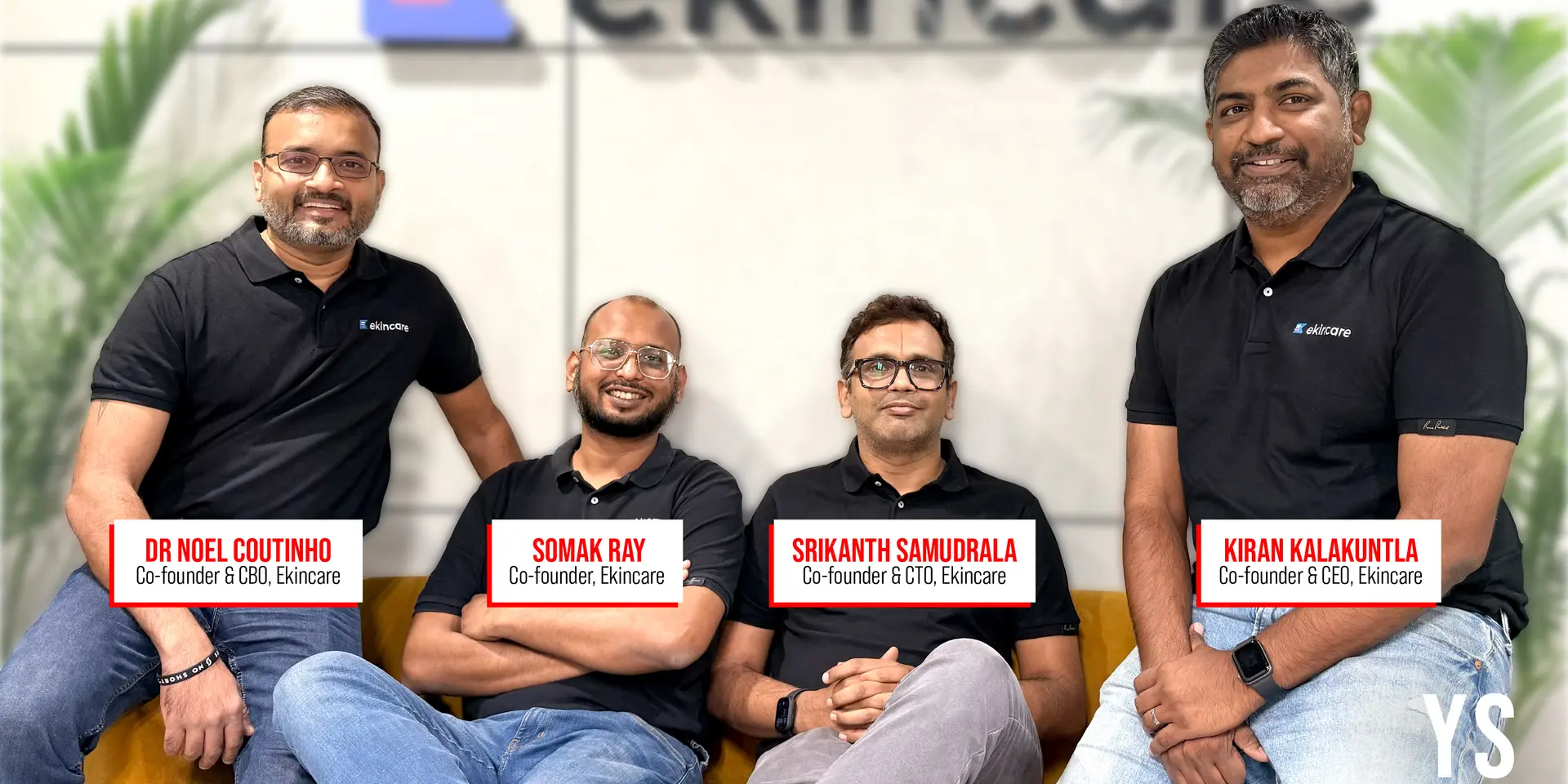
That's the idea Kiran Kalakuntla had when he founded eKincare in 2014 along with Srikanth Samudrala and Dr. Noel Coutinho . Not the flashy version of digital health, no telemedicine app, no on-demand doctor consultations. Just a quiet obsession with one question: what would it take to build a truly continuous, intelligent picture of a person's health over time?
A decade later, with over 1,200 enterprise clients across 500 cities and 40–45% CAGR over four years, the answer is coming into focus with Hyderabad-based healthtech startup eKincare.
The beachhead it chose was corporate health — and not by accident. India's employer-sponsored health ecosystem is enormous: over 500 million workers, most of them covered by some form of company-mandated annual health check. On paper, that sounds like a gold mine of longitudinal health data. In practice, it is closer to a landfill.
A typical corporate health check works like this: a company ties up with a diagnostics aggregator, employees visit whichever lab is nearest, reports are emailed as PDFs, HR files them away, and nothing happens until next year. No benchmarking. No follow-up. No memory. The company pays for the check but has no idea whether its workforce is getting healthier or sicker. The employee walks away with a report they don't understand and no one to explain it.
eKincare stepped into that gap. By embedding itself as the health benefits layer between employers and their workforce, it manages everything from annual health checks and OPD reimbursements to chronic disease programmes and mental wellness. The company says it has become the first entity with a reason to standardise the data. Not for academic purposes, but because its own product only works if the data does.
Today, it quietly does the unglamorous work that makes everything else possible: ingesting health records from hundreds of diagnostic providers, parsing inconsistent formats, and stitching them into a single, comparable health timeline for each employee. The companies get a real picture of workforce health risk. The employees, for the first time, get continuity.
The problem nobody wanted to solve
The reason that continuity is so hard to build goes deeper than corporate habit. Different diagnostics centres provide different reports for the same tests. There is no standard in formatting or even reference ranges. For a doctor reviewing a file, this is an inconvenience. For an algorithm trying to track your health over five years, it's a wall.
"If the data is represented differently, the algorithms will not understand from a continuity of information," Kalakuntla explains. "We had to first extract the data from medical records, then clean it, structure it, standardise it, so that you can compare apples to apples, irrespective of where you went."
This is why AI in Indian healthcare is so hard. Everyone talks about the potential — predictive diagnostics, personalised treatment, population-level risk mapping. However, the foundation is unstable. The country has no standardised medical data infrastructure. EHR systems can't connect because every provider has built their own. Nobody has fixed it from the top.
eKincare built a workaround from the bottom up.
The pivot
Founder Kalakuntla used the seed capital of Rs 2 crore to do what most investors then considered as absurd: going B2C to collect medical records. He wanted to gather data. From that base, the company built and patented its core algorithms in 2018. Kalakuntla considers that the real founding year.
The pivot that followed was clean. Large employers generating thousands of health records through annual checkups and insurance claims had the data but no intelligence. They couldn't answer basic questions: how healthy is our workforce? Where are the risks concentrating? What are we actually spending on?
eKincare stepped in. The key architectural decision was treating the individual, not the hospital, or insurer. Wherever an employee went within eKincare's network, their records came back to a single, clean, longitudinal profile.
"For companies who have been on our platform for five or six years," Kalakuntla says, "we can show a cohort actually moving from unhealthy to healthy over four years."
The health score
This is where the CIBIL analogy lands hardest.
eKincare has built what it calls a Health Score, which is a continuous, dynamic metric drawing from lab reports, step counts, family history, dietary habits, and every health interaction a person has through the platform.
"Your cholesterol three years ago was this much. It is not improving. You are only taking 5,000 steps per day. Your risk for cardiovascular disease is elevated. You need to do A, B, and C."
A CIBIL score works because it is longitudinal, standardised, and actionable. eKincare's Health Score is built to the same spec. For the first time, a CHRO can look at a workforce of 10,000 people and understand — not guess— where the health risks actually are and where the preventive care budget should go.
"If somebody wants to just do this for the sake of a checkbox, we are not the company," Kalakuntla says plainly. "If you really want to understand where you're spending, who is at risk, why — then we are the only solution available in the country."
The moat
Behind the data intelligence is a harder-won asset: the care delivery network itself. eKincare operates cashless primary and preventive care across 500 cities, diagnostics, doctor consultations, dental, vision, and 20-plus services.
Because eKincare was generating demand for healthcare providers before it needed them, it could set terms. Providers who wanted eKincare's volume had to meet ekincare's data requirements — feeding structured records back into the platform. Demand built supply. Supply generated data. Data improved
the product.
The experience standardisation layer is equally difficult to replicate. A person booking diagnostics through eKincare in Gurgaon gets the same experience as someone in a Tier ii city. Building that consistency across 100,000-odd diagnostic centres and clinics, without owning any of them, is operationally brutal. And it's already done.
The pharmaceutical hint
A major pharmaceutical company was trying to understand haemophilia prevalence across India before pricing a new drug. The traditional approach: go city by city, survey doctors, wait months.
They approached eKincare. Within 24 hours, eKincare returned a complete demographic breakdown, age distribution, gender split, comorbidities, risk concentration by region drawn from its structured health database.
"It helped them to price the drug better," Kalakuntla says simply.
This is population health intelligence as a product. And it hints at what eKincare is quietly sitting on: one of the largest, cleanest, most longitudinal private health datasets in India. The applications — pharma R&D, insurance underwriting, public health policy — are significant. This is not eKincare's core business today. It may be a large part of what it becomes.
"What ABDM is trying to do at a national level," Kiran says, referring to the government's Ayushman Bharat Digital Mission, "we have essentially already built in a private setting."
A CIBIL score took years to become the invisible backbone of Indian lending. Its health equivalent, continuous, trusted, longitudinal, is being assembled, quietly, in Hyderabad.