


3 Indian semiconductor startups are taking India’s chip story to France
VerveSemi, AGNIT and Netrasemi, 3 Indian semiconductor startups bound for Bharat Innovates 2026, an initiative of the Ministry of Education in France, tell YourStory what it takes to build world-class chips in India.

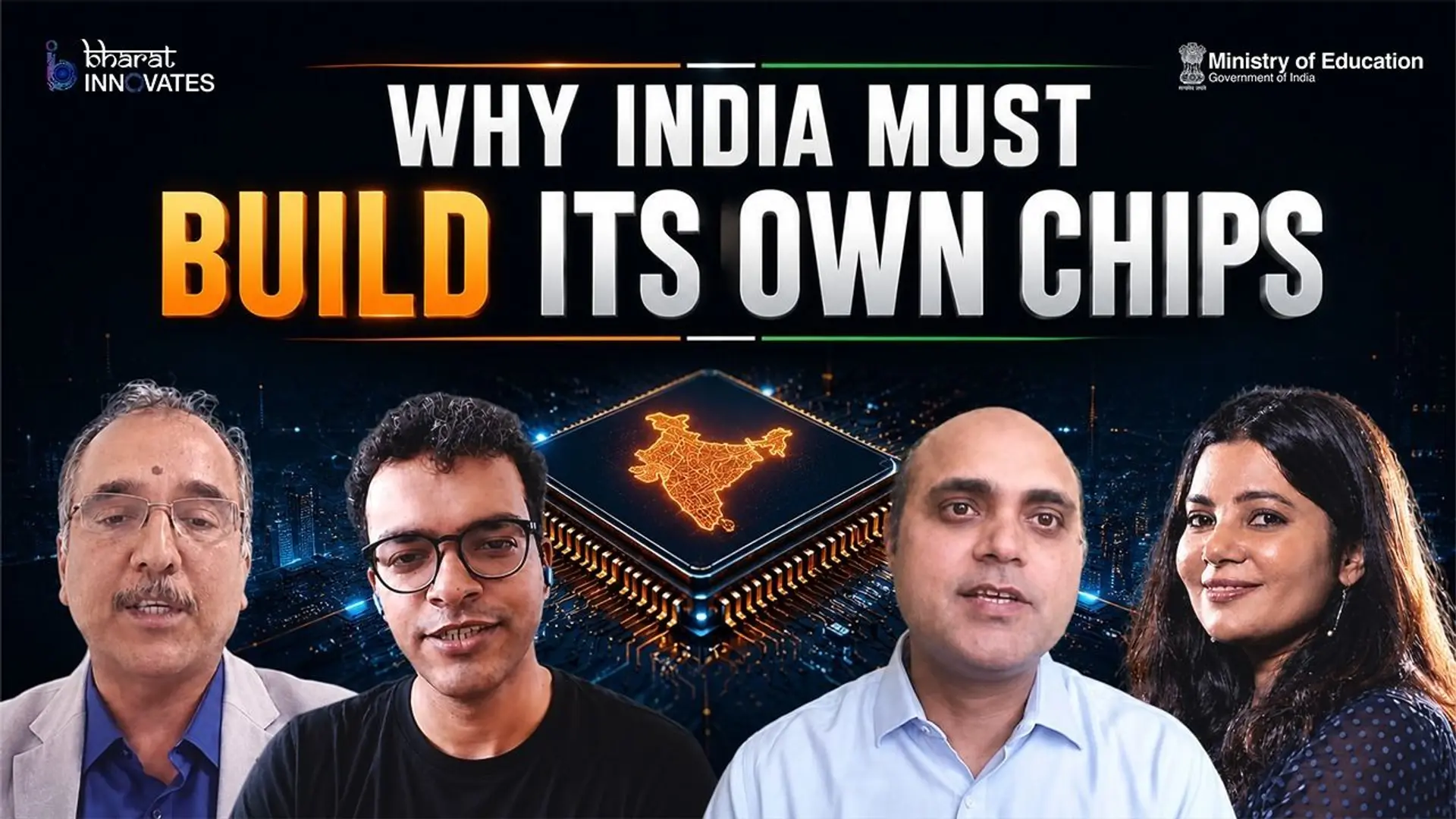

When Shradha Sharma, Founder and CEO of YourStory and The Bharat Project, sat down with three chip founders for a recent round table, the mood was one of quiet confidence.
Her guests were the Indian semiconductor startups picked to represent the country at Bharat Innovates 2026, an initiative of the Ministry of Education in France, the deep-tech showcase running from 14 to 16 June 2026 in Nice, France.
VerveSemi, AGNIT Semiconductors and Netrasemi have all made the cohort. Why does that matter to the rest of us? Because India still imports most of the chips it uses, and these are among the companies showing that the country can design and build its own, right here.
Why India wants its own chips
Shradha opened with the big question. Why have semiconductors suddenly become so important for India, and is it a jump in capability, or is geopolitics driving it? Jyothis Indirabhai, Co-founder and CEO of Netrasemi, said it was a few things landing at once.
The world has grown wary of leaning so heavily on Taiwan for advanced chips. AI has arrived, and the older generation of chips was never built for it, which opens a real opportunity for newcomers. Pratap Narayan Singh, Co-founder of VerveSemi, added the economic angle. India imports chips on a massive scale, he said, and building at home is the natural next step, much as the country has long wanted with energy.
The government has put serious weight behind the shift. Schemes such as the Design Linked Incentive and Chips to Startup, under the wider India Semiconductor Mission, have brought both funding and credibility to founders who, not long ago, had to begin every investor meeting by explaining what a semiconductor was.
What the three Indian semiconductor startups are building
Under the hood, the three could hardly be more different, and that is the good news. VerveSemi, started in 2017 and based in Greater Noida, makes mixed-signal and analogue chips, the parts that let the physical world talk to digital systems.
In February 2026, it raised a $10 million Series A round led by investor Ashish Kacholia and Unicorn India Ventures, a round it says was oversubscribed several times over. Reports suggest its technology now turns up in everything from EV motor controllers to space-grade sensors.
AGNIT Semiconductors is a spin-off from the Indian Institute of Science in Bengaluru, and calls itself India’s first vertically integrated gallium nitride company. You have likely used gallium nitride without realising it, in your fast charger or in white LEDs, but it also does heavy lifting in radio frequency and power electronics.
Founded in 2019 and properly operational by 2021 after roughly 15 years of research, AGNIT is, according to available information, readying gallium nitride chips for the strategic and defence sector. Co-founder and CEO Hareesh Chandrasekar describes the work as turning long years of lab research into something a customer can actually use.
Netrasemi, based in Thiruvananthapuram and founded in 2020, builds power-sipping chips for edge AI. Its flagship A2000, made on a 12nm process at Taiwanese foundry TSMC, recently reached silicon bring-up, and IT Minister Ashwini Vaishnaw described it as India’s first edge AI SoC.
Built for surveillance cameras, drones and robotics, the chip comes from a company backed by around Rs 125 crore from the likes of Zoho and Unicorn India Ventures, with commercial volumes targeted for 2027.
A funding mood that has flipped since 2022
When Shradha asked whether India truly has the right conditions today to build deep tech, Indirabhai did not hesitate. “This is the best time,” he said. Rewind to before 2022, and pitching a chip company here meant first explaining what a semiconductor was, then politely dodging advice to go build software instead.
That has changed, and quickly. Borrowing a line the Prime Minister likes, Indirabhai said anyone not building in India right now is missing the bus.
Why does building a chip company take so many years
Here is the part outsiders find surprising. Chips are slow. A single design can take years of testing and tweaking before it earns a place on a customer’s board, and the priciest piece is often getting the design ready to make, not the making itself.
The flip side is a real advantage. Once your chip is designed into a product, customers tend to stick with it for close to a decade because nobody wants the hassle of swapping parts. That patience, the founders say, rewards those who stay the course.
Asked what they had learnt in the trenches, Singh said founders should find a customer first, because with a customer, they can build anything. Chandrasekar’s advice was simpler still: ask for help, since plenty of founders have walked this road before.
The road to Nice
It was near the end, when Shradha asked what India should aim for over the next decade, that Singh offered his sharpest line. The country, he said, should keep climbing the manufacturing ladder, from low-value goods towards becoming a maker of the central computing parts the world runs on.
France is a confident step in that direction. Each of the three startups is chasing a way into the European market through joint development with local systems companies and research tie-ups. VerveSemi is quietly pleased that both its founders speak French.
With chips already moving from the lab towards production, the trio heads to Nice carrying not just their own products, but also a growing belief that the next generation of the world’s semiconductors can carry a made-in-India stamp.