



Atlassian
View Brand PublisherAt Atlassian Unleash, AI speed reinforced tough parameters of context, trust and resilience
At Atlassian Unleash, leaders examined how organisations must rebuild workflows, accountability and engineering foundations as software creation accelerates from open agentic infrastructure to context-aware enterprise AI.


AI is rapidly making execution cost-efficient. Code can be generated, specifications drafted, and prototypes assembled in a fraction of the time they once required.
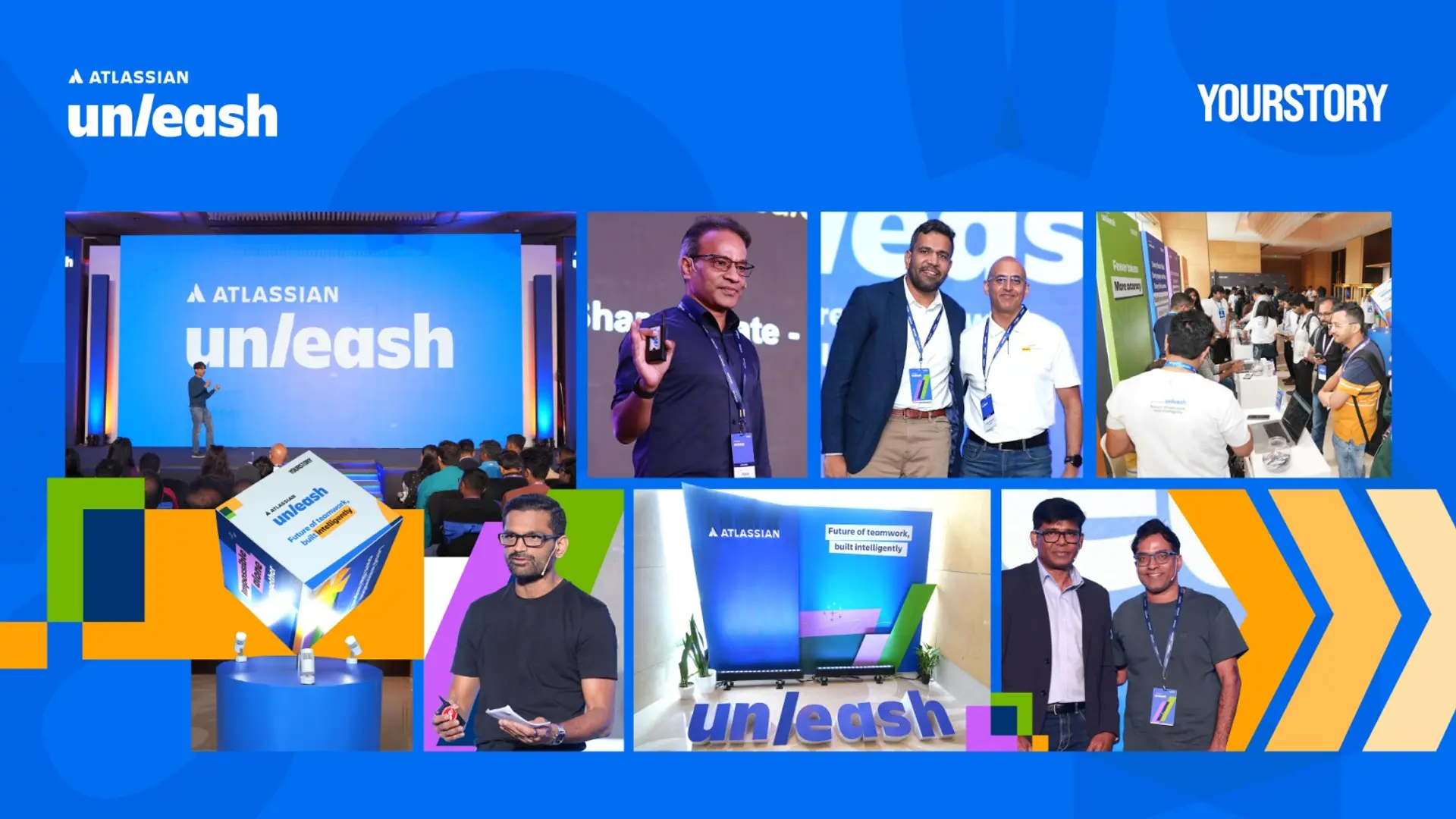
But at Unleash, an invite-only tech gathering by Atlassian, in association with YourStory, the harder questions began where generation stopped. Does an AI system understand the organisation within which it operates? Can teams trust what it produces? And can the engineering beneath it withstand the speed it introduces?
Across keynotes, demonstrations, fireside conversations and technical deep dives, the summit presented an optimistic—but grounded—view of AI-led work. Powerful models are only one part of the equation. The organisations that benefit most will also need context, redesigned workflows, dependable systems and clearer lines of human accountability.
Opening the event, Paranth Thiruvengadam, Site Leader and Head of Engineering at Atlassian, framed the company’s AI thesis around a simple equation: acceleration is the product of intelligence and context.
Frontier models may provide raw capability. Enterprise value, however, emerges when that intelligence understands the relationships between a company’s people, goals, projects, documents, repositories and decisions.
Building the trust layer for an agentic economy
Dr Pramod Varma, Co-founder & Chief Architect NFH & FIDE, Co-chair CDPI, took the discussion beyond enterprise productivity.
As AI lowers the barriers to creating software and services, Varma argued, individuals and smaller enterprises could gain capabilities once available largely to powerful platforms. Personal agents may discover services, negotiate terms and conduct transactions for billions of users.
Yet an economy potentially involving trillions of agents cannot function on intelligence alone.
It will require open, programmatic trust systems capable of establishing identity, verifying claims, recording actions and supporting enforceable digital contracts. India’s digital public infrastructure—including Aadhaar, UPI, e-sign and ONDC—offers an early foundation, but the next phase must support interactions involving people, businesses and autonomous agents.
Varma’s appeal to the tech builders in the room was also a warning. Unless the underlying infrastructure preserves user agency, equity and open participation, AI risks concentrating power rather than broadening economic opportunity.
Why enterprise AI needs organisational context
The next keynote moved from the public foundations of an agentic economy to the context required within an enterprise.
Regunath Balasubramanian, Vice President of Engineering and Platform Architect at Atlassian, alongside Anand Narayanan, Head of Product at Atlassian, demonstrated how the company’s Teamwork Graph and Rovo bring this idea into organisational workflows.
The Teamwork Graph connects information distributed across documents, code, pull requests, teams, projects and third-party tools. This, in turn, powers Atlassian’s AI offering Rovo, helping its agents understand how people, work, and decisions relate instead of retrieving isolated pieces of information.
The demonstrations showed Rovo agents synthesising customer feedback from multiple sources, identifying priorities, drafting product requirement documents, generating technical specifications and coordinating work across planning, development, review, and production support.
According to Atlassian's internal benchmarking, grounding an agent in the Teamwork Graph resulted in 44% improvement in answer quality, while using 48% fewer tokens than the same agent operating without that context.
The numbers captured one of the day’s central arguments: context does not simply make AI responses more relevant. It can also make the model use more efficient.
The future of work presented on stage was not one in which agents operate independently. It was a shared workspace where people and agents work from the same organisational context, with humans directing, reviewing and refining the outcome.
When AI writes the code, ownership does not disappear
The changing responsibility of developers came into focus during a conversation between Thiruvengadam and Mukund Jha, Founder and CEO of Emergent.
Emergent is built on the premise that people closest to a problem should be able to create the software needed to solve it—even when they are not conventional developers.
However, as AI generates more code, Jha said, the bottleneck moves elsewhere. Testing, verification, reviews, security, staging infrastructure, observability and governance become more important, not less.
At Emergent, faster code generation has enabled smaller, cross-functional teams to own outcomes end to end. It has also increased the need for platform guardrails that allow rapidly created software to reach production safely.
Jha suggested that code may become less important as the primary software artefact. Product requirements, technical specifications, verification loops, and clearly expressed intent could carry greater weight. Engineers would not disappear; their work would shift towards creating the systems, controls and environments that make AI-generated software dependable.
Speed without resilience creates new fault lines
The optimism around faster creation was followed by a necessary counterpoint.
Utkarsh, Technology Leader and Tech Advisor at Xmplify.tech, argued that scaling systems has become comparatively easier, while ensuring reliability remains difficult.
Redundancy, retries, autoscaling, queues and abstractions are designed to protect systems. But each can become a fault line when shared dependencies, amplification effects and recovery behaviour are poorly understood.
Reliability, he argued, is not simply a measure of capacity. It is a system’s behaviour when conditions deteriorate.
His recommendations included failure-mode reviews, retry budgets, visibility into shared dependencies, degraded-service tiers and rehearsed recovery plans. AI can help engineers surface possible failure scenarios, but experience remain necessary to identify which risks matter and how they should be addressed.
Product thinking and engineering for an AI-native world
The afternoon breakouts carried these ideas into product management and engineering practice.
Sharath Bulusu, Senior Director, Google Pay and Wallet at Google, examined why technological shifts deliver their full value only when organisations redesign workflows around them. Simply adding AI to existing processes may produce incremental efficiency; transformation requires teams to reconsider how they research, prototype, evaluate and decide.
Kumaresh Pattabiraman, Country Head and Vice President of Product, India, at LinkedIn, explored what remains difficult when building becomes dramatically easier. As execution accelerates, product vision, strategy and zero-to-one thinking become more valuable. Entire teams—not only a handful of proficient individuals—must become AI-native, or the least transformed function becomes the next bottleneck.
Khilan Haria, Chief Product Officer at Razorpay, offered a practical view of that transition. Razorpay began with narrow, deterministic agents, including one built to handle payment disputes. Evaluations, tracing and human fallback mechanisms helped establish trust before agents were given greater autonomy.
Several Atlassian sessions showed how these principles translate into technical choices.
Falguni Chitkara, Principal Engineer at Atlassian, examined how enterprise commerce systems must evolve for usage- token- and credit-based pricing while preserving auditability and billing accuracy.
Khushboo Gupta, Senior Software Engineer at Atlassian, detailed how grouped subscriptions, durable replay and admission controls helped strengthen real-time systems at SaaS scale. Grouping identical subscriptions reduced internal messaging overhead by approximately 99.99%, while replay mechanisms preserved ordered updates after clients reconnected.
Together, the sessions showed that AI adoption is not merely a race to generate more, faster. It requires organisations to strengthen everything surrounding the model: context, trust, evaluations, architecture, recovery and accountability.
The code may now come faster. Building an organisation capable of using it well remains the harder task.