




Bharat Innovates
View Brand PublisherBharat Innovates 2026: How an IIT Madras incubator helped build the world's first 3D-printed rocket engine
Agnikul Cosmos is building India's most flexible launch system using 3D-printed engines, modular rockets, and the country's first private launchpad. The Chennai startup, incubated at IIT Madras Research Park, is among the ventures the Ministry of Education will showcase at Bharat Innovates 2026 in N

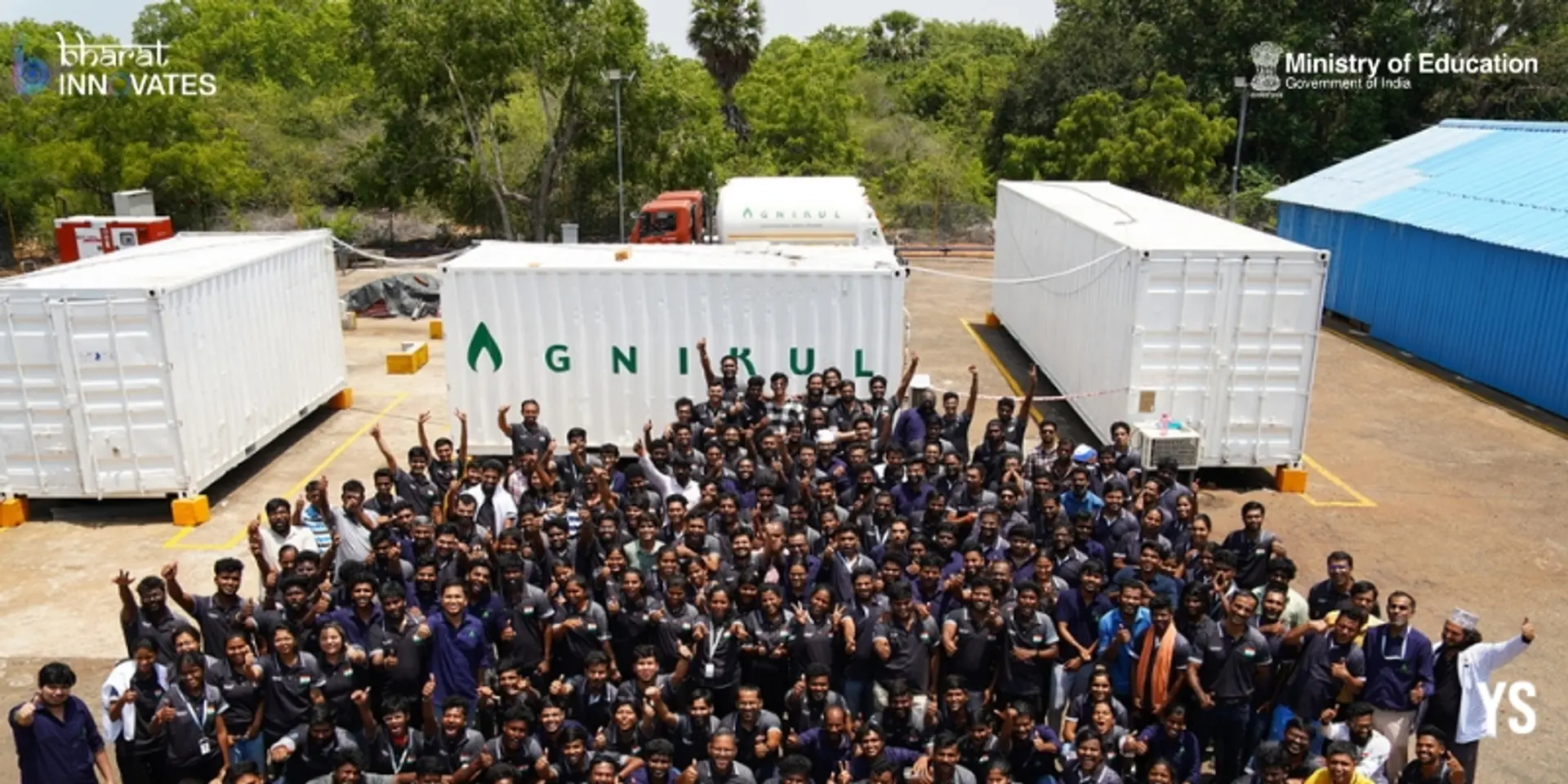

India's ambition to lead in space is no longer just a government story. Through Bharat Innovates 2026, the Ministry of Education is backing a new generation of private deep-tech companies building critical technologies from the ground up, and showcasing them to global investors and partners at an event in Nice, France, from 14 to 16 June 2026. The initiative spans 13 frontier sectors, including Space, Advanced Computing, Semiconductors, Defence, and Manufacturing and Industry 4.0, and brings around 120 R&D-backed ventures before industry leaders and policymakers as part of the India-France Year of Innovation.
That ambition is being built on a foundation that has been quietly strengthening for years. Reforms under the National Education Policy 2020, international research partnerships through SPARC, and the Study in India initiative are collectively reshaping what Indian institutions produce and who they attract. In the QS World University Rankings 2026, 54 Indian institutions made the list, with IIT Madras climbing 47 places to 180 and IIT Delhi reaching its best-ever 123rd position. India now ranks fourth globally by institutions represented, and is the fastest-growing higher education system in the G20 over the past decade. Among the companies receiving recognition under Bharat Innovates 2026 is Agnikul Cosmos, building technology that is making space more accessible for a new generation of satellite missions.
For small satellite companies, getting into space has often depended on compromise. Most are forced to hitch rides on large rockets, wait months for launch windows, and adjust missions around the priorities of bigger payloads. The result is an industry where access to space remains expensive, inflexible, and slow-moving for smaller players. But as demand for satellite launches accelerates, driven by communication, climate monitoring, defence, and earth observation, the need for faster, on-demand launch solutions has become impossible to ignore.
Founded in 2017, Agnikul Cosmos was created to address that gap. The idea emerged when Co-founder and CEO Srinath Ravichandran, then based in Los Angeles, noticed how difficult it was for small satellite companies to secure timely and affordable launch opportunities. Seeing an opportunity to build more responsive launch solutions, Ravichandran teamed up with Co-founder and COO Moin SPM. The duo began connecting with experts and exploring access to testing infrastructure in India before eventually setting up the company in Chennai, where they found a home at the IIT Madras Research Park, one of India's most active technology incubation ecosystems.
Building a rocket from the ground up
Agnikul Cosmos set out to build Agnibaan, a small-lift launch vehicle capable of carrying payloads of up to 100 kg to a 700-km orbit. But the company's biggest breakthrough lay not just in the rocket itself, but in how it was built. Traditional rocket engines are made from hundreds of separate parts that require complex manufacturing and assembly processes. Agnikul took a different approach: it designed and 3D-printed the engine as a single integrated piece, dramatically simplifying production.
The result was Agnilet, the world's first single-piece 3D-printed semi-cryogenic rocket engine, developed entirely in India. Powered by subcooled liquid oxygen and aviation turbine fuel, the engine represents a major leap in indigenous rocket manufacturing. Agnibaan is built for flexibility, with a modular first stage that can accommodate between four and seven engines depending on mission requirements. The rocket is also compatible with a mobile launchpad mounted on a truck, allowing launches to be carried out from multiple locations. Agnikul holds the patent for the design and manufacturing process.
A day that made history
On May 30, 2024, at 7:15 AM IST, Agnibaan SOrTeD, the company's SubOrbital Technology Demonstrator, lifted off from Dhanush, India's first private launchpad, at SDSC SHAR, Sriharikota. The mission marked several milestones: the world's first flight powered by a single-piece 3D-printed engine, India's first semi-cryogenic engine-powered rocket launch, and India's first launch from a private launchpad.
The rocket reached an altitude of 20 km, completed all mission objectives, and carried a payload of approximately 7 kg before descending into the Bay of Bengal. The launch also demonstrated the use of Linux-based flight computers and Ethernet-based architecture, both firsts for Indian rockets.
Building more than a rocket
From the beginning, Agnikul focused on building the infrastructure needed to support long-term space manufacturing in India. At the IIT Madras Research Park in Chennai, the company established Agnikul Rocket Factory-01, India's first dedicated private rocket engine factory, where its 3D-printed engines are manufactured at scale. It has also set up a Large Format Additive Metal Manufacturing facility equipped with India's largest 3D printer and an indigenously developed depowdering system.
In December 2020, Agnikul became the first Indian spacetech startup to sign an agreement with ISRO through the IN-SPACe initiative, giving private players access to India's space infrastructure. Since then, the company has raised $40 million in funding, including a $26.7 million Series B round in 2023. Earlier this year, Tamil Nadu's industrial development agency TIDCO invested Rs 25 crore in the startup, the first time a government body in India took an equity stake in a space startup.
Agnikul, valued at more than $500 million as of 2026, is now working toward an ambitious target: launching up to 50 rockets annually by 2028, positioning itself at the centre of India's rapidly expanding commercial space ecosystem.
Built for the long haul
In less than a decade, Agnikul Cosmos has emerged as one of India's most closely watched spacetech startups. The company has been recognised by the World Economic Forum among its Top 100 Emerging Companies, featured in Forbes Asia's 100 to Watch, recognised as a Top Innovator at the ET Startup Awards 2020, and won the National Startup Awards 2021 in the space sector. Its rise reflects something larger than startup success or industry recognition.
Agnikul represents a new phase in India's space ambitions, one driven not just by government agencies, but by young private companies building cutting-edge technology from the ground up. Its progress also signals how India's commercial space ecosystem is beginning to mature, with startups now designing engines, building launch systems, and creating manufacturing infrastructure once considered the domain of national space programmes alone.
The Ministry of Education's recognition of companies like Agnikul Cosmos points to a broader shift in how India sees innovation: not merely as research or experimentation, but as the ability to build globally competitive technology within the country.