


PM Modi and President Macron inaugurate Bharat Innovates 2026 in Nice, opening India's deep-tech showcase to the world
Prime Minister Narendra Modi and French President Emmanuel Macron inaugurated Bharat Innovates 2026 in Nice, showcasing 120 Indian deep-tech startups across AI, space, defence, biotech, semiconductors and clean energy.

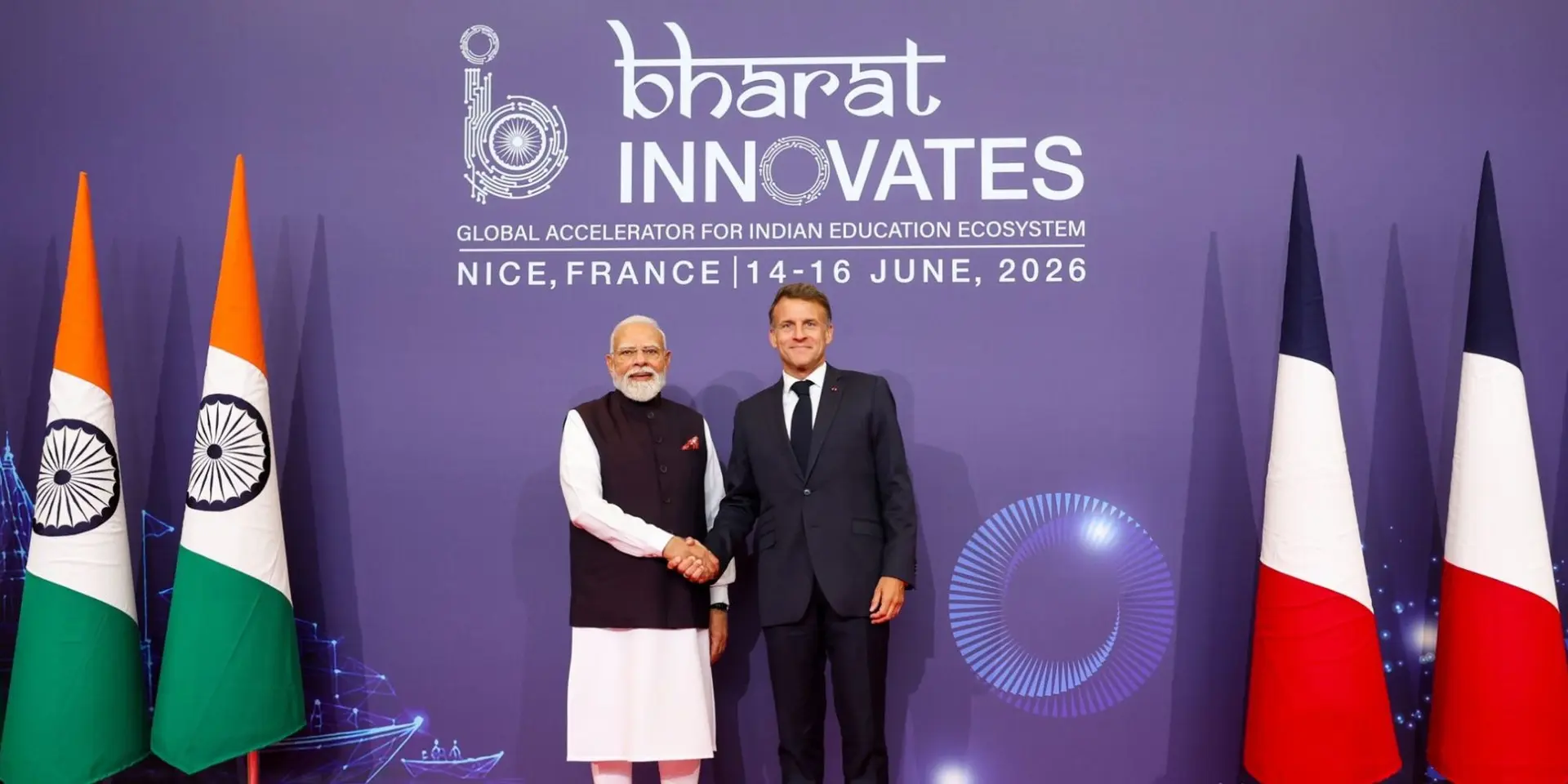

Prime Minister Narendra Modi and French President Emmanuel Macron jointly inaugurated Bharat Innovates 2026 in Nice on 14 June 2026, opening a three-day showcase of India's deep-tech startups with a set of addresses that cast the country as an emerging innovation partner for the world. The maiden edition, an initiative of the Union Ministry of Education organised by the Government of India, is the first time India's deep-tech cohort has been presented on a dedicated stage abroad, and it anchors the India-France Year of Innovation.
Union Minister of Commerce and Industry Piyush Goyal opened proceedings with the welcome remarks, inviting French partners to invest, design and manufacture in India for both its domestic market and exports, and describing the country as the world's innovation partner powered by more than 2.3 lakh startups.
In his special address, Macron reaffirmed France's belief in India's capacity to innovate, pointing to its demographic strength and its deep pool of engineers, and restated France's support for Make in India. He set out areas for deeper work together, from artificial intelligence and clean energy to civil nuclear technology and small modular reactors, and repeated the goal of welcoming 30,000 Indian students to France by 2030. In a warmer aside, the French President congratulated Modi on becoming India's longest continuously elected Prime Minister, a record Prime Minister Modi passed days earlier, ahead of Jawaharlal Nehru's mark.
Delivering the keynote, Modi described the India-France relationship as one built on shared vision rather than shared interest alone, and framed the showcase as a bridge between India's young talent and European capital. He said India had moved from being a consumer of technology to a contributor of solutions, and pitched the country to investors as a destination driven by talent, scale, stability and reforms, inviting global partners to co-create the next phase of innovation. India, he noted, is now the world's third-largest startup ecosystem.
What the floor showed
The conclave runs from 14 to 16 June 2026 at the Palais des Expositions de Nice under the theme Global Accelerator for the Indian Education Ecosystem, building on the Year of Innovation the two leaders launched in Mumbai in February 2026. After the addresses, Modi and Macron toured the exhibition floor and stopped to speak with founders working in quantum computing, semiconductors, biotechnology, defence, space, healthcare, medtech, advanced materials and clean energy. The showcase spans 13 frontier sectors and, according to the Ministry of Education, features 120 Indian innovators, around 15 higher education institutions and over 500 investors. Officials said the participating ventures collectively hold more than 1,500 patents and have raised over USD 1.5 billion in funding, with the cohort including drone maker ideaForge and electric two-wheeler firm Ather Energy. Principal Scientific Adviser Ajay Kumar Sood said more than 150 technologies were on display.
The agreements and the money on the table
The day also set the summit's first cross-border agreements in motion. iCreate, an Indian deep-tech incubator, signed a memorandum of understanding with the Hauts-de-France Regional Council to establish the India-Hauts-de-France Bilateral Corridor for Deep Tech Innovation, a channel for startup collaboration, market access, pilot deployments and technology commercialisation, among the first of a wider set of agreements being concluded at the event. Ahead of the summit, the Education Ministry said around 28 innovation-focused MoUs were expected to be signed with French and other international partners, spanning startups, investors, IITs, IISc and overseas universities, supported by two mechanisms it calls the Incubator Innovation Bridge and the Industry Innovation Bridge.
On investment, Union Education Minister Dharmendra Pradhan said ahead of the event that the initiative had already generated nearly USD 20 million in finalised or near-closure commitments, built through roadshows in Paris, Tokyo and Bengaluru. Venture firms including Avaana Capital have joined as growth partners, and Sood pointed to government backing for deep-tech through the Research, Development and Innovation scheme and a Rs 10,000 crore fund.
Why pair the showcase with France
Bharat Innovates is built to be a bridge, taking science-heavy ventures out of India's campuses and labs and putting them in the same room as the capital and corporates that can help them scale.
Deep-tech is the reason the format matters. These are companies built on hard science, in fields like semiconductors, quantum and space, where research is slow and capital-hungry, which makes patient global investors especially valuable.
France brings its own strengths in AI, nuclear energy and space, so the Nice setting hands Indian founders ready partners and a doorway into the European market rather than a one-off stage.
The opening day frames the deal-making expected over 15 and 16 June 2026, when more of the mooted MoUs, tie-ups and investor conversations are due to be firmed up. For Modi, Nice is the first stop on a week that continues to the G7 summit in Evian and VivaTech in Paris, keeping India's deep-tech pitch in front of global capital and policymakers well beyond the Riviera.